

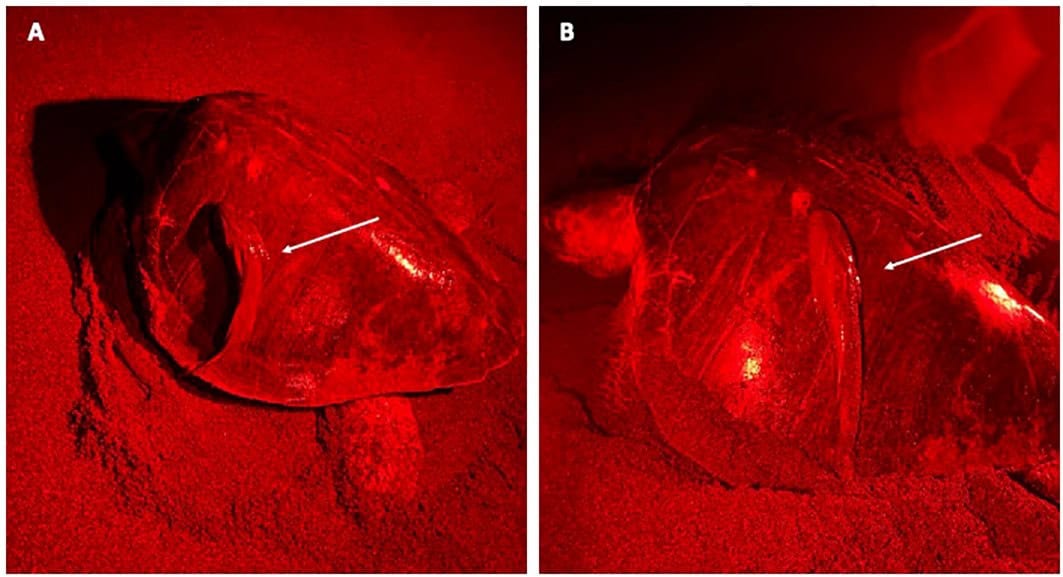
On a dark night last September on the Osa Peninsula, a female olive ridley sea turtle dragged herself out of the Pacific to nest at Playa Pejeperro carrying a passenger that should not have been able to survive the trip.
Research assistants with Comunidad Protectora de Tortugas de Osa (COPROT)met the turtle at 10:29 p.m. on September 24, 2025, moments after she cleared the surf. Clamped to the left side of her shell was a large common remora, the suckerfish that spends most of its life stuck to sharks, rays, whales and turtles.
The patrol watched the pair for 19 minutes. The fish stayed almost motionless, working its gill covers open and shut, and only shifted position on the shell when a researcher moved in to detach it. Lifted free and carried back to the water, the remora writhed, then swam off. It had been out of the sea for the better part of a third of an hour and was still alive. The turtle appeared entirely untroubled by any of it. She went about the standard business of digging a body pit and began laying eggs at 10:48 p.m.
The observation has now been published as a brief research report in the journal Frontiers in Marine Science by Megan J. Bullock of the University of West Florida and COPROT, Vicente Peña Eisele of COPROT, and Emily A. Yeager of the University of Miami, who is the corresponding author. The paper appeared on June 8 and drew wider attention this month after the journal featured the night photograph in a monthly roundup of images from its research.
The turtle measured an average of 68.4 centimeters (26.9 inches) along the curve of her shell and 72.6 centimeters (28.6 inches) across it. Using those figures as a known scale, the team estimated the remora at roughly 28 centimeters (11 inches) from photographs taken later. Because the entire encounter was observed under red light, which is used on nesting beaches to avoid disorienting turtles, no reliable note could be made of the fish’s color.
Remoras attach with a modified dorsal fin that works as an adhesive disc, and the arrangement saves them the energy of swimming while putting them close to a host’s meals. Whether the relationship benefits both animals, only the fish, or actively costs the host is still argued over in the scientific literature.
What is not in dispute is that a remora out of water cannot breathe, and following a turtle onto a beach can kill it. That has happened in the handful of previous cases on record, which involved nesting leatherbacks in French Guiana in the late 1970s and olive ridleys in Mexico. The Costa Rican observation adds a Central American record to a list that already spanned North and South America, which suggests the behavior may be far more widespread across turtle populations than the thin documentation implies.
The authors read the risk-taking as a clue about how tightly these fish bind themselves to particular hosts. Recent work has tracked individual remoras staying with one animal for extraordinary stretches, including a sharksucker that remained with the same parrotfish for 238 days while much larger potential hosts swam past.
Other studies have followed remoras riding manta rays and sharks into deep water once thought physiologically off limits to them. Taken together, the researchers argue, the picture is less of a fish that opportunistically grabs whatever passes and more of one that will not risk losing the specific animal it has chosen, even when staying attached is dangerous.
Playa Pejeperro sits inside the Río Oro National Wildlife Refuge on the Pacific side of the Osa Peninsula, on a stretch of largely undeveloped coastline that COPROT patrols nightly from June through April. The study reports about 7,000 olive ridley nests and 600 green turtle nests laid at the beach in 2024, making it one of the most important nesting sites on the country’s Pacific coast. COPROT was founded in 2018 and describes its model as training and paying local residents, including people who had been working in the area’s illegal gold mining, to run the monitoring and hatchery work.
The record itself came out of nothing more elaborate than that routine. A crew walking sand in the dark with a red light, writing down carapace measurements, noticed something on a shell that did not belong there and logged it. Much of what is known about the ordinary traffic of the ocean has been assembled the same way, one incidental line in a field notebook at a time.





