

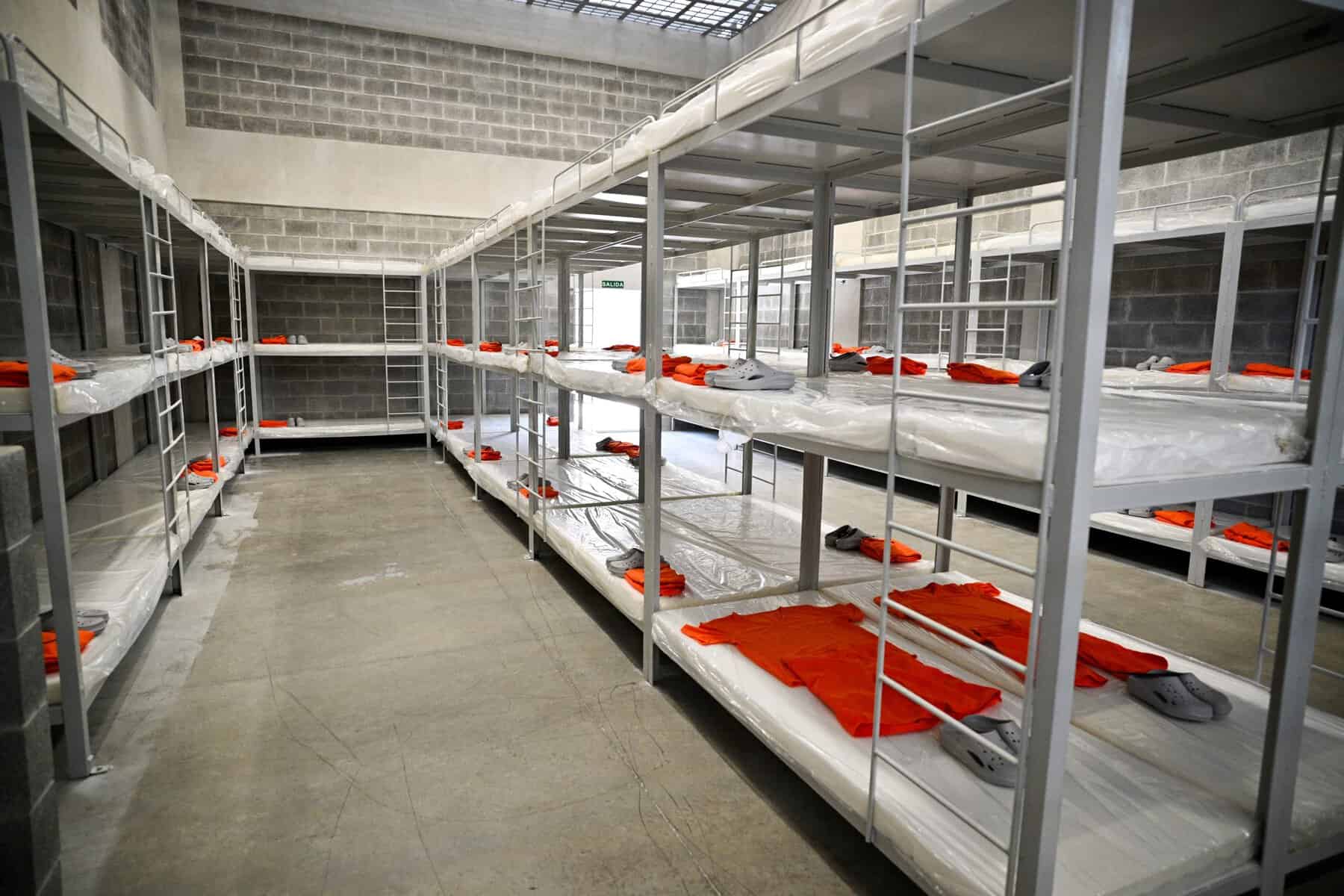
Costa Rica was scheduled to begin moving prisoners into its new maximum-security facility today, marking the next step in the government’s effort to tighten control over organized crime and ease overcrowding in our prisons. The Centro de Alta Contención y Crimen Organizado (CACCO), located within the La Reforma prison complex in San Rafael de Alajuela, was inaugurated on October 14. The $33.2 million facility is designed to hold up to 5,100 inmates, making it one of the largest prison projects in Costa Rican history.
Justice Minister Gabriel Aguilar confirmed that the first prisoners selected for transfer would include suspects connected to the killing of police officer Gerson Rosales, who was shot dead in Batán, Limón, on May 13. President Laura Fernández specifically requested that those implicated in the officer’s death be among the first housed at the new facility. Three men were detained in connection with Rosales’ killing. They remain suspects, and their detention does not mean they have been convicted.
The government has not publicly confirmed how many inmates will be transferred during the first phase. As of Monday afternoon, independent confirmation that the initial transfers had been completed was not available. The first arrivals are expected to be followed by prisoners already being held in high-security sections of other Costa Rican prisons. Officials plan to move inmates gradually rather than fill the new complex all at once.
CACCO consists of five sections, each designed to accommodate 1,020 prisoners. The facility includes surveillance cameras, body scanners, biometric identification systems and additional security measures intended to prevent inmates from bringing in prohibited items or continuing criminal activities from behind bars.
Prisoners will be required to wear orange uniforms specifically designed to make it more difficult to conceal weapons, drugs and other contraband. The government considers the prison an important part of its campaign against drug trafficking organizations and violent criminal groups. Officials have repeatedly argued that some imprisoned gang leaders continue directing criminal operations from their cells, creating security problems both inside and outside the prison system.
The opening also comes as Costa Rica struggles with severe prison overcrowding. The Ministry of Justice estimates that once CACCO reaches full capacity, the prison overcrowding rate could fall from approximately 59% to 15%. Those figures are government projections, not improvements that have already occurred.
Authorities have indicated that they hope to fill the facility by December, although that timetable will depend on the transfer process and the prison’s ability to accommodate additional inmates. The project has attracted attention because of its similarities to El Salvador’s high-security prison system under President Nayib Bukele. Fernández visited El Salvador earlier this month to examine how its massive CECOT prison operates, including security procedures, medical services and daily routines.
However, Costa Rica’s approach has also raised questions about the treatment of inmates and how decisions will be made about who belongs in maximum-security custody. Our National Mechanism for the Prevention of Torture has warned that the facility needs clear rules governing inmate transfers, living conditions and the treatment of prisoners.
The watchdog has argued that decisions should be based on established security criteria rather than political instructions or arbitrary judgments. Fernández has asked Aguilar to publicly explain the procedures that will govern the new prison, including medical care, access to legal assistance, exercise and other basic services.
The start of the transfer process represents a test of those plans. While the new facility gives Costa Rica considerably more room to hold high-risk prisoners, questions remain about staffing, operating costs and whether stricter confinement will reduce criminal activity outside prison walls.
For the Fernández administration, CACCO is intended to demonstrate a tougher approach to organized crime. Its longer-term success will depend on whether authorities can maintain security while following the legal protections required under Costa Rican law.





