

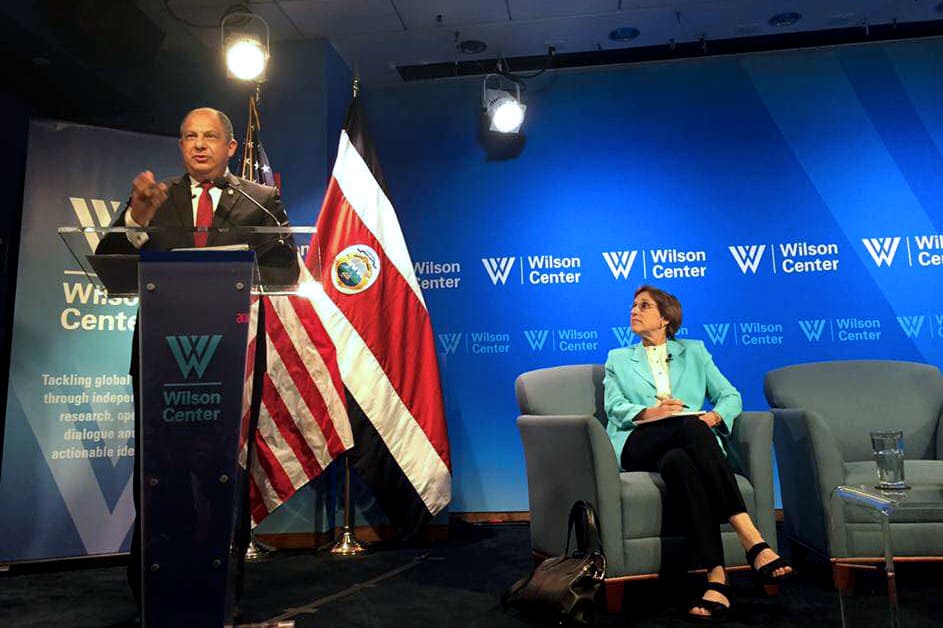
WASHINGTON — Speaking to an overflow crowd in Washington D.C., Costa Rica President Luis Guillermo Solís addressed the issue of immigration in the Central American country, saying “immigrants deserve dignity.”
Solís was in Washington to meet with President Barack Obama and Vice President Joe Biden to discuss several key issues between the two countries, including an agreement that Costa Rica will begin next month to offer temporary protection to refugees fleeing violence in Guatemala, El Salvador and Honduras.
“I had a great meeting with the U.S. president,” Solís told the overflow crowd at the Wilson Center, a prominent think tank in the U.S. capital.
The U.S. Department of Homeland Security reports that the number of people from El Salvador, Guatemala, and Honduras seeking asylum in the U.S. has increased to more than 100,000 in the last year, five times what it was three years ago.
In Costa Rica, the number of Salvadorans seeking asylum has also skyrocketed in recent years. Salvadorans are now poised to surpass Colombians as the top group of asylum-seekers in Costa Rica.
“It’s a humanitarian crisis that Costa Rica has never experienced before,” Solís said during his remarks. “Violence continues to be a challenge in Central America.”
Costa Rica is one of the safest and most prosperous countries in Central America and because of that it has attracted a large number of migrants and refugees. Under the so-called Protection Transfer Agreement with the Obama administration for Central American refugees, Costa Rica — along with the United Nations — will help identify and preselect the most vulnerable people in Guatemala, El Salvador and Honduras, a region commonly referred to as Central America’s Northern Triangle.
Costa Rica has agreed to allow up to 200 refugees at a time for six months before resettling in the United States.
The country recently hosted an unexpected surge of Cubans fleeing to the U.S., and is now seeing a continued flow of migrants from Africa, Asia and Haiti on the same route north.
Costa Rica received nearly $1 million from the U.S. to maintain shelters for Cuban migrants heading to the United States last year. Costa Rica Interior Vice-Minister Carmen Muñoz said the U.S. had recently donated 1,500 tents for the new wave of migrants.
“This is a completely different phenomena than what we have been used to,” Solís told the gathering at the Wilson Center, adding that Costa Rica has also seen an increase in the number of people who arrive in the country with no intention of leaving.
“Many don’t want to go back to their countries, and this is putting a serious financial stress on us. We are paying for their medical costs but we have neither the mandate nor the money to pay for it, and Costa Ricans in poor regions of the country are asking, ‘Why are you helping foreigners and not helping us?’ But if the government doesn’t take care of migrants, they will be blamed for everything.”
Solís said his administration is currently negotiating a new tax with the Costa Rican legislature to help pay for these additional costs, but it is a controversial endeavor with no guarantee of passage. “Fiscal reform is going to be fundamental for Costa Rica,” he said, adding, “Not all expensive democracies are good, but all good democracies are expensive.”
Solís said he dislikes the word “illegal” to describe migrants without documents, preferring to call the phenomenon “irregular migration.” He said Costa Rica is taking the approach that immigrants, regardless of legal status, deserve to be treated well.
“My great grandmother came from Jamaica in the early 1920s. This is not about criminalizing migration,” he said.
Migration was a key sticking point in Costa Rica opting to leave — albeit temporarily — the Central American Integration System (SICA, in Spanish) earlier this year. Costa Rica bowed out of the regional entity’s main forums over disagreements on how to handle the 8,000 Cuban migrants who got stuck in Costa Rica last year after Nicaragua closed its borders to Cuban migration.
“I was very upset with the lack of solidarity among other Central American countries. We deserve a more regional understanding of our issues,” Solís said. Costa Rica returned to SICA after a six-month absence, saying it was satisfied with promises to implement several reforms.
Solís also spoke Monday of neighboring Nicaragua, a relationship he has labeled “complicated” in previous remarks. Nicaragua is currently in the throes of a controversial presidential campaign that has seen that country’s Supreme Court stripping opposition parties of their legal status and creating what critics say is a one-party election favoring current President Daniel Ortega in November.
The Nicaraguan government has also been criticized for cracking down on protestors and imposing other limits on those not favoring the Ortega government.
The Costa Rican president said that he respects a democratic political and electoral process. “It’s not comfortable to see a government acquiring as much power as the Nicaragua government is acquiring,” he said.





