

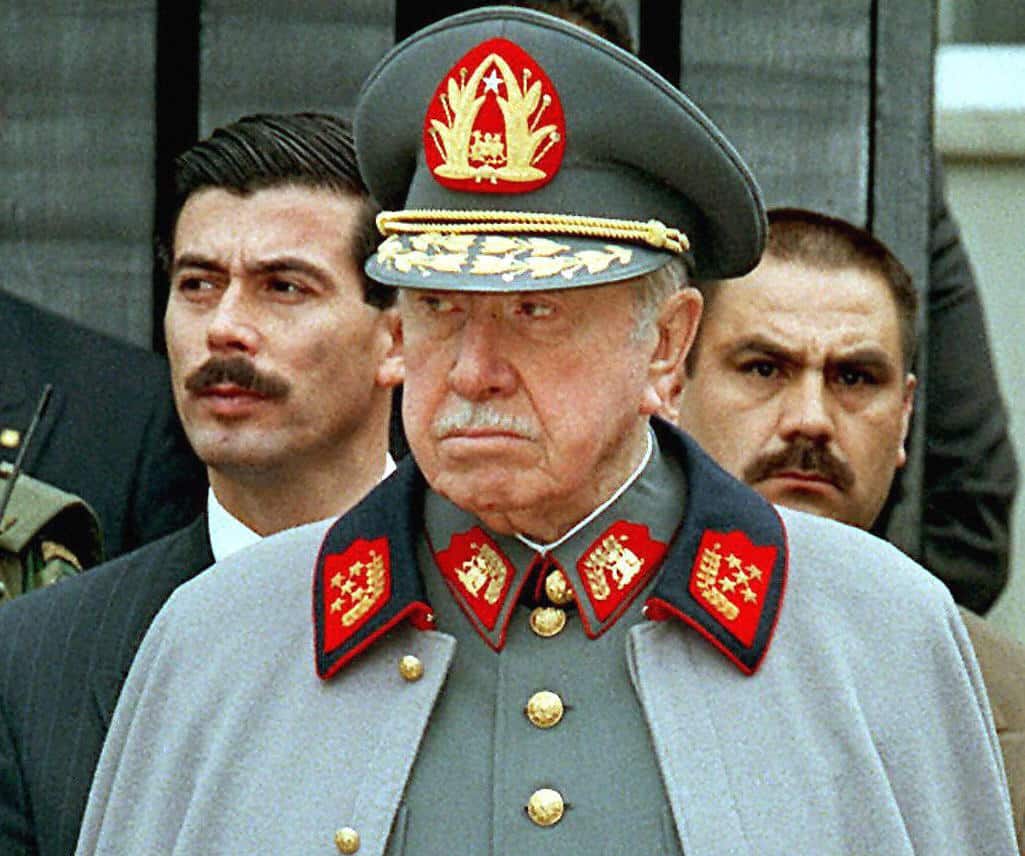
Forty years after Chile’s dreadful 9/11, when Gen. Augusto Pinochet overthrew democratically elected President Salvador Allende, people in the U.S. still ask me: Wasn’t Pinochet responsible for the economic miracle that made Chile a success story?
After the coup in Egypt in July, a Wall Street Journal editorial argued that “Egyptians would be lucky if their new ruling generals turn out to be in the mold of Chile’s Augusto Pinochet,” who, it said, “hired free-market reformers and midwifed a transition to democracy.” Some years ago, Jonah Goldberg made a similar argument in a Los Angeles Times column headlined “Iraq needs a Pinochet.”
As an established Pinochet opponent, I can affirm that he personified a disturbing contradiction. He won praise for transforming the economy, operated by the “Chicago Boys” (Chilean students of Milton Friedman at the University of Chicago), into the most prosperous in Latin America. He encouraged export growth, removed trade barriers, established an independent Central Bank able to control interest and exchange rates, and privatized social security and state companies. Chile became the Washington Consensus model for countries seeking to put their house in order.
The main problem for Pinochet’s apologists was his brutality and corruption. This is why, although the U.S. government intervened to destabilize Allende before and after he came to power and initially backed Pinochet, the dictator never found lasting friendship in Washington. If only he had modernized Chile’s economy without assassinating, torturing and exiling tens of thousands of dissidents and getting caught hiding offshore bank accounts. What seems to matter for some Pinochet defenders is that, much like Mussolini, he made the trains run on time.
It should be noted, however, that the groundwork for Pinochet’s economic modernization of Chile was laid by his predecessors under democratic rule. Land reform in the 1960s and early ’70s broke up inefficient semi-feudal estates, allowing the military regime to stimulate an export-oriented economy driven by large-scale agricultural production. Some aspects of Chile’s modernization began around 1920. By the 1973 coup, most Chileans enjoyed a high level of education (the illiteracy rate was less than 10 percent in 1970), and malnutrition and infant mortality had been declining for decades. Chilean universities were among the best in the Americas; the country’s Central Bank, Internal Revenue Service and General Comptroller’s Office were all solid state institutions.
Could Chile have reached prosperity without Pinochet? My answer is yes. Many Latin American countries that endured economic crises in the 1970s and ’80s, including Brazil and Peru, introduced tough economic reforms — not without vigorous opposition.
A Pinochet-type regime is not a necessary evil. No nation needs a tyrant to modernize and attain well-being. As Nobel laureate Mario Vargas Llosa has written, reforms imposed by dictatorships always result in “atrocities that leave civic and ethical sequels infinitely costlier than the status quo.” In the end, economic liberty seldom thrives in the absence of political freedom.
The return of democracy in 1990 started to remedy the social costs of the Pinochet era. In the next two decades, Chile grew at more than 5 percent per year, almost doubling its growth rates of the three previous decades. Meanwhile, Chile’s poverty rate plummeted from 40.8 percent in 1990 to 9.9 percent in 2011, by some measures; meat consumption increased from about 80 pounds per capita in 1990 to about 186 pounds; the share of homes with refrigerators jumped from 55 percent to 92 percent; the share of homes with washing machines rocketed from 37 percent to 82 percent. But U.N. Development Program data from 2010 show that Chile is still among the 15 most unequal countries in the world, though subsidies soften the gross gap in income inequality.
Chile’s social miracle is yet to come. To reduce social and economic inequalities, efforts need to be made toward affordable, quality education and tax reform. Recent street demonstrations in Chile and elsewhere in the region are being led by the new middle classes. Highly indebted and frustrated by lingering inequalities, they feel vulnerable and are demanding efficient public services and decent treatment.
Like the various identities Pinochet used in his secret bank accounts, he means different things to different groups. Some will continue to underscore that he championed economic reforms that transformed Chile and influenced other nations.
Ultimately, however, Pinochet should be remembered more as a notorious symbol of repression than an economic reformer. One symbol of a new era came two months ago when the name of Santiago’s September 11 Avenue, designated to celebrate the date of Pinochet’s 1973 coup, was finally changed, thanks to the initiative of a mayor new to politics. Although his long shadow remains, the Pinochet days are over.
Heraldo Munoz is an assistant secretary general of the United Nations and the United Nations Development Program director for Latin America and the Caribbean. He is the author of “The Dictator’s Shadow: Life Under Augusto Pinochet.”





