

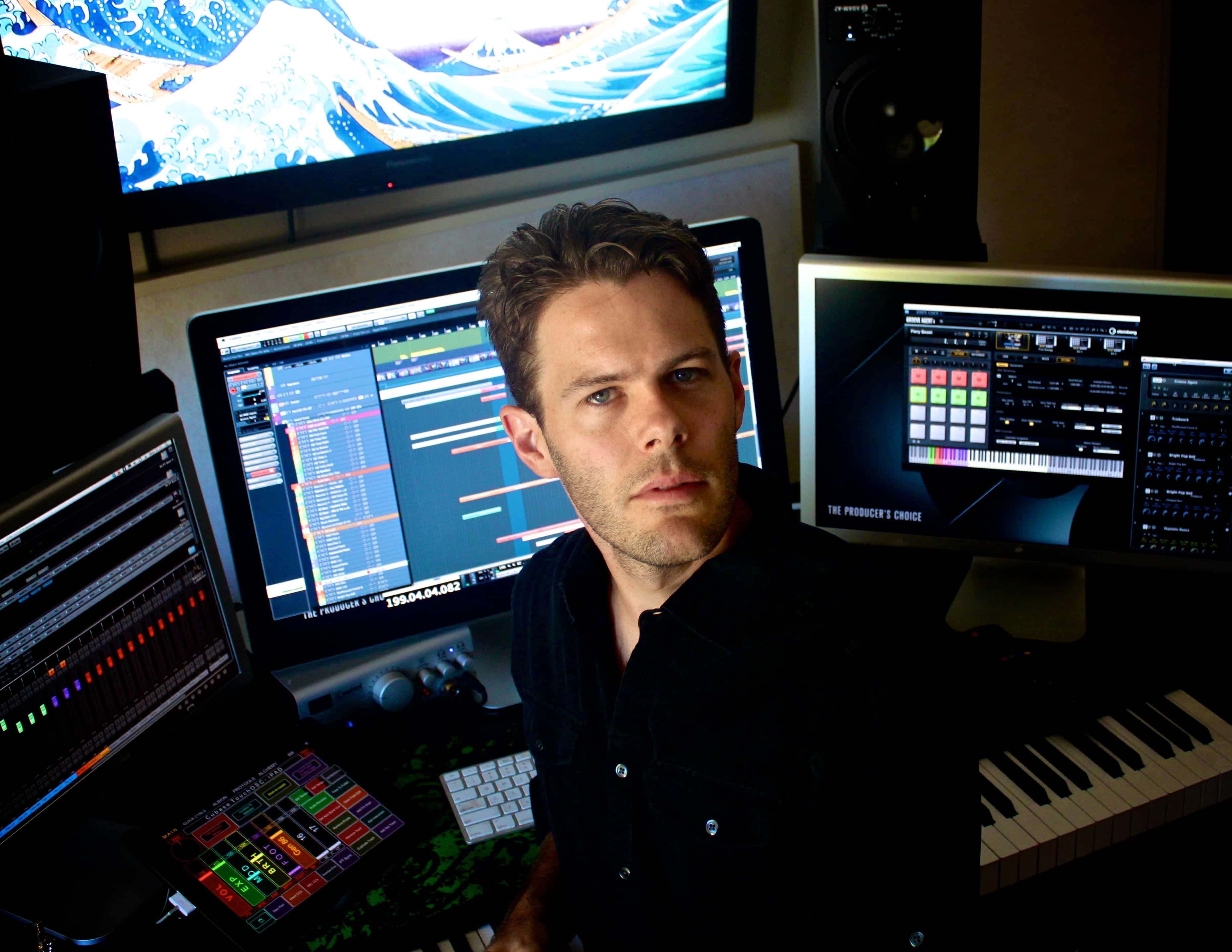
Pieter Schlosser, a California-based composer whose music you have almost certainly heard in a film, TV show or video game, counts Costa Rica among several countries he has called home during his very international 35 years. Born in Guatemala, Schosser also lived in Austria and Panama before moving to Costa Rica at the age of 15. While he had been involved in music throughout his life, he says it is here that he got serious about music, taking saxophone lessons with Javier Valerio and playing with the Costa Rican Symphony’s Intermediate and Advanced levels.
The Humboldt School graduate majored in film scoring and music production and engineering at the Berklee College of Music in Boston. Since then, his work has included collaborations with famed Costa Rican band Editus, music scores for shows such as NBC’s “You, Me, and The Apocalypse,” “The Lying Game” and “The Client List,” and additional music for “Transformers,” “Resurrection,” and “Desperate Housewives.” He has also collaborated with music for video games such as “The Sims III,” “Gears of War II,” and “Gears of War III.”
The Tico Times spoke with this talented musician who focuses on transforming emotions into music. Excerpts follow.
Why did you choose musical composition focused on film scoring?
The best example that everyone refers to is “Star Wars” and John Williams. Without his music, it wouldn’t be half the film we know. John Williams is someone who I’ve always thought of as a reference. I’d say he’s the one who decided my future as a musician.
I began working with film scoring. Lately, I’ve been working more on music for TV. I like the idea of extracting the emotions that film or television are showing me. Music can completely transform a scene. It can be a very intense scene about love, and if I place comical music in it, it will become ridiculous. Maybe with one or two notes I can communicate what the actors are not saying. The idea is to extract the emotion from the movie or TV show: not necessarily tell the audience what to feel, but complement what the visual part is communicating.
How do you make the audience identify with what is happening?
There’s no [single] answer to that question. Emotions can be communicated through 60 musicians playing one single note, or by a single guitarist playing a thousand notes. It all depends on the producers’ or director’s visions. The way in which you extract the emotions is what I’m trying to figure out every time I sit down in front of the computer. It’s all about what the scene, director, and actors are telling me. Maybe it’s even about what they’re not telling me.
The best example of a show with great music communicating a comical feeling is “Tom and Jerry.” It had spectacular music and it was all done live. You had 80 musicians recording every note you listen to in the show. Everything was synchronized with the music. The show had Tom, Jerry, and the music; the music was another character all its own. There’s a musical term in film scoring called Mickey Mousing. It’s about accentuating every movement with an instrument or musical phrase, and that show has it.
If it’s for children, everything is way more obvious. If it’s for adults, it depends whether it’s a drama or comedy. Comedy is much more difficult for me. You have to be very careful to avoid selling out the joke before it appears on the screen. You also have to make sure it’s not too late. As a spectator I want you to feel what I’m doing without you noticing it right away. The moment in which the music is not there, you ask yourself what happened. I’m often told to place music in a certain place, but what if we leave it without music? I don’t want to tell people what to feel.
How does the process for video games, films and TV shows differ?
A film and a TV show are similar in the sense that it’s something linear; the difference is that in a film you have an arc that lasts 90 minutes, and in TV you have acts, about four or five acts that last eight minutes each, more or less, divided by space for advertisements. Each act is constructed in a way in which people wonder what’s going to happen next and must keep watching the same channel. I’ve got to do the same thing with the music. For films you have much more space to create a theme and a more fluent arc.
Video games are not linear because the user decides where he or she’s going. If they go somewhere, monsters might appear or nothing might happen. It’s constructed in a manner in which the user decides what happens next. One music piece might have five different tracks and each track is independent from each other. You might start off with a bit of tension and very little movement, but then a guy appears and he wants to kill you. You’ve got to integrate different tracks to build up the tension. It’s a very technical thing that the console does by itself. Depending on what the player does, the tracks are activated. If you get nowhere in the game, the musical piece might only reach certain level.
https://soundcloud.com/pieterschlosser/sam-meets-wang?in=pieterschlosser/sets/pieter-schlosser-composer
How did you end up making music for “Desperate Housewives,” and what was the experience like?
I was working for Steve Jablonsky as his first assistant, and he began making music for “Desperate Housewives.” At the beginning we thought it was some sort of reality show, but it was a success. They wanted Danny Elfman to make the music: he composed the show’s main theme, and for the first three episodes they wanted a similar sound to his. Steve had written a demo for them and every time they needed music they would use his demo. They liked it so much that they then called him and asked him if he would like to compose the music. From the fourth episode onward the music is his.
I began composing every time I went to his studio and showed him what I had done. It was there when I began composing for him and for the show. The more music I composed, the more it was used for the show. He was focusing on movies and would delegate more responsibility to me for “Housewives.” This show had a bit of everything: comedy, drama, romance. There was a lot to choose from musically.
Which has been your favorite work?
The work that I did with Editus is something that I’m very proud of. I loved collaborating with other musicians. There’s something magical that happens when you record with someone else. The last piece I composed was a demo I made for some people in San Francisco who make virtual instruments. I created a composition for an electric cello. The song was missing something: a voice. I asked my daughter if she wanted to sing. At first she said no. Twenty minutes afterwards, she came into the studio and put on the headphones. She sang. It was only a melody, no lyrics. It’s not necessarily the best composition, but the moment spent with her was very nice; the experience of being with her and creating music with her. So right now, that would be the musical piece I’d tell you about. I like it because my daughter is singing in it.
Check out Schlosser’s “Parzival & Art3mis” recorded with his daughter:
https://soundcloud.com/pieterschlosser/parzival-art3mis
Our “Weekend Arts Spotlight” presents Sunday interviews with artists who are from, working in, or inspired by Costa Rica, ranging from writers and actors to dancers and musicians. Do you know of an artist we should consider, whether a long-time favorite or an up-and-comer? Email us at kstanley@ticotimes.net.





