


Ed. Note: This profile is third in a series by students of the University of Arizona School of Journalism’s study abroad program in Costa Rica. Ostional recently made international headlines when a mob of tourists prevented sea turtles from nesting. Since then, officials have implemented better crowd control measures to respond to the problem.
PLAYA OSTIONAL, Guanacaste – For tourists, the beaches of Costa Rica are known as a prime location for rest and relaxation, but they’re the exact opposite for Hellen Lobo, a conservation biologist. For Lobo, the volcanic sand beaches of Ostional National Wildlife Reserve are a place where she works long hours researching, recording and writing.
Lobo starts her workday before sunrise by monitoring the nocturnal movements and nesting behavior of olive ridley sea turtles. These turtles tend to retreat to the ocean once their security blanket of darkness has been lifted, which protects their eggs from predators that dig up and eat the eggs and hatchlings.

Lobo is Ostional’s nature research manager, acting as a liaison between the Environment Ministry (MINAE) and the sleepy coastal town whose economy depends on a unique turtle egg harvesting and consumption program. She is the first woman in Ostional to take on this intensive job.
“Some people have confessed to me that they weren’t very confident that a woman could possibly do this job, but now they are calm and happy,” Lobo said during a recent visit.
She and a co-worker search for trails left by the turtles from the ocean to their nesting sites on the beach, located well above the high tide line so that eggs won’t be swept away.
“My work day generally consists of waking up at 4:40 a.m. I then sweep the beach from beginning to end with my co-worker Juan Ramón Avilés Vega. This process takes about two hours,” Lobo said.
She counts the number of turtles that come to the beach to lay eggs by checking how many turtle trails were left on the beach throughout the night.
Tens of thousands of nesting turtles come to shore during the arrivals, known as arribadas.
“We work with a lunar calendar. It’s very rare that the turtles come when there is a full moon because the light deters them. They prefer the darkness because it hides them from predators,” she said.
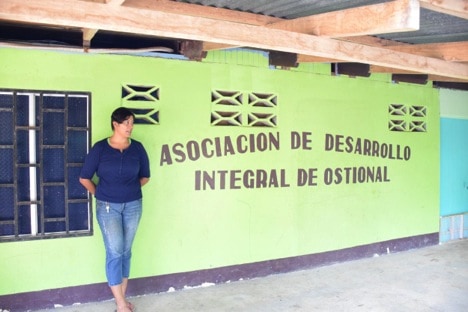
Lobo encourages Ostional’s visitors to contribute to the development of the community and to participate in cultural and educational activities.
She mentioned some of the difficulties associated with doing such a demanding job: “I have a lot of work that goes beyond the work of a managing biologist. I am far from my family and husband.”
“I have knowledge in marketing, management and accounting. I like to get involved with people, and developing an understanding of communal processes is something that attracts me a lot,” Lobo added.
The Ostional community includes about 450 people who are reliant on the regulated harvesting of olive ridley turtle eggs for their livelihood. The egg harvest is currently the primary source of income for 70 percent of households in the town. In 1983, the wildlife reserve was established, and later, egg harvesting became legal and sanctioned.
Residents of Ostional harvest eggs during the first 72 hours of an arribada. This harvesting is legal because predators or subsequent turtles would have destroyed the same number of eggs, supporters of the program say.
That approach is called community-based conservation, which comes from the idea that engaging the community and allowing them to profit from conservation is a good incentive. This type of conservation is the exact opposite of the traditional approach, which fences out the local community. Ostional is a good case study of community-based conservation and locals and some biologists praise its success.
However, Ostional’s conservation program isn’t without its critics. Some say the egg-harvesting program has actually caused the turtle population to decrease. According to Mario Boza, a conservationist and author of “Costa Rica National Parks,” the legalization of eggs from Ostional has made it easier for contraband eggs harvested outside of Ostional to flourish in the legal egg market.
“The project has room for improvement,” Boza said.
He said he has encountered eggs for sale that were clearly too big to be from the olive ridley, and they were missing the official Ostional packaging. Those eggs were most likely from leatherback turtles being passed off as legal, he said.
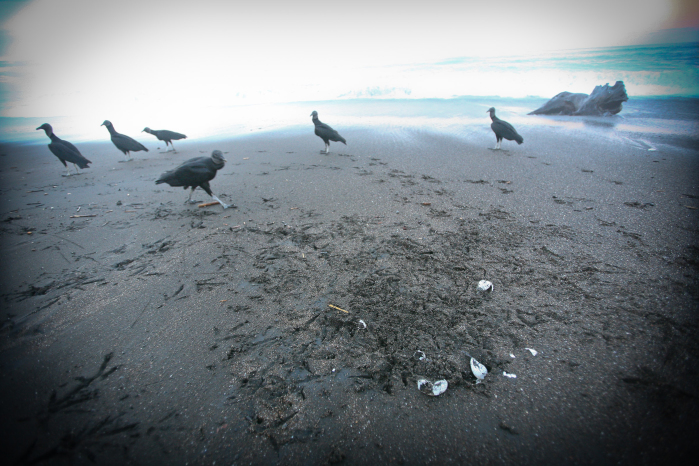
Harvesting the eggs prevents the eggs on the surface of the beach from being trampled and broken by the next wave of turtles. The broken eggs create a bacteria-laden slime that lowers the probability that the remaining number of viable eggs will hatch. Researchers claim that removing the eggs in the first hours of an arribada helps increase the number of hatchlings because bacteria are removed from the process.
Residents of Ostional are the only ones legally permitted by MINAE to harvest eggs. The cost of obtaining a permit is $8, and the law keeps outsiders from exploiting the harvest.
Also, women in the Ostional community clean the beach because baby turtles can’t hatch when it’s too dirty.
“The women separate the eggs into sacks of 10, and the men carry these sacks on their shoulders,” Lobo said.
The female turtles return to the same beach where they were hatched to lay their eggs. The turtles usually lay one or two clutches of eggs each season. Each turtle lays an average of 80 to 100 eggs in one night. The Ostional residents harvest and then package the eggs for sale and distribution throughout the country in all seven provinces.
While the members of the community keep busy during las arribadas, which are largest during Costa Rica’s rainy season, so does Lobo. She travels back and forth between Ostional to monitor the harvesting process, and San José, where she attends the National University. Despite all the challenges personally and professionally, Lobo said the effort has been worth it.
Surya Greer is a journalism and anthropology student at George Washington University in Washington, D.C. Read more stories in the student series here and here.





