

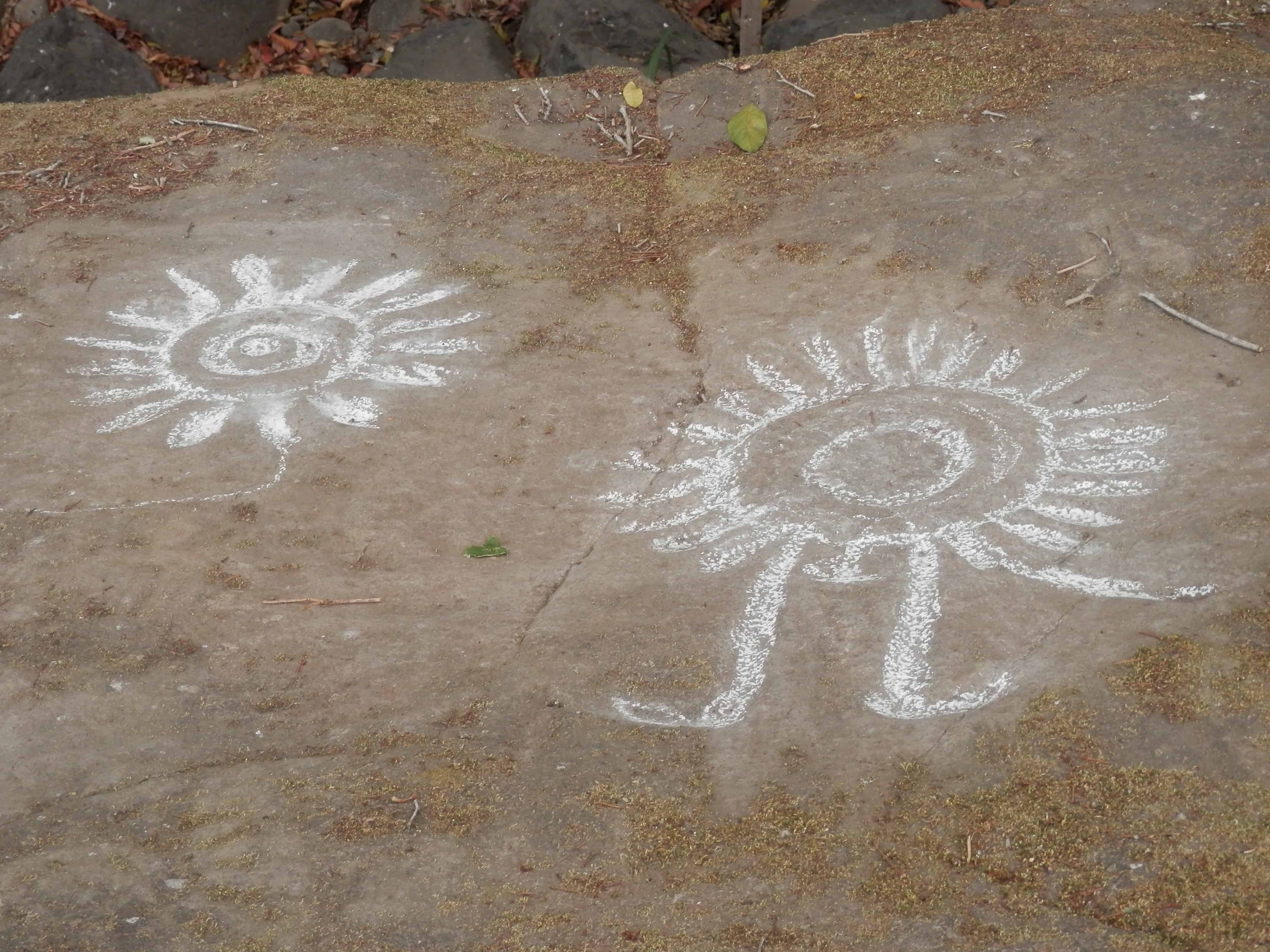
Long before Columbus found his way to America – and long, long before there were telephones and computers – the people of the Central Valley had a durable communication system.
Petroglyphs can still be found on rocks along the Itiquis River in the western part of Alajuela province, although no one today knows what they stand for. They are the only reminder of the Catapa people who once lived here.
The Catapas occupied an area of about 15 kilometers by 10 kilometers, extending from what’s now the city of Alajuela to Santa Barbara de Heredia.
“There’s very little known about them,” explains area resident Ronald Castro, whose deep interest in the history of Alajuela has led him to study the area and give tours and classes. “Nor do we know what the symbols mean. Similar designs are found on rocks along the river and up to Las Pilas, several kilometers away.”
Some pictures resemble lizards, or maybe iguanas which were used for food. Others seem to depict sunflower designs. There are also grooves between some of the pictures which, Castro says, could be a map. Castro suggests they might have been made with rocks; spreading talcum powder on the designs and rubbing it in makes them easier to see.
There have been no serious studies on the Catapas, said Castro, although fragments of pottery plus the petroglyphs show that their civilization thrived in the area. Some of the petroglyphs are found in Barrio San Jose, surrounded by houses and streets, but they are located at the back of a coffee farm and have been preserved by the owners. Others are along the rocky shore and are almost inaccessible.
The petroglyphs along the shore “could have been signs for people travelling on the water. At that time the river was probably much higher than it is now,” said Castro. The river may have served as a sort of highway.
Up in Sabanilla de Alajuela on the way to the Poas Volcano, there is a flat rock with channels and holes in it, according to Castro. A possible explanation is that the river flowed down over the area and the rock was used for filtering out gold.
Why did the Catapas disappear? They were one of many small indigenous groups that lived in Costa Rica when the Spaniards arrived. The first mention of the Catapas was in a census in 1569; by that time, only 40 Catapas were left to be counted. It is known that after the conquest, indigenous populations were rounded up as encomiendas, groups kept to work as slaves on farms.
Around 1577, conquistador Francisco Corajo received a group of Catapas as an ‘encomienda,’ a term for a group kept to work as slaves on farms. In 1605 his son asked for legal recognition that his inheritence includes the group of Catapas and their territory. The son’s widow, Juana de Vera y Sotomayor, included in her will her hacienda and the ‘encomienda de indios.’
There is no record of what happened after that.
“Disease and hard conditions probably killed them off,” suggested Castro. And all that remains of their society is the petroglyphs on the rocks along the Itiquis River.
Ronald Castro writes a weekly newsletter on Alajuela history and gives walking tours of Alajuela





