

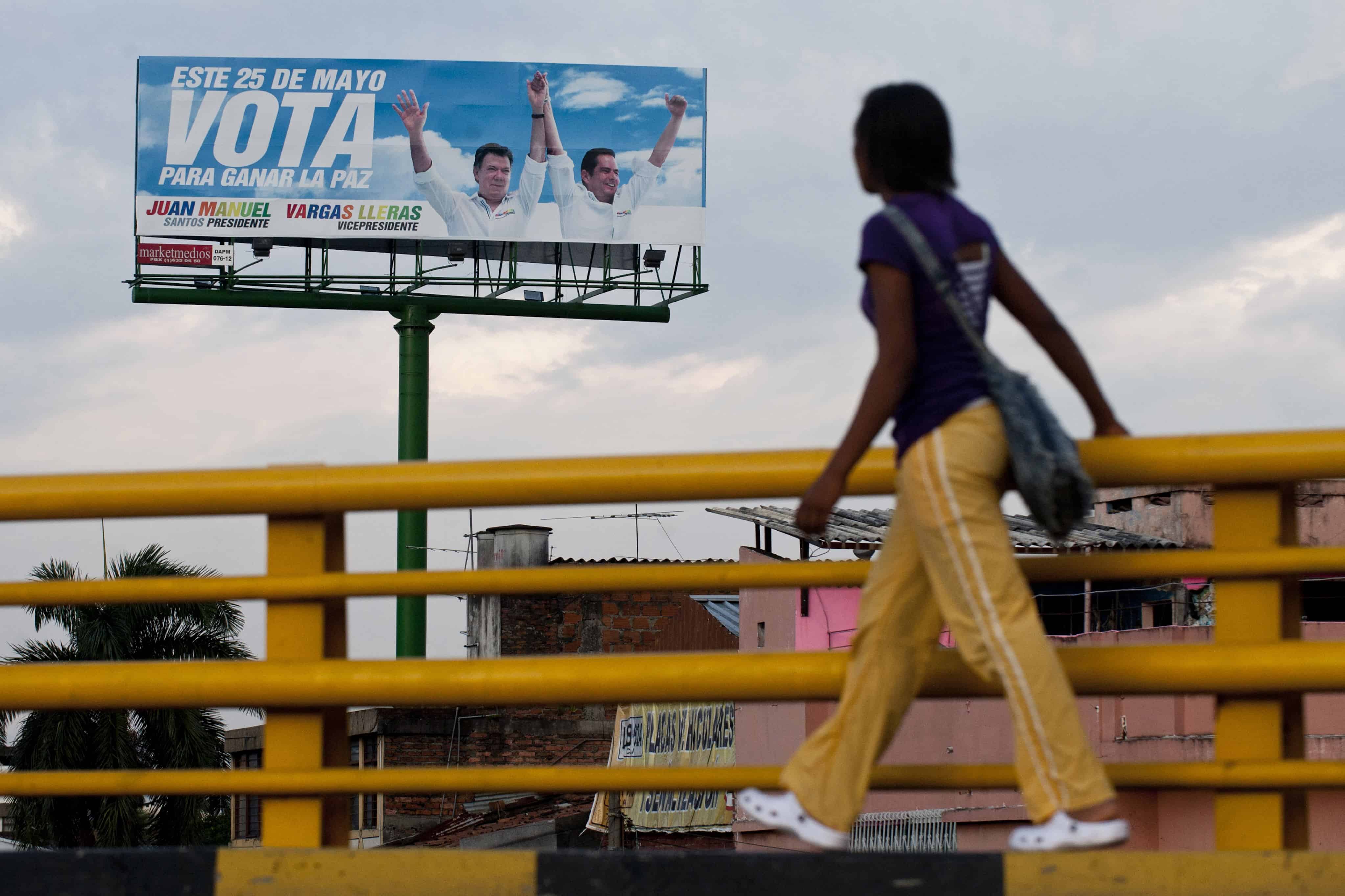
Wiretaps. Drug-gang payoffs. Clandestine videos. Unspeakable insults. Photoshopped campaign pictures. For Colombia’s voters, going to the polls on Sunday comes as a catharsis after the ugliness that has marred one of this year’s most important presidential elections in Latin America.
Underlying the bitter contest between incumbent President Juan Manuel Santos and his closest challenger, Óscar Iván Zuluaga, is what amounts to a blood feud between Santos and his predecessor and former boss, Alvaro Uribe. Uribe — now an elected senator, Zuluaga’s patron and head of the opposition Democratic Center party — blames Santos for opening talks with Colombia’s rebels, who among their numerous crimes and atrocities killed Uribe’s father and tried to kill him as well.
Yet whoever eventually wins this election — a June runoff seems likely — will face a much bigger challenge: ending Latin America’s oldest insurgency and sustaining Colombia’s economic dynamism while restoring public faith in its political leadership. Their success or failure in doing so will ripple far beyond Colombia’s borders.
The tragedy is that Uribe and Santos were together responsible for an almost-miraculous national rebirth. Just over a decade ago, Colombia verged on becoming the Somalia or Yemen of South America. Suffering from attacks and depradations by drug cartels, paramilitaries and the 20,000-strong Revolutionary Armed Forces of Colombia (FARC), the central government had little control over more than a third of the country. With help from the United States, Uribe and Santos, who became his defense minister, fought back, going after rebel commanders and reducing the FARC’s ranks by half.
During that time, Colombia also hewed to sound economics, not the magical realism that passes for policy in some parts of Latin America. Last year, its growth rate of 4.3 percent beat most of the continent’s, as did its inflation rate of less than 3 percent (versus, for instance, more than 50 percent in Venezuela or more than 30 percent in Argentina). Foreign direct investment hit record heights in 2013, and Colombia’s ratio of external debt to gross domestic product is well below the median in Latin America and emerging markets.
As former finance ministers, Santos and Zuluaga mostly see eye to eye on the economy. The same can’t be said of their attitudes toward ending an insurgency that has taken 220,000 lives and displaced several million Colombians. Santos has staked his presidency on the success of negotiations with the FARC, which he initiated in September 2012. Progress has been real, but fitful. Zuluaga has scoffed at the rebels’ willingness to give up, among other things, their lucrative drug trade and has said that, if elected, he will suspend talks and give them one week to “end all criminal actions.”
Notwithstanding the military push led by Uribe and Santos, history suggests that force of arms alone won’t secure victory. The remaining rebels are dispersed over remote and difficult terrain. Even in their weakened state, they have hit pipelines and other sites, costing Colombia’s oil industry $300 million in lost revenue last year. What’s more, Colombia’s military mobilization isn’t cheap: Over the last decade, the military budget has eaten up more than 3 percent of its gross domestic product each year. That’s two or three times what any other country in Latin America spends, and has surely sapped Colombia’s effort to meet needs in education, health and infrastructure. Colombia’s finance minister has said that peace could raise the country’s growth rates by an additional percentage point.
Santos, however, made a mistake by mixing the pursuit of peace with the pursuit of re-election and presidential greatness. When he first opened the talks, he spoke of them lasting “months, not years.” That was almost two years ago. Most Colombians have tended to support negotiations, but enthusiasm may be waning; and although details of the interim agreements between the two sides remain secret, the rebels have exploited Santos’ hunger for a deal. Latin America as a whole has suffered, as Colombia muted its criticism of repression in Cuba and Venezuela, both patrons of the rebels.
Colombia’s next president will have the chance to leverage his victory both on the battlefield and at the negotiating table. He would be wise also to gird his country for the struggle of reintegrating the rebels — not easy when more than a third of Colombians say they have a family member whom the conflict has victimized. Paying for things such as crop substitution programs to wean farmers from coca cultivation will require Colombia to broaden its tax base. Foreign donors and supporters of the peace talks such as the U.S. and Norway should be prepared to step up, not draw down, their assistance. Wars end when combatants put down their arms. That’s also when the real work of peace begins.
© 2014, Bloomberg News





