
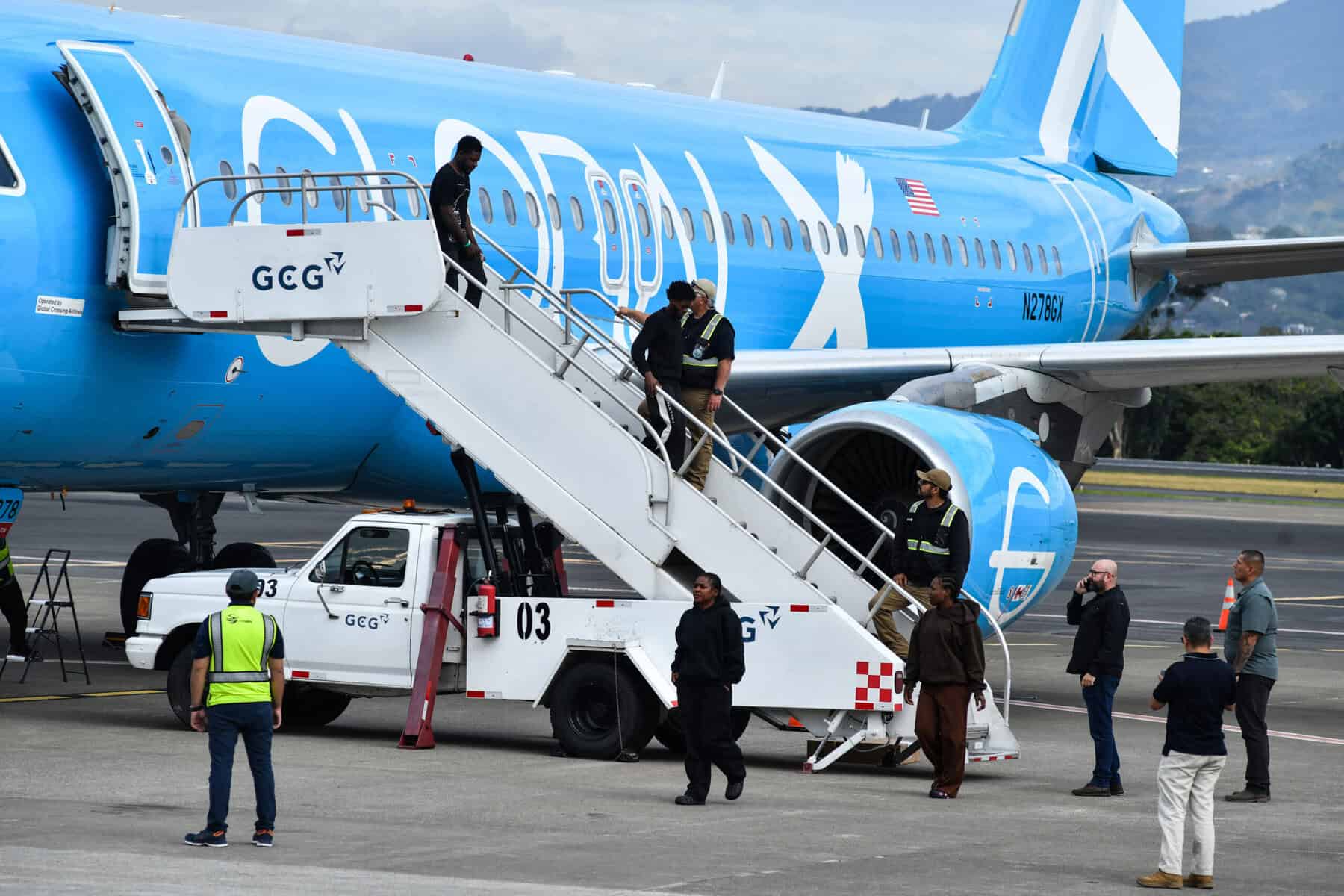
Costa Rica cannot fully meet its human rights obligations to the migrants the United States is deporting here from other countries, according to a report by two international advocacy groups. The report recommends suspending the arrangement until Costa Rica has the resources and conditions to receive more people.
The study, by Refugees International and the Global Strategic Litigation Council, examines the first months of a memorandum of understanding signed in March 2026 under then-President Rodrigo Chaves with U.S. Homeland Security Secretary Kristi Noem. Under the agreement, Costa Rica accepts up to 25 people a week who are not Costa Rican and who were removed from the United States, with the intention to serve as a transit point for their return home.
Its central conclusion is that the Dirección General de Migración y Extranjería (DGME), the immigration agency, cannot fully meet its national and international human rights obligations toward the people it receives. The groups found that migrants struggle to obtain identity documents, find work, get legal advice and stay in contact with their families. Of 21 people interviewed in April, nine had not received Costa Rican identity documents.
Some of those interviewed held humanitarian migration status and work authorization but found that employers and banks did not always recognize the paperwork. The authors note that their sample is not representative of everyone received or of every nationality. According to the report, 210 of the first 460 people transferred were still in Costa Rica as of Sept. 25, including 37 waiting to enter an assisted voluntary return program.
Figures from the immigration agency as of Oct. 2 put the total at 478 people on 23 flights. Of those, 183 stayed here, 26 were in the process of returning and 269 had left. They came from 39 nationalities, mainly Mexico, China, Colombia and Brazil. That marks a steady increase from early September, when government figures showed 424 people had arrived on 20 flights and 187 were still in Costa Rica.
The report argues that the government did not adequately plan for the administrative and financial consequences of receiving people who may need long-term protection. It also says the International Organization for Migration (IOM) has become the main point of contact for the deportees, even though responsibility for their rights rests with the Costa Rican state.
The groups also object to limits on outside access. After civil society organizations visited the hotels housing the deportees on Aug. 10, the agency stopped further visits, citing emotional distress among the migrants and their questions about documents, according to the report. The organizations say the restriction cuts migrants off from information and independent legal advice at the moment they are deciding whether to stay, return home or try to move elsewhere.
DGME director general Omer Badilla rejected the report’s conclusions in early October, denying that Costa Rica is failing its human rights obligations. He acknowledged that some people remain here while their immigration status is decided and attributed the buildup to differences in how long each person stays.
Badilla said between 55% and 60% of those received have already left Costa Rica. He said the IOM funds the assistance with U.S. money while his agency supervises the process and remains the regulating authority. He also said a process will be set up to issue DIMEX residency cards to those who stay and announced a U.S.-funded integration program offering Spanish classes, job-search help and housing support that would begin enrolling participants in the coming weeks.
Badilla defended the hotel visit restrictions as a privacy measure, saying migrants are free to speak with journalists outside the hotels. He said the agency has faced no legal proceedings related to deportees received under the agreement, and that he respects the report’s view but does not share it.
Costa Rica is one of several countries taking part in the wider U.S. practice of third-country deportations, which sends people to nations other than their own. Unlike deportees held in some other countries, those sent here are housed in hotels rather than detained and may move around freely.
The call to suspend the agreement comes just as the government prepares to launch its integration program. Whether the people who stay can get the documents they need to work, open bank accounts and rent homes will shape whether Costa Rica remains a transit point or becomes a lasting destination for people the United States has removed.