
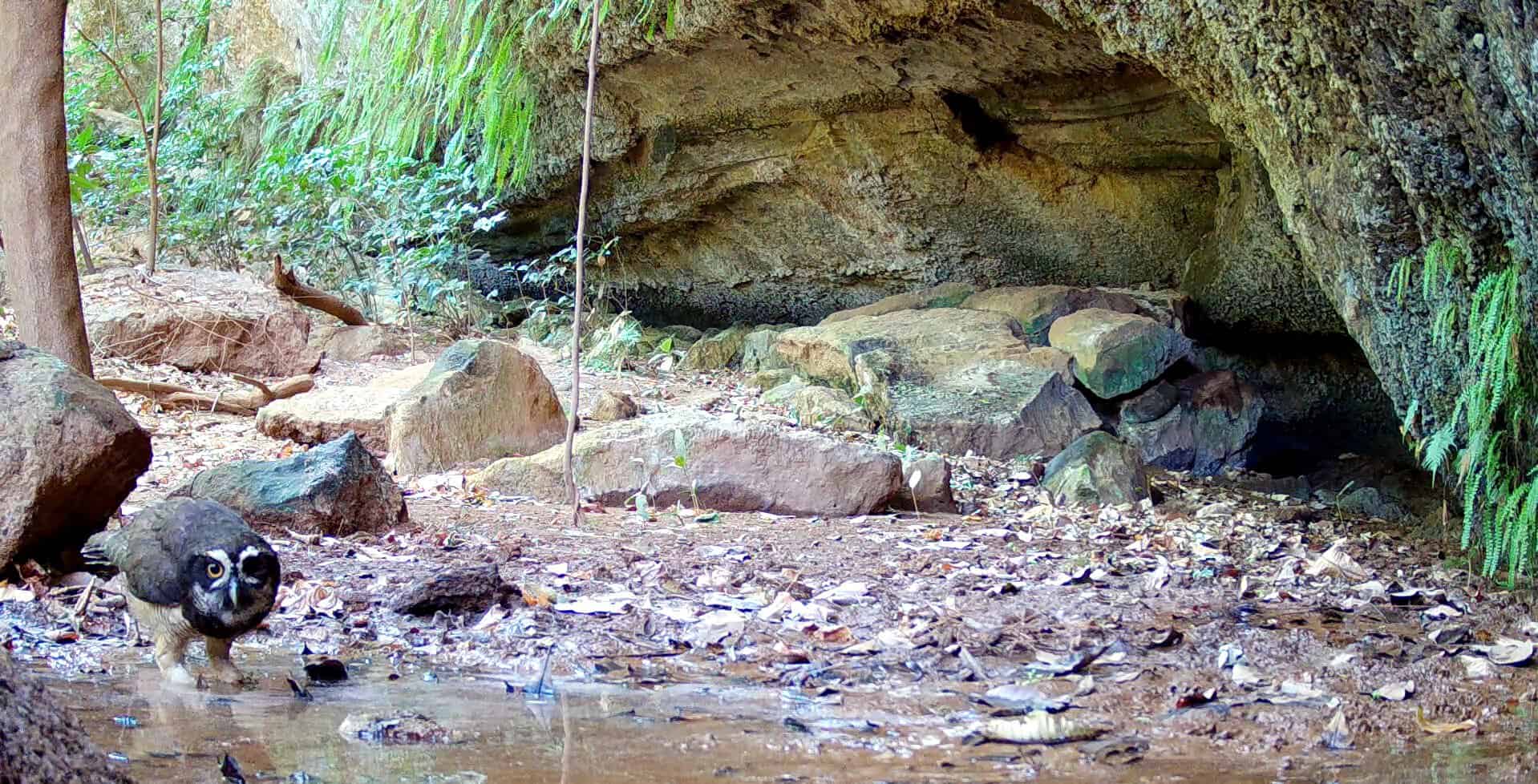
Costa Rica is home to an array of owl species. They come in a variety of patterns, shapes, and sizes, but they have a few things in common. They are all predators and most do their hunting at night. They generally have stout bodies and round heads. My favorite shared trait among owls is how ticked off they always look. Every time I see them in person or record them with my camera traps, the expression is always the same, a stern face that seems to say, ‘Hoo are you looking at?!’ (Sorry, I couldn’t resist.)
Another attribute that makes owls popular amongst birders and the public in general is the sense of mystery surrounding them. Most remain hidden during the day and difficult to spot at night. Frequently a distant hoot or shriek is the only evidence of their presence in the forest. That makes a sighting or camera trap recording of any owl species a special treat. I’ve only seen and recorded a few species over the years, and I’d like to tell you a little about each. They will appear in the order that I talk about them in the video below.
A Giant Owl
The spectacled owl (Pulsatrix perspicillata) is a hefty beast. Its Spanish name is oropopo, which is easy to remember because it’s fun to say. I see this owl in person more than any other owl species. There’s a type of habitat and time of year where I see them most frequently. It’s during Guanacaste’s dry season in trees that still have their leaves along dried streambeds.
They seem to enjoy hiding in the shady trees during the day, waiting for night to fall. I’ve gotten so good at predicting where to see them, that one time I was hiking with another biologist, and I told him that this seems like a good place to see spectacled owls and one flew over us ten seconds later. That counts for 1,000 biology points! I can still feel a buzz of pride when I think back on it.
I record these big owls pretty frequently with my camera traps as well. Some recent highlights include one drinking from a puddle in the mouth of a beautiful cave, one eating a white-throated magpie-jay on a tree branch, and a couple of different individuals splashing around, taking a bath.
Two Small Owls
The Pacific screech owl (Megascops cooperi) and the Ferruginous pygmy owl (Glaucidium brasilianum) come in on the other end of the owl size spectrum. The screech owl is small, and the pygmy owl is straight up tiny. Every once in a while, I’ll look up from messing around with a camera trap at the base of a tree and notice a Pacific screech owl staring daggers at me from the branch of a nearby tree. The pygmy owl, I always hear before spotting.
Their call is a repetitive whistle that’s easy to imitate. I’ve learned that I can repeat their simple call back to them and they’ll fly in to investigate, but I’ve also learned to not do it too frequently because many times, I’ll call one over to me and it’ll end up getting mobbed by all the local birds who don’t appreciate the presence of the tiny predator as much as I do.
I record the screech owl much more frequently than the pygmy owl with my camera traps for reasons that are unclear to me. When I record either species, it is generally doing the same exact thing, snacking on an insect.
More Owls
Of the many other species of owl in Costa Rica, I’ve only had interactions with a few others. I once worked with a striped owl (Pseudoscops clamator) in a wildlife rehabilitation center, and its striped plumage and long ear tufts made it one of the most beautiful birds I’ve ever seen. I helped raise three barn owl (Tyto alba) chicks at the same rescue center and I recorded one really nice, clear barn owl video with one of my camera traps. Finally, every once in a while, I’ll record a mottled owl (Ciccava nigrolineata) with my cameras, though I’ve never seen one in person.
About the Author
Vincent Losasso, founder of Guanacaste Wildlife Monitoring, is a biologist who works with camera traps throughout Costa Rica