

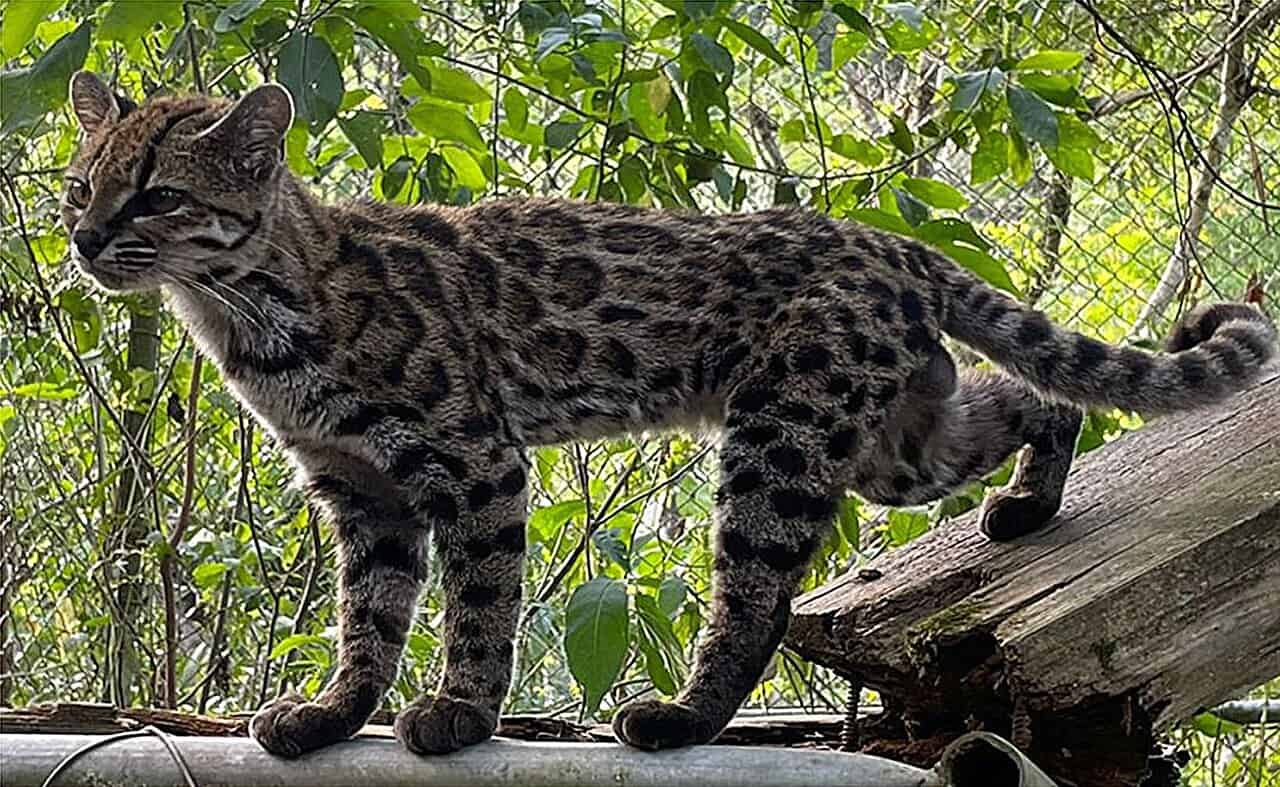
A small spotted wild cat from the cloud forests of Bolivia has been formally described as a new species. Scientists say it is the first time in more than a century that a new living feline species has been formally named and described. The cat, now called Leopardus tilcayo, was described in a study published on Thursday in the journal Current Biology. Its name comes from tilcayo, the word local communities in Bolivia have long used for the animal.
It is smaller than a house cat and the species measures 46cm (18 inches) long and weighs about 1.4kg (3 pounds). Researchers describe light brown fur with irregularly shaped rosettes across its body. The tilcayo belongs to the tiger cats, small, wild cats in the Leopardus genus native to South and Central America. It lives in the Bolivian Yungas, the cloud forest where the Andes mountains meet the Amazon basin.
The discovery began with one cat at a wildlife sanctuary. In 2016, Paola Nogales-Ascarrunz, a biologist and National Geographic Explorer working in Bolivia, received a call from a local wildlife sanctuary that had just been given what they described as “a weird cat.” The animal came from a local man who found it as a kitten on a road near a forest and kept it at home for about a year before realizing it was wild.
The cat went to the Senda Verde Wildlife Sanctuary as Nogales-Ascarrunz first assumed it was a northern tiger cat, a species described back in 1775 from a single illustration of an animal seen in French Guiana and long thought to live across Central and South America.
National Geographic
Her doubts grew in 2019 as while she was preparing a booklet about Bolivia’s cat species, she realized the cat she’d photographed didn’t look like a guidebook reference photo from neighboring Brazil. That led to a large genetic study and the team analyzed DNA from 38 cats sampled across several South American countries, including eight museum specimens and found that tiger cats are really five genetically distinct species.
Co-lead author Jonas Lescroart, an evolutionary ecologist at the University of Antwerp in Belgium, said the team never expected the Bolivian cat to be a separate species, and no one had ever proposed it as a different animal, subspecies or otherwise. He described tiger cats as “cryptic species,” meaning it is difficult to distinguish them by appearance alone.
Scientists believe the tilcayo cat likely evolved from a common ancestor of “tiger cats” around 1.4 million years ago. The same study also identified a subspecies of another tiger cat species, named Leopardus tigrinus antisuyo, which lives in Peru.
Much about the new species remains unknown. Lescroart said the team’s information is limited to the two live individuals that we examined, and a small number of camera-trap records. Rodent remains in scat samples hint at its diet, and camera-trap evidence suggests the cats are more active at night.
The sanctuary cat, a 10-year-old male at the sanctuary is the only known tilcayo cat in captivity, but others are believed to have been photographed by camera traps placed in the cloud forests. The researchers say the finding raises urgent conservation questions. Tadeu de Oliveira, a co-author and ecologist at the State University of Maranhão in Brazil, said all five tiger cat species are in habitats that are vanishing fast.
Nogales-Ascarrunz said naming a new cat after more than 100 years shows how much remains to be learned about nearby biodiversity, and that it underlines the need to protect the Yungas forests, which are home to so many species—including some we are only beginning to understand.





