
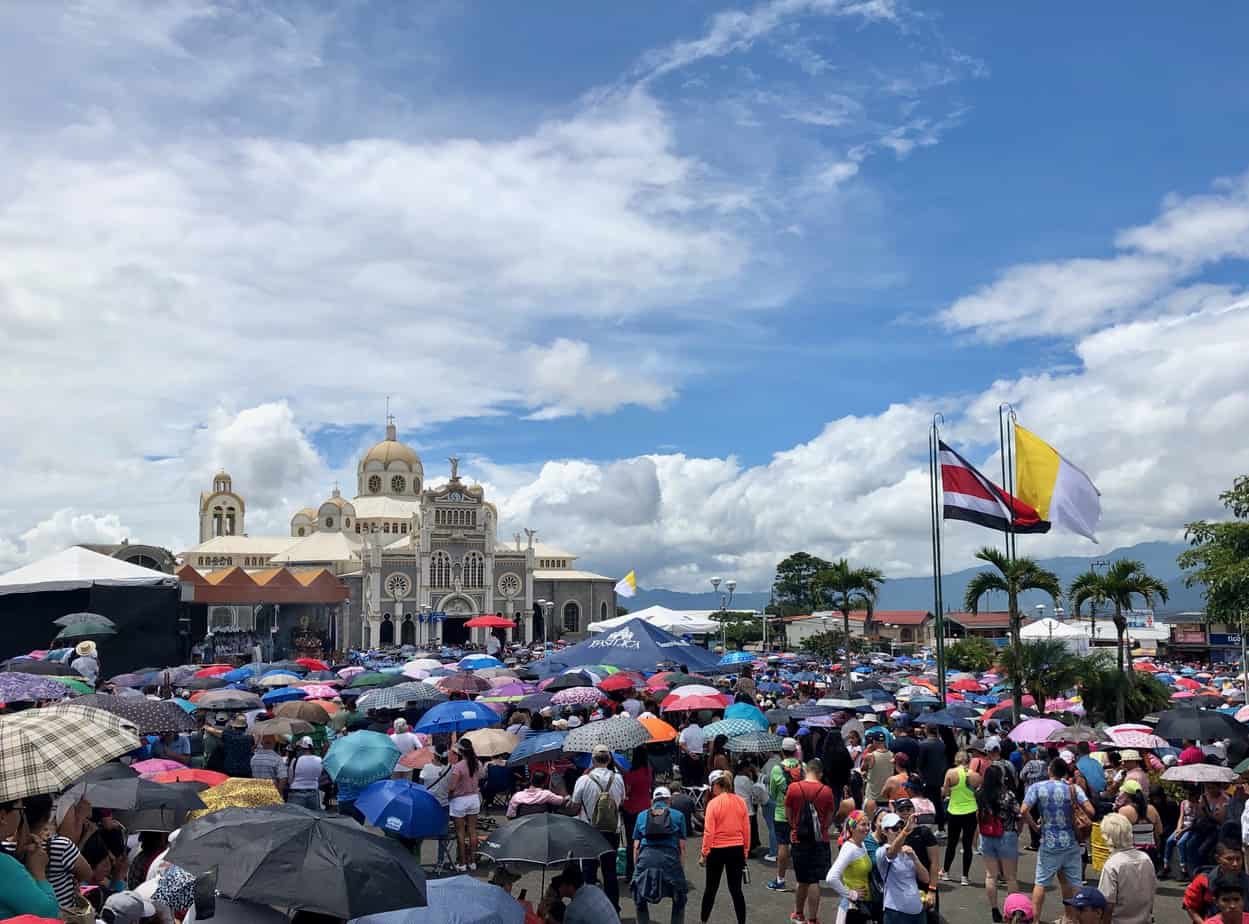
Today is the day the walking stops. August 2 is the feast of the Virgen de los Ángeles, the small dark stone image Costa Ricans call La Negrita, and it closes the Romería — the pilgrimage that has been filling the shoulder of every road into Cartago for the past week. If you were anywhere near the San José–Cartago corridor last night, you already know. If you slept through it, you will still feel the effects of it today.
As you may or may not know, tradition holds that on August 2, 1635, a young woman named Juana Pereira found a stone figure of the Virgin holding the infant Jesus on a rock near a spring outside Cartago. She took it home. It reappeared on the rock. A shrine went up around the spot, and the Basílica de Nuestra Señora de los Ángeles now stands over it — the rock itself sits in the crypt, and people still line up to touch it and fill bottles at the spring behind the church.
The Virgin was declared Costa Rica’s patron saint in 1824. Every year, people walk to her. The classic route runs about 22 kilometers (14 miles) from San José over the Ochomogo ridge, but walkers come from Guanacaste, Limón, the Southern Zone and the Northern Zone, some covering more than 280 kilometers (174 miles) over six or seven days.
Church estimates put participation near two million people across the period. Some finish the last stretch on their knees. This year carries an extra weight. It falls in the centenary of the Virgin’s pontifical coronation, which Pope Pius XI granted in April 1926, and the official program was built around that anniversary, running from July 23 through tomorrow.
The main event today is the solemn Mass at 9 a.m., celebrated outdoors on the plaza in front of the basilica rather than inside it, because nothing like the crowd would fit. Mario Enrique Quirós Quirós, the bishop of Cartago, presides. Civil and religious officials attend alongside pilgrims who have been sleeping in tents on the plaza and in the parks around it. In the evening, the Rosario de la Luz brings a candlelit rosary back to the same plaza.
If you are going, walk in. The three-block ring around the basilica is closed to vehicles, and only residents inside the perimeter can drive through it. Dress for cold and wet — Cartago sits at roughly 1,435 meters (4,708 feet) and this morning it is around 18°C (65°F) under heavy cloud, with a high near 21°C (70°F) and a real chance of rain by afternoon. Yesterday’s walkers got soaked and wind-blown by Tropical Wave 27, and the pattern has not fully cleared.
If you are trying to leave Cartago, move before mid-morning. The Cartago–San José train has been running without a break since 9 a.m. Saturday and stops at midday today, and it is the fastest way out while it lasts. Buses are the fallback: the temporary terminal at Plaza de la Soledad, a few blocks southwest of the basilica, runs until 10 a.m., while the regular downtown terminal reopens at 6 a.m., so there are two departure points this morning.
About 146 buses were authorized for the return, including 34 extra units on the main San José route, with direct services to Guadalupe, Desamparados, Heredia and Escazú. Expect lines anyway. Everyone finishes at roughly the same time, which is exactly the problem. If you are driving today, the restrictions come off in stages. Toll collection at the Tres Ríos plaza on the Florencio del Castillo resumed at 6 a.m. after twelve free hours overnight.
The ban on heavy trucks and hazardous-materials transport along Ruta 2 between Hacienda Vieja de Curridabat and the La Lima junction lifts at noon, as does the alcohol sales ban in the perimeter around the basilica. Traffic Police reinforced the Florencio del Castillo from 6 a.m. this morning, watching for speeding, illegal parking and drivers overcharging for rides. Assume pedestrians on the road well into the afternoon — the return trip is on foot for plenty of people too, and reversible lanes may be used between Cartago and San José depending on volume.
The support operation behind all of this stays in place. More than 500 Fuerza Pública officers and about 150 traffic officers have covered the route since Friday, backed by roughly 840 Red Cross volunteers and more than 145 emergency vehicles, a network of 25 health posts run by the Caja Costarricense de Seguro Social, and over 500 cameras along the pilgrim corridor from Cristo Rey in El Fierro through central Cartago. Most of what the Red Cross treats is not dramatic: blisters, muscle strain, dehydration, blood pressure trouble.
Last year nearly nine in ten cases traced back to physical overexertion, and the largest single group of patients was over 61. If you are walking today and your chest hurts, you are dizzy, or you cannot catch your breath, stop and find a post. Those are not part of the experience.
One more day follows. Tomorrow at 9 a.m., the image leaves the basilica in the procession known as La Pasada and travels to the Nuestra Señora del Carmen cathedral, where it stays until the first Sunday of September. The return trip in September is the one to mark on a calendar — families spend the pre-dawn hours laying carpets of dyed sawdust, flowers and seeds across the streets of central Cartago, and the procession walks over them and erases them.
Today is also a national holiday, though an unusual one. Under article 148 of the Labor Code, August 2 is a feriado de pago no obligatorio — everyone is entitled to the day off, but how it is paid depends on whether wages are calculated weekly, biweekly or monthly. It does not shift to another date, so falling on a Sunday this year means it passes largely unnoticed on the calendar even as it fills the roads.