
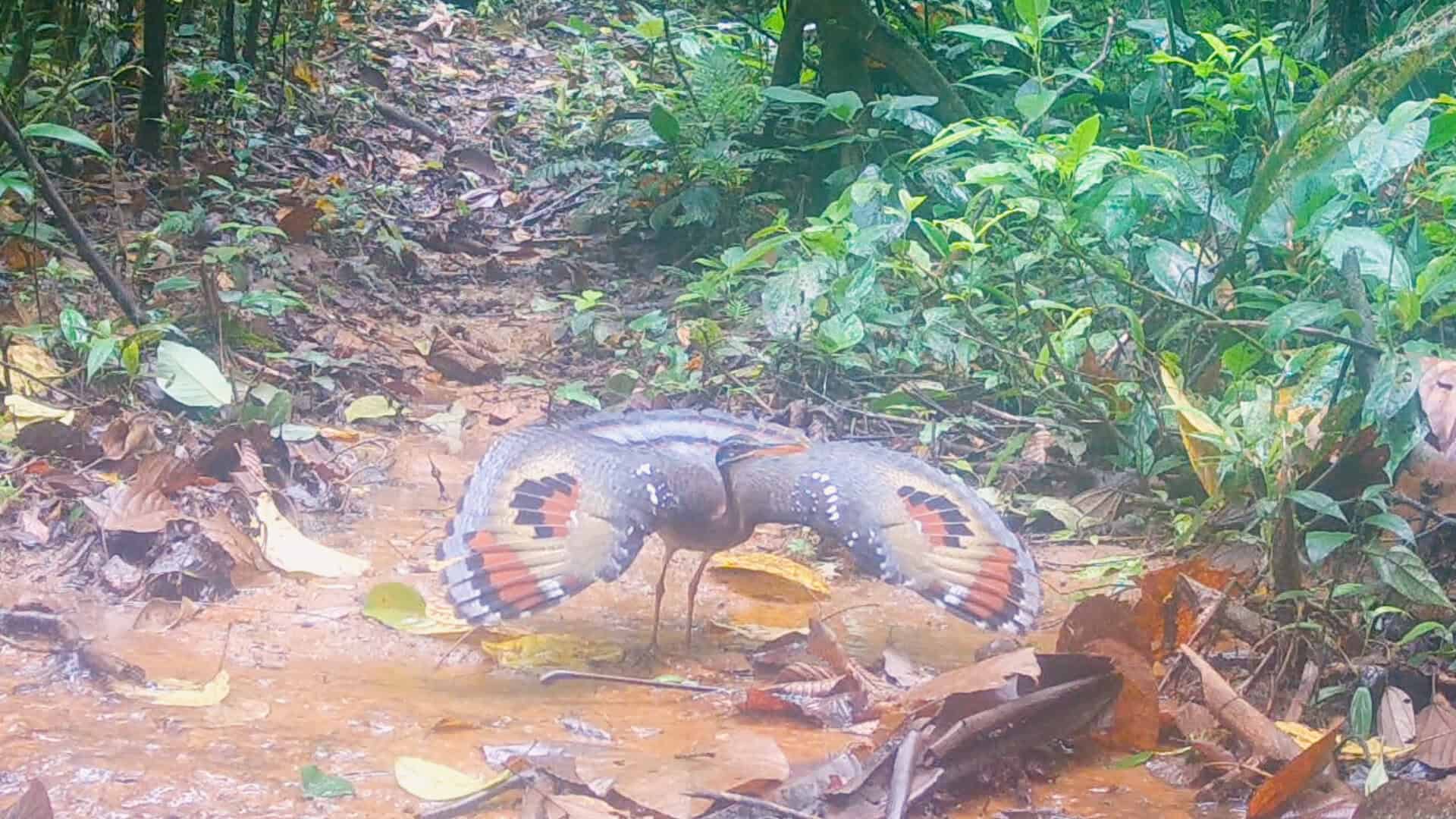
Today we meet the sunbittern, a unique bird that’s nearly impossible to see until it screams its presence at you. And the remiges? Don’t get me started on the remiges.
The sunbittern (Eurypyga helias) is known as the garza del sol in Spanish which translates to ‘sun heron.’ While the English and Spanish names are similar, they’re both a bit misleading as this bird is not actually related to bitterns nor herons. These birds are the sole member of their taxonomic family. Oddly enough, its closest relative seems to be the kagu which is a wild-looking bird that lives on the opposite side of the planet in New Caledonia.
A succinct physical description of a sunbittern is that it looks like a small heron. It’s a waterbird with longish yellow legs, a long, thin neck, and a straight, pointy beak, but this bird is really two birds packed into one. The calm sunbittern is nearly impossible to see. Its plumage is black and brown with specks of white, allowing it to blend in perfectly with the rocky edge of a stream or the fallen leaves of a forest.
A fired-up sunbittern is a different animal. Whether in the presence of the opposite sex, which requires some wooing, or the presence of a threat, which requires some scaring off, the sunbittern quickly fans its tail and extends its wings vertically transforming it from impossible to see to impossible to miss.
The extension of its wings displays its remiges, the wing-feathers used for flight, which have a beautiful sunburst pattern that resembles two large eyes. During courtship, these beautiful wings exhibit to a potential mate the fitness of the individual. When a sunbittern feels threatened, it displays its wings and charges at the threat, making it appear as though something with two big eyes is coming in hot.
This beautiful bird can be found patrolling quick flowing streams or sometimes swampier environments in forested areas. They eat a diet consistent with the normal waterbird menu, amphibians, crayfish, insects, and small fish. When it comes to nesting behavior, not too much is known because only a few nests have been located in the wild. Generally, the nests are a messy glob of leaves, stems, and sticks, placed a few meters up a tree that sits along a stream where they lay a pair of speckled eggs.
I’ve never actually seen a sunbittern with my two brown eyes, but I have recorded them with my camera traps. I first recorded one a few years ago on a farm in Pérez Zeledón. I recorded a handful of videos of an individual along a fast-flowing forest stream. It even displayed its wings in one of the videos, but it didn’t quite scratch the itch of recording a really good sunbittern video because it was too far away.
After that, I decided to wait until I recorded a really nice video of one displaying its wings directly in front of the camera before I wrote a Tico Times article about the species. Well, you’re reading the article so you can guess what happened recently. A few months ago, I got a video of one aggressively displaying its wings at a brown basilisk and then chasing it off.
It was an excellent video, but it happened in the early morning when there wasn’t a lot of light, so the video was in black and white, not really showing off the wing display in the way I wanted. A few days ago, I recorded the video I was waiting for on a forest trail just above a stream.
A male great curassow walked out of the forest directly in front of the camera causing a sunbittern farther up the trail to display its wings and charge forward. The curassow took off, leaving the sunbittern to display its wings directly at the lens of the camera. The wait was over and the article could be written. Take a look at the long anticipated video below.