

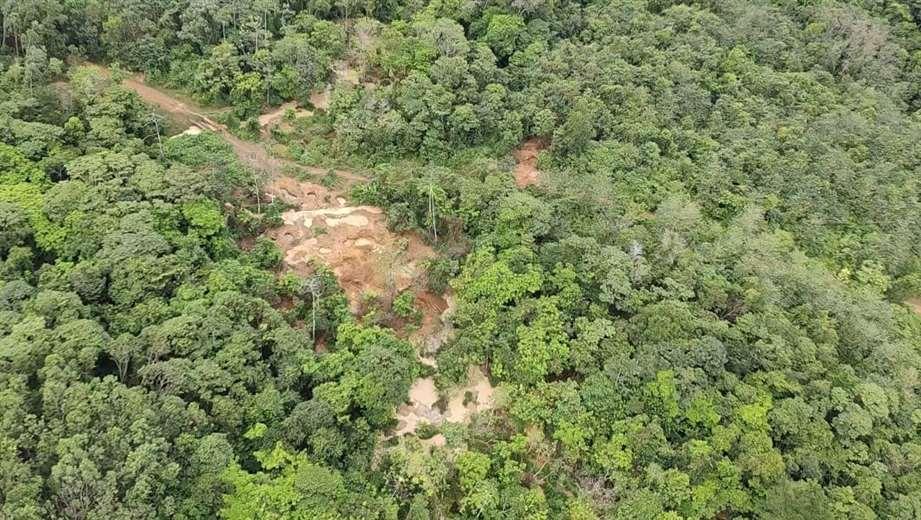
President Laura Fernández said the government could take the Crucitas mining issue to a national referendum if a bill to allow regulated open-pit gold mining in the area remains stalled in Congress.
“Yes, it is a possibility,” Fernández said Thursday when asked about submitting the issue to voters. Her comments came ahead of a planned visit to Crucitas, in northern Costa Rica near the Nicaraguan border, with members of her Cabinet and a group of lawmakers.
The bill backed by the government would create an exception to Costa Rica’s ban on open-pit metallic mining, allowing gold extraction in the district of Cutris, San Carlos. Supporters argue that regulated mining would let the state control an area now dominated by illegal extraction, environmental damage and criminal networks. Opponents warn it would reopen the door to large-scale mining in one of the country’s most sensitive environmental disputes.
Fernández framed the situation as both an environmental and security emergency. Authorities say Costa Rica is spending more than $1 million per month to maintain a security operation in Crucitas, where police work in difficult conditions across a remote area of more than 800 hectares along the border with Nicaragua.
The president also said authorities have identified more than 600 cyanide pools so far this year, used in illegal gold processing. She described the situation as a mix of environmental destruction, theft of national resources and organized crime.
For the government, that argument has become central: doing nothing, Fernández says, allows illegal miners and criminal groups to keep profiting while taxpayers cover the cost of policing the area. She has said Costa Rica cannot continue losing gold, damaging forest and water sources, and exposing police officers to dangerous field conditions without a long-term solution.
The referendum idea adds political pressure to a bill already facing a slow path through the Legislative Assembly. The proposal has accumulated hundreds of motions, forcing lawmakers to review the text in committee before it can move forward. The mayor of San Carlos, Juan Diego González, has also pushed the idea of taking the issue directly to voters if Congress does not act.
A referendum would not be automatic. Under Costa Rican law, an executive-backed referendum requires formal approval through the Legislative Assembly and review by electoral authorities. Still, Fernández’s party holds a majority in Congress, giving the administration a stronger position than recent governments if it decides to pursue that route.
Crucitas has been one of Costa Rica’s most divisive environmental issues for more than a decade. A previous mining project in the area was canceled after court rulings and public backlash, and Costa Rica later banned new open-pit metallic mining. Since then, illegal miners have repeatedly entered the area, digging tunnels, processing sediment with toxic chemicals and moving gold through informal networks.
That history is why the current debate is so sensitive. For environmental groups and opposition lawmakers, reopening open-pit mining would reverse one of Costa Rica’s most important conservation decisions. For the Fernández administration, the current situation has already become a de facto mining operation, only without regulation, taxes, environmental controls or security.
The president’s visit to Crucitas is expected to keep the issue at the center of national politics. Whether through Congress or a referendum, Fernández is signaling that her government intends to force a decision on a problem Costa Rica has left unresolved for years.





