

Costa Rica’s incoming National Assembly faces an urgent piece of legislation this week that reflects just how badly illegal gold mining has spiraled out of control: a bill that would lock up those responsible for up to ten years and cast the net wide enough to catch everyone from the miners themselves to the truck drivers who bring them fuel.
The proposal, registered as Expediente 25.576 and published in the official government gazette on May 13, was introduced by former ruling-party legislator Manuel Morales. It targets the Mining Code, which currently carries penalties as low as three months and no higher than five years, sentences that have clearly failed to deter what has become an industrialized criminal operation.
The new bill would push base sentences to between six and ten years for anyone directly or indirectly involved in illegal extraction, and five to eight years for anyone financing mining in national parks, biological reserves, or wetlands. Crucially, those penalties extend to anyone who provides machinery, equipment, transport, or logistical support, an explicit attempt to dismantle the supply chain rather than simply arrest the men holding the shovels.
The harshest penalties, reaching the full ten years, would apply when the activity takes place in indigenous territories, protected wildlife zones, aquifer recharge areas, or any region under special environmental protection.
The bill arrives against a backdrop that has been deteriorating for years, with the crisis most acute in Crucitas, a remote area in Costa Rica’s northern zone bordering Nicaragua. What is happening there has moved well beyond opportunistic small-scale gold panning.
Security Minister Mario Zamora testified before the Assembly earlier this year that gold illegally extracted from Crucitas is being loaded into sacks and transported across the Nicaraguan border, where it is then sold to a Chinese-owned company operating on the other side. Nineteen Nicaraguan nationals have been detained in connection with the operation, and the two countries held emergency border meetings at Peñas Blancas in late February specifically to coordinate a response.
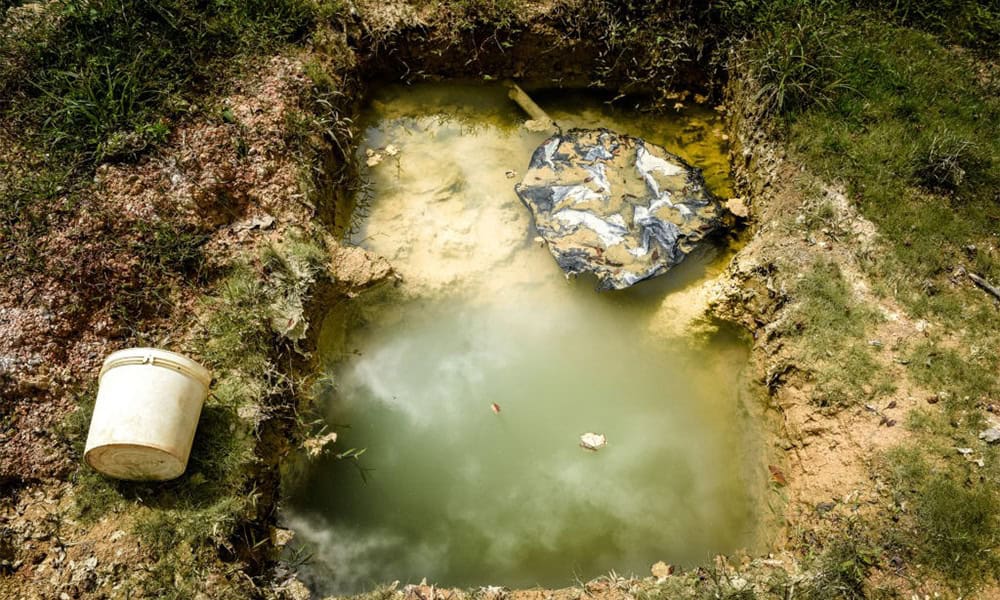
The transnational dimension of what is happening makes it, in every meaningful sense, organized crime rather than environmental lawbreaking. The environmental damage compounds the security threat. Illegal miners in the region use mercury to process gold, a heavy metal that seeps into soil and waterways, threatening both ecosystems and the communities that depend on them for drinking water.
The Constitutional Court stepped in earlier this year with a landmark ruling that found the government guilty of systematic and repeated failures to protect fundamental rights in the affected area, including the right to a healthy environment, public health, and clean water. It ordered the Ministry of Security to maintain a permanent police presence in Crucitas indefinitely, reinforce border controls, and provide the resources needed to sustain those operations.
Officials who fail to comply were warned they face criminal sanctions themselves. The Assembly bill is actually the second significant legal intervention of 2026. In January, the executive branch pushed through modifications to the Penal Code that already set sentences of five to eight years for illegal mining and six to nine years for trafficking in the chemical supplies or machinery that feed it.
That January reform also did something strategically important: it brought illegal mining formally within the scope of Costa Rica’s Law Against Organized Crime, giving prosecutors and police the same investigative tools they use against drug trafficking networks. The new bill now being considered would raise the ceiling further still, suggesting that even those January measures are being judged insufficient.
What emerges from all of this is that Costa Rica is confronting an uncomfortable gap between its international reputation and a harsher domestic reality. Costa Rica has built its identity around environmental stewardship, national parks, biodiversity corridors and carbon-neutrality targets, even as a criminal industry has been quietly poisoning rivers, tunneling through protected forests, and shipping contraband gold across the border.
The courts, the executive branch, and now the legislature are all moving at once, which reflects the scale of the failure but also, perhaps, the beginning of a serious response. The open question is whether sentences of ten years will deter an operation backed by organized crime and cross-border gold markets.
Enforcement, not legislation, will ultimately determine the answer.





