
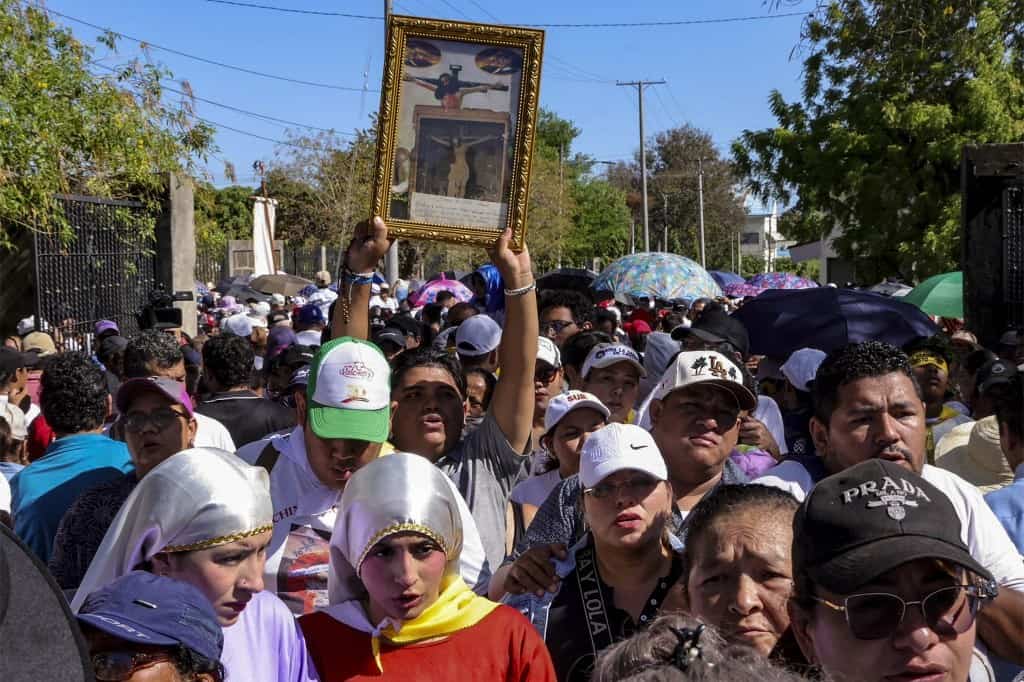
Thousands of Nicaraguans took part this Friday in Holy Week celebrations limited to church atriums or the interior of churches, amid a government ban on street processions that has been criticized by the United States as a serious violation of religious freedom. Co-presidents and spouses Daniel Ortega and Rosario Murillo, who rule Nicaragua with absolute power, have not authorized any public demonstrations in the country, including religious ones, for the past four years.
Worshippers who attended the religious celebration in Managua said by telephone that the Stations of the Cross took place in the gardens, in a square within the cathedral walls, and under police surveillance. After the Stations of the Cross, Cardinal Leopoldo Brenes, who never refers to the government or the religious restrictions, estimated that more than 25,000 people had gathered in the cathedral square, according to statements to pro-government media.
Last Tuesday, U.S. Deputy Secretary of State Christopher Landau said that the Ortega-Murillo dictatorship denies the people of Nicaragua the right to practice their faith. Responding in a statement on Wednesday, the Ortega-Murillo government said it categorically rejected Washington’s malicious and false accusations.
This Friday, Murillo said the turnout of worshippers at churches contradicted those who distort reality, and she criticized religious figures who call themselves pastors, but from their souls or their mouths come toads and snakes. Nicaraguan lawyer and church affairs expert Martha Patricia Molina, who is exiled in the United States, estimated that there are more than 400 confined parishes and hundreds of other chapels.
Ortega and Murillo accuse the Catholic Church of having supported the 2018 protests against them, which they view as an attempted coup sponsored by the United States. The crackdown left more than 300 dead, according to the United Nations, and forced hundreds of thousands of Nicaraguans into exile, including hundreds of politicians, intellectuals, students, social leaders and journalists, whom the government stripped of their nationality and property.
Over the past eight years, the leftist government has expelled hundreds of Catholic priests, including the president of the Episcopal Conference, Carlos Herrera, in 2024.