

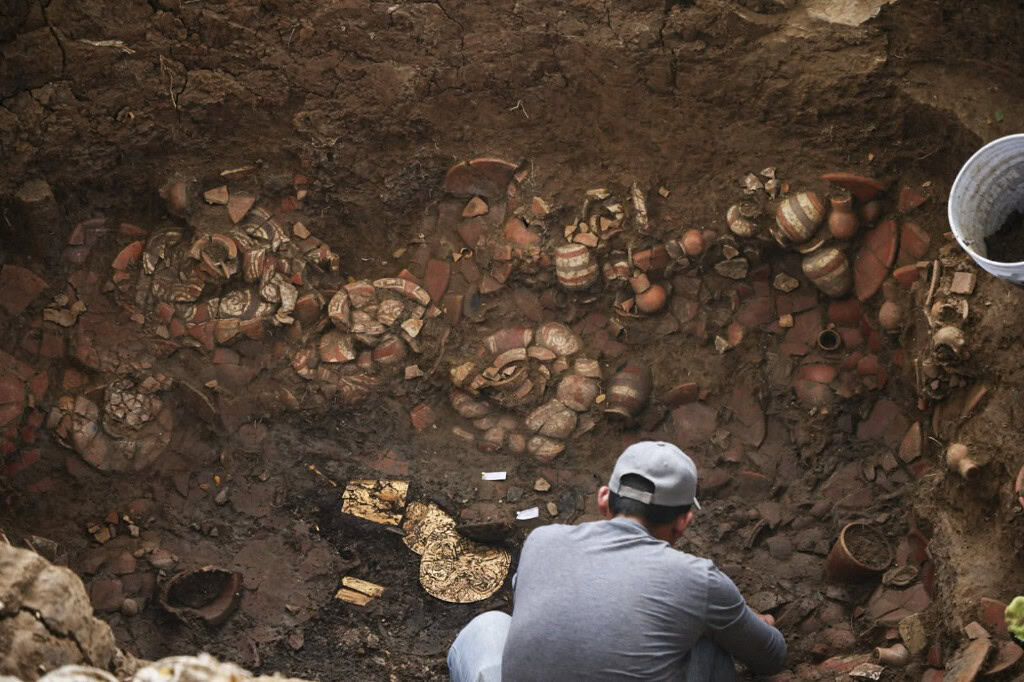
Archaeologists have excavated a tomb more than 1,000 years old containing human remains along with gold objects and ceramic vessels at El Caño in central Panama. The site sits in Natá district of Coclé province, about 200 kilometers southwest of Panama City. Excavations have taken place there for two decades.
Julia Mayo, the archaeologist leading the project, talked today about the discovery. The remains are surrounded by gold objects and ceramic vessels decorated with traditional imagery. These indicate the buried people held high status. “The person with the gold is the highest-status person in the group,” Mayo said. The principal occupant’s body was dressed with two bracelets, two pectorals and two ear ornaments. The pectorals feature representations of bats and crocodiles.
Mayo dated the tomb to between the years 800 and 1000 AD. Nine other similar tombs have already been excavated at the site. “They have been burying their people there for 200 years,” she said.
The El Caño site is associated with societies that inhabited Panama’s central provinces between the eighth and 11th centuries. This tomb, designated Tomb 3, was first detected in 2009 by concentrations of ceramic and metal fragments. The excavation finished in the 2026 season.
It reveals a multiple burial with the main individual in extended position accompanied by other people. The Ministry of Culture said in a statement that the discovery holds great relevance for Panamanian archaeology and the study of pre-Hispanic societies of the Central American isthmus.
According to experts, the excavation shows that for these cultures, death did not represent an end but a transition to another phase in which social status continued to matter. The discovery will provide new information on social organization, political power, exchange networks and ritual practices, among other aspects, the ministry added.
The richness of the funerary trousseau, particularly the metal objects, confirms that El Caño formed part of a regional system of interaction that included other contemporary centers, including Sitio Conte. Mayo said the funerary offerings indicate the rank and lineage of the individuals. The arrangements reflect beliefs in which the deceased played a role as intercessor with the other world. Power in these societies came from ideology and shared convictions.
Culture Minister María Eugenia Herrera visited the site. She said the government focuses on advancing the El Caño Museum as a center for research and education for all Panamanians and visitors interested in the country’s origins and history. “We are ready to tell the world much more about our cultural richness,” Herrera said.





