
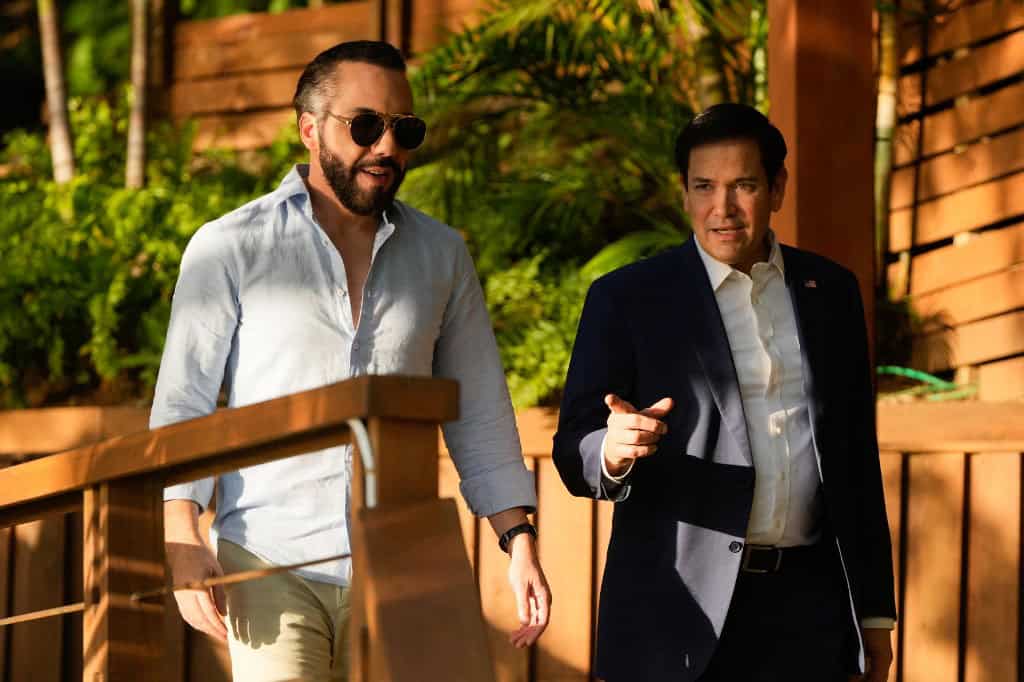
El Salvador’s President Nayib Bukele offered to imprison dangerous “criminals” from the United States and foreigners sent from the United States in his country’s mega-prison, Secretary of State Marco Rubio announced Monday. Bukele decided to “accept for deportation any illegal foreigner in the United States who is a criminal of any nationality,” such as those from the MS-13 gang (from El Salvador, Honduras, and Guatemala) and Venezuela’s Tren de Aragua, Rubio stated.
“He has offered to house dangerous American criminals detained in our country in his prisons, including those with US citizenship and legal residence,” he added in statements to the press after meeting with Bukele. There is virtually no precedent in contemporary times of a democratic country sending its own citizens to foreign prisons, and any attempt to do so will surely be challenged in US courts.
Rubio welcomed the proposal and said he was “deeply” grateful to Bukele, whose war on gangs has skyrocketed his popularity in El Salvador and other countries, even in the United States among President Donald Trump’s supporters. “No country has ever made such an offer of friendship,” emphasized the US chief diplomat, who said he spoke early with Trump about the issue.
Since his return to the White House on January 20, Trump has undertaken mass deportation of migrants, tried to end birthright citizenship, and announced plans to detain 30,000 immigrants at the US base in Guantánamo (Cuba).
Bukele’s Mega-Prison
Bukele enjoys great popularity for his offensive against gangs, based on a state of exception that, since 2022, has left about 83,000 detained without judicial order, many of them innocent, for which he is criticized by human rights groups. An emblem of that anti-gang war, the Terrorism Confinement Center (Cecot), considered Latin America’s largest prison, was inaugurated by Bukele two years ago on the outskirts of Tecoluca, 75 km southeast of San Salvador.
“We are willing to host only convicted criminals (including US citizens) in our mega-prison (Cecot) in exchange for a fee,” Bukele announced on social network X. “The rate would be relatively low for the United States but significant for us, which would make our entire prison system sustainable,” he wrote in English.
The prison, surrounded by huge concrete walls, is designed for 40,000 inmates, but currently houses about 15,000 from the MS-13 and Barrio 18 gangs, which terrorized the Salvadoran population for decades. Wearing sunglasses, sneakers, and an unbuttoned shirt, Bukele received Rubio at his residence by Lake Coatepeque in western El Salvador.
With supporters nearby on a boat, the Salvadoran president waved and told Rubio with a smile, switching momentarily to English: “90% approval!” It was at this meeting that Bukele told journalists he was close to an agreement with the United States on migration that would go beyond one signed in 2019, in which El Salvador accepted migrants from third countries.
Allies
Bukele said he was eager to have solid relations with the Trump administration. The United States is “our biggest partner, with whom we must strengthen relations,” he assured. On good terms with Bukele, the Trump administration has not yet touched the status protecting about 232,000 Salvadorans in the United States from deportation.
On the eve of Rubio’s visit, Bukele praised Trump’s effort to dismantle the United States Agency for International Development (USAID), noting that it funds opposition groups, including NGOs. As a sign of Bukele’s harmony with the Republican mogul’s government, Donald Trump Jr., the US president’s son, attended his inauguration a year ago after winning reelection with 80% of votes.
Rubio made El Salvador his second stop on his first trip as US chief diplomat, after visiting Panama, where he discussed Trump’s warning that he will retake control of the Panama Canal because it is under “Chinese influence.” On Tuesday he will visit Costa Rica and then Guatemala and the Dominican Republic at the end of his tour on Thursday.