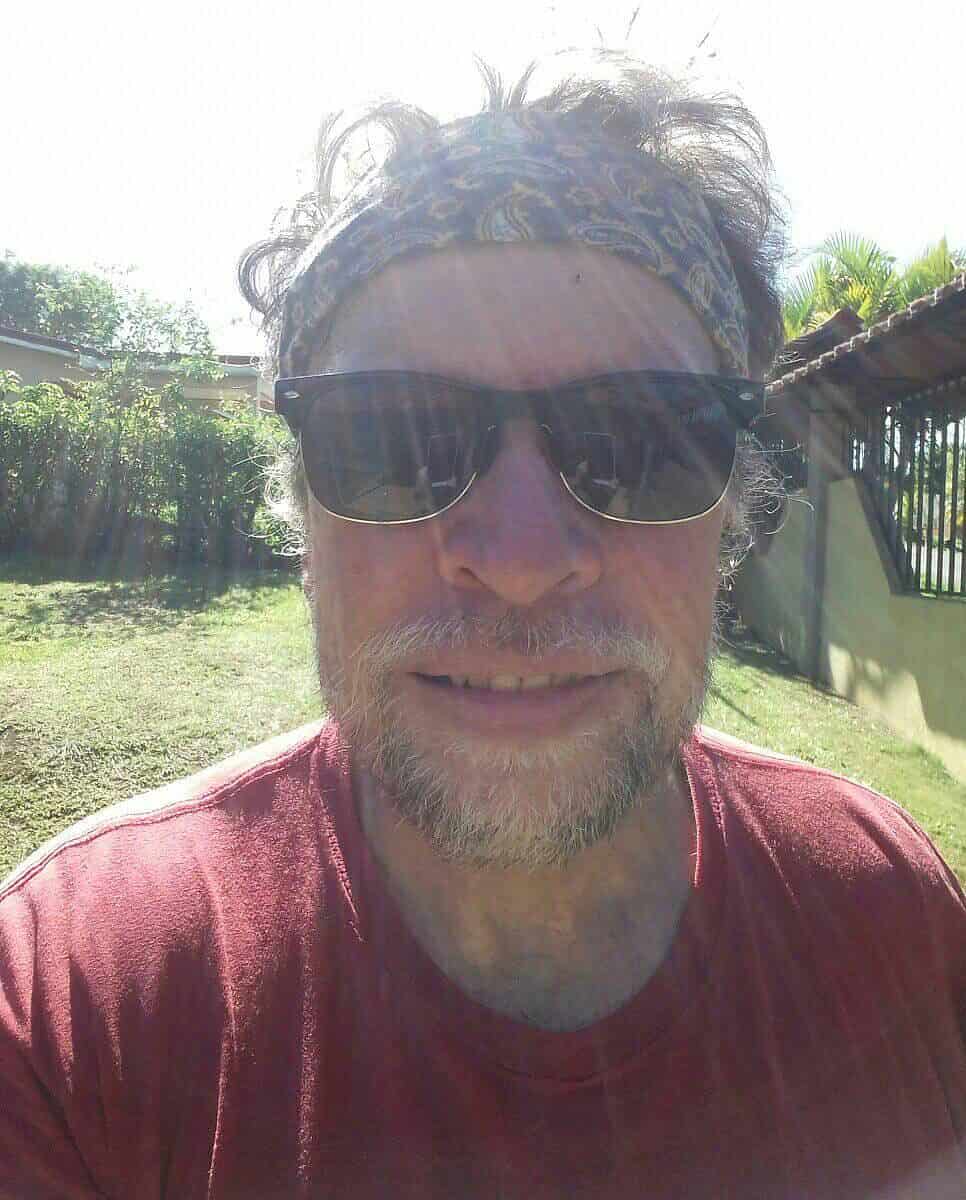
After 25 years of residency in Costa Rica, I became a temporary tourist. My cedula expired, and the caja and I are a couple million colones apart on what they say I owe. To keep my U.S. passport up to date and my status in the country legal, I made a border run. I bought two bus tickets—one to the border and a return ticket from the Panamanian city of David to San Jose. I put on a pair of Levi’s—the one pair of long pants I own, worn only when traveling—packed a few days’ worth of clothes, and caught a taxi to the bus station.
My assigned seat was soaking wet, which I discovered after sitting. I took the seat across the aisle and warned anyone who wanted to use the wet seat. We got to the border around noon. A light rain and gray sky greeted us. I had been here twice previously, in 1991 and 2011. Paso Canoas had not changed; it was grungy, a bit moldy, with narrow sidewalks and leaky gutters dripping water on passersby. On this overcast, drizzly Sunday, it seemed a sort of purgatory. I walked around for a few minutes, picking my way through shoppers, vendors, taxistas, and the assorted riff-raff common to many border towns.
I heard the moneychanger’s call of “dólares, dólares” for the first time in years. I had planned on using my debit card but decided once there that I wanted some cash. Neither ATM in Canoas had dollars. So, I paid my exit fee by focusing the camera on that techno-hieroglyphic block that I only recently learned how to use. My phone jumped to a website where I filled out all the information to pay the tax. Done. Not that many years ago, at Juan Santamaría airport, you lined up inside and waited for an open kiosk to pay the departure tax. Now, even here at the aging, gloomy aduanas building in Paso Canoas, technology reigned.
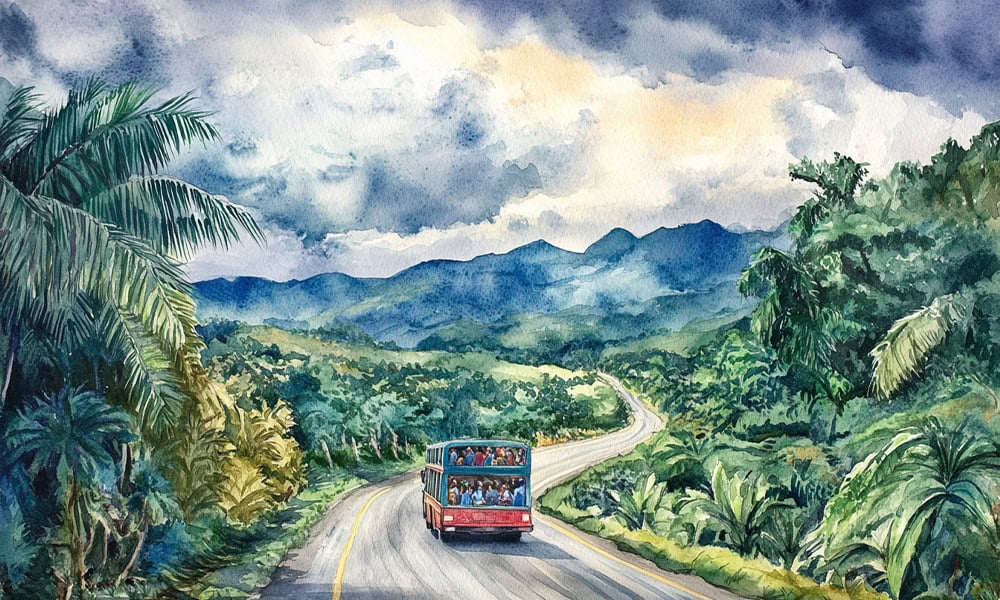
I got on a cramped $3 minibus that flew down the divided highway to a nonstop merengue soundtrack. Western Panama and southeastern Costa Rica share a common geography with tropical lowlands and gently rolling fincas to the south, and the ruggedly forested La Amistad International Park to the north. We arrived in David, a sprawling city of a couple hundred thousand, where I met with friends and spent the next three days nearby.
The usual first observations of Panama still ring true. The currency is the Balboa, though the only Balboas seen are coins. The U.S. dollar is the actual money. Reverse sticker shock is immediately evident. Gas stations sell gas at a bit over 80 cents per liter, less than two-thirds of the price in Costa Rica.
In the supermarket, the only items I saw priced comparably to Costa Rica were eggs, bananas, and coffee. Otherwise, the difference was striking—a block of cheddar cheese I pay the equivalent of $18 for in Costa Rica costs $10 in Panama. The same box of cereal was slightly over half the Costa Rican price. A big $26 jar of cashews in Costa Rica was about $18 in Panama. A six-pack of Heineken was half the price. And on and on.
No comparison between the two countries is complete, of course, without mentioning the highways. Everywhere I traveled in Panama, the roads were well-maintained, divided highways with two lanes each way. Oddly, the lanes were a bit narrower than is typical, at least in the David area. I took long walks each day and saw many small, modest cement houses with nice, late-model cars parked in the driveways. Many had two or three cars. Some of these houses had dogs—angry ones that barked and ran to the end of their short chain leashes as I passed.
A year ago, Panama was wracked by street protests over a mining concession. Protestors closed highways throughout the country. Things were so bad that people in the west of the country were making trips to the border with Costa Rica to obtain needed goods. At one roadblock, an elderly man killed two protestors. In all, the shutdown lasted about six weeks. Costa Rica now has a law against protestors closing highways, but when it was not illegal, the longest disruption I remember was two to three weeks in 2020. It was irritating, but goods and services still flowed. While tensions flared at many roadblocks, no one was killed.
During the pandemic, Panama had one of the strictest lockdowns. In what sounded like something inspired by a hardcore Islamic regime, men were allowed out three days a week, women on alternate days, and everyone was locked down on Sundays. Meanwhile, in Costa Rica, everyone wore masks, and there were some curfews and beach-time limitations, but life went on without the severity of restrictions inflicted on Panamanians.
I like Panama. It reminds me a bit of the U.S. in some places. It is cheaper and has better infrastructure. I am sure I will visit more down the road. But after three days, I returned home to Costa Rica with a new 180-day lease until the caja and I can come to terms.