
Panama’s President Laurentino Cortizo on Friday announced a ban on new metal mining concessions, but maintained a contract with a Canadian company that has sparked massive protests in the country.
In a televised address, the president said the government had issued a decree “declaring a ban on granting new metallic mineral concessions throughout the country.”
Cortizo made no mention of the controversial contract with First Quantum Minerals, the Vancouver-based company whose Caribbean copper mine sparked demonstrations over potential environmental impacts and in which protesters have clashed with police.
“All new metal mining applications and also those that are currently in process will be rejected outright,” the president said, adding that “this ban will be effective as of today.”
Cortizo, who signed the decree before television cameras, said he made this decision “taking into account the different positions of society in relation to the issue of mining.”
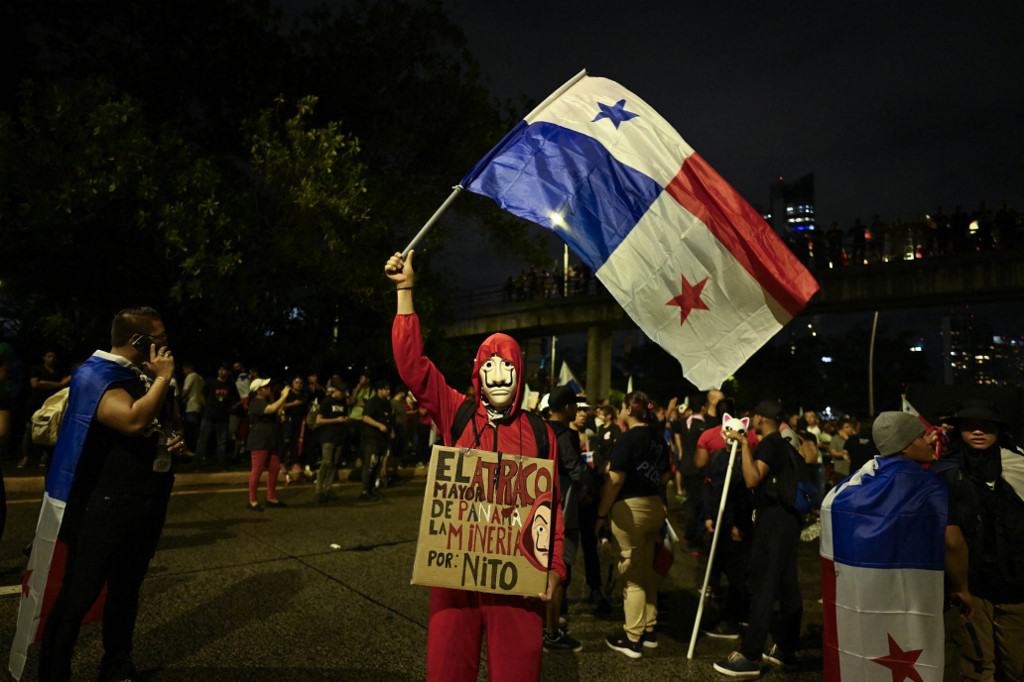
But his announcement did little to quell tempers at a protest by thousands of people that was taking place in the financial center of the capital even as he spoke.
They’re robbing you
Thousands of Panamanians marched again Friday to demand that the contract with the Canadian company, which operates the largest copper mine in Central America, be repealed.
“You who are watching, yes, they are robbing you too,” protesters chanted as they banged pots and pans and waved Panamanian flags.
The demonstrations began a week ago and have drawn thousands of people, an unusual occurrence in this country of 4.2 million inhabitants.
“The government has not been listening to us, it has used all means to repress us and to suppress information,” said activist and protest organizer Felipe Chon.
“The mine has been a bad deal for the nation, because of the ecological damage they have done,” said protester Alfredo Fonseca.
In the past week, the protests have grown, with street blockades set up in the capital and other cities, including some blocking the Pan-American highway that connects the country with the rest of Central America.
Schools were suspended all week and in some areas clashes broke out between stone-throwing protesters and police who fired tear gas at the demonstrators.
Protests intensified last Friday after Cortizo signed a bill establishing the mining contract. The demonstrators have been calling for that law to be repealed.
The Supreme Court had declared the original contract unconstitutional in 2017, but the government has argued that the new version sets out a minimum annual contributions from the mining company to the state of $375 million, 10 times the amount of the initial agreement.
In addition, the company and the government point out that the mine generates 8,000 immediate jobs and 40,000 indirect jobs, and will contribute four percent of the Panamanian GDP.
The contract allows the mining company to operate on Panama’s Caribbean coast for 20 years, with the chance to extend for another 20. Since February 2019, the open-pit mine has been producing about 300,000 tons of copper concentrate per year.