

No menu items!

COSTA RICA'S LEADING ENGLISH LANGUAGE NEWSPAPER

HomeTopicsEnvironment and WildlifeMeet Costa Rica’s Diving Lizard: The Anole’s Incredible Underwater Survival

Meet Costa Rica’s Diving Lizard: The Anole’s Incredible Underwater Survival

Costa Rica is home to thousands of unique animal species, many of which captivate scientists from around the world. Among these fascinating creatures is the anole lizard, a small, semi-aquatic reptile that inhabits the country’s lush rainforests.

Recently, Lindsey Swierk, an assistant research professor of biological sciences at Binghamton University in New York, conducted groundbreaking research on the remarkable abilities of these lizards, often referred to as “diving lizards.”

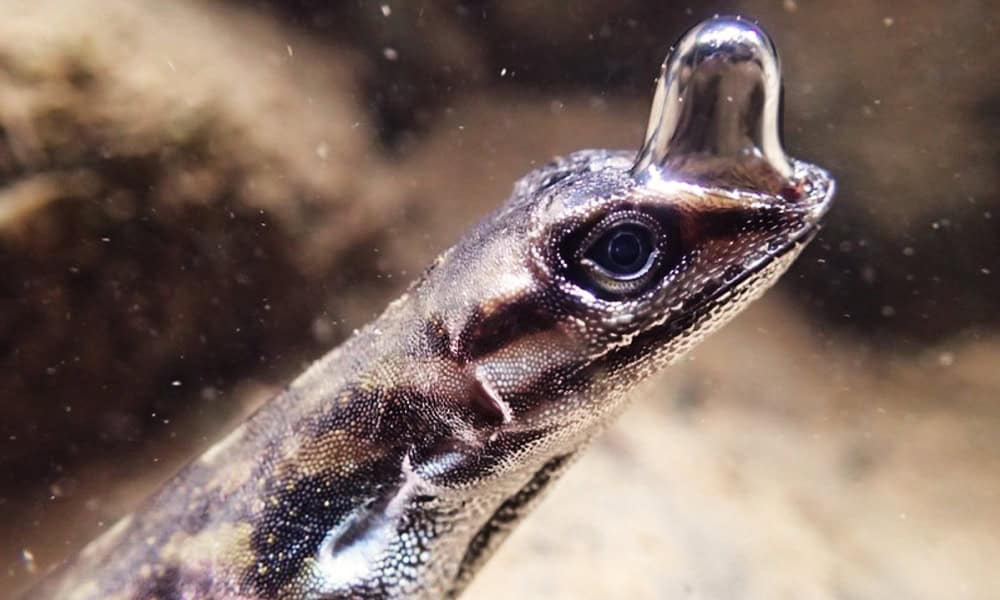
The anole lizard is known for its incredible survival tactics, particularly its ability to evade predators by diving underwater and using a bubble of air as a makeshift scuba helmet. This bubble, which forms on the top of the lizard’s head, allows the reptile to remain submerged for extended periods, making it nearly invisible to predators.

“Diving underwater and remaining there for a long time is an anti-predator strategy for water anoles. These lizards aren’t particularly speedy, and taking to the water is a very effective option. It’s easy to disappear from a predator’s eye once you hide underwater for a few minutes,” Dr. Swierk explained.

Dr. Swierk’s research captured this fascinating behavior in a video, showing the anole breathing out and re-inhaling air pockets while submerged. She first noticed this unique adaptation while walking along mountain streams in Costa Rica, observing the lizards dive and remain underwater for surprising lengths of time.

According to her findings, published in Biology Letters, the lizard’s bubble system may allow it to extract oxygen while submerged. Swierk theorizes that additional air pockets are trapped around the lizard’s head and throat, enabling it to exchange and refresh the air within the bubble—much like a scuba diver’s air tank.

Dr. Swierk conducted further experiments to test whether the bubble had a functional role in respiration or was simply a byproduct of the lizard’s skin properties. By applying a substance to the lizards’ skin that prevented bubble formation, she observed that those in a control group—able to form bubbles—could stay underwater 32% longer than those with impaired bubble production.

“This is the first experiment that truly shows the adaptive significance of bubbles. Rebreathing bubbles allow lizards to stay underwater longer. Before, we suspected it, but we didn’t actually test if it served a functional role,” Swierk added.

Swierk’s lab plans to conduct several types of follow-up research on the “bubble-breathing” observation.


Trending Now

Panama to Build Maximum-Security Prison to Isolate Gang Leaders

Panamanian President José Raúl Mulino announced plans to build a new maximum-security prison for gang leaders, placing Panama more firmly inside a regional shift...

Taylor Swift, Travis Kelce and the Costa Rica Sloths Named After Them

As Taylor Swift and Travis Kelce draw global attention around a reported wedding celebration at Madison Square Garden in New York, Costa Rica’s...

Costa Rican Travelers Get New Global eSIM Option

Costa Rican telecommunications brand kölbi has launched a new Global eSIM service with Airalo, giving travelers a way to buy international data packages before...

Costa Rica Bill Could Make Some Small Loans More Expensive

A government-backed bill moving through Costa Rica’s Legislative Assembly could make some small consumer loans more expensive by shifting them into a category that...

Costa Rica Geologists Call for National Plan as Illegal Gold Mining Spreads

Costa Rica’s illegal gold mining problem is no longer confined to the long-running Crucitas debate, the Colegio de Geólogos de Costa Rica warned, calling...

Costa Rica Carries Out Second Mass Deportation Flight

Costa Rica carried out its second mass aerial deportation of foreign nationals today, sending 26 people to Colombia and Ecuador in an operation...

Costa Rica Bull Shark Festival Highlights Tourism and Conservation

Playas del Coco will host the Festival del Tiburón Toro from tomorrow July 3 until Sunday the 5th, bringing researchers, divers, students, tourism businesses...

Bite Free, Naturally: Plant-Based Mosquito Repellents in Costa Rica

There's nothing worse than an itchy mosquito bite — except, in Costa Rica, what that bite might carry. With the rainy season in full...

Argentina Survives Cabo Verde Scare in World Cup Thriller

Argentina kept its World Cup title defense alive Friday night, but only after Cabo Verde pushed the defending champions to the edge in one...
🌴 The Weekly Pura Vida

Costa Rica, Once a Week

The week's top stories, weather & insider tips — delivered every Sunday. One email, zero clutter.

🔒 Free. No spam. Unsubscribe anytime.

Loading…

Latest News from Costa Rica

Costa Rica Coffee Maker Chorreador
Costa Rica Car Rentals
Costa Rica Travel Insurance
Costa Rica Travel


