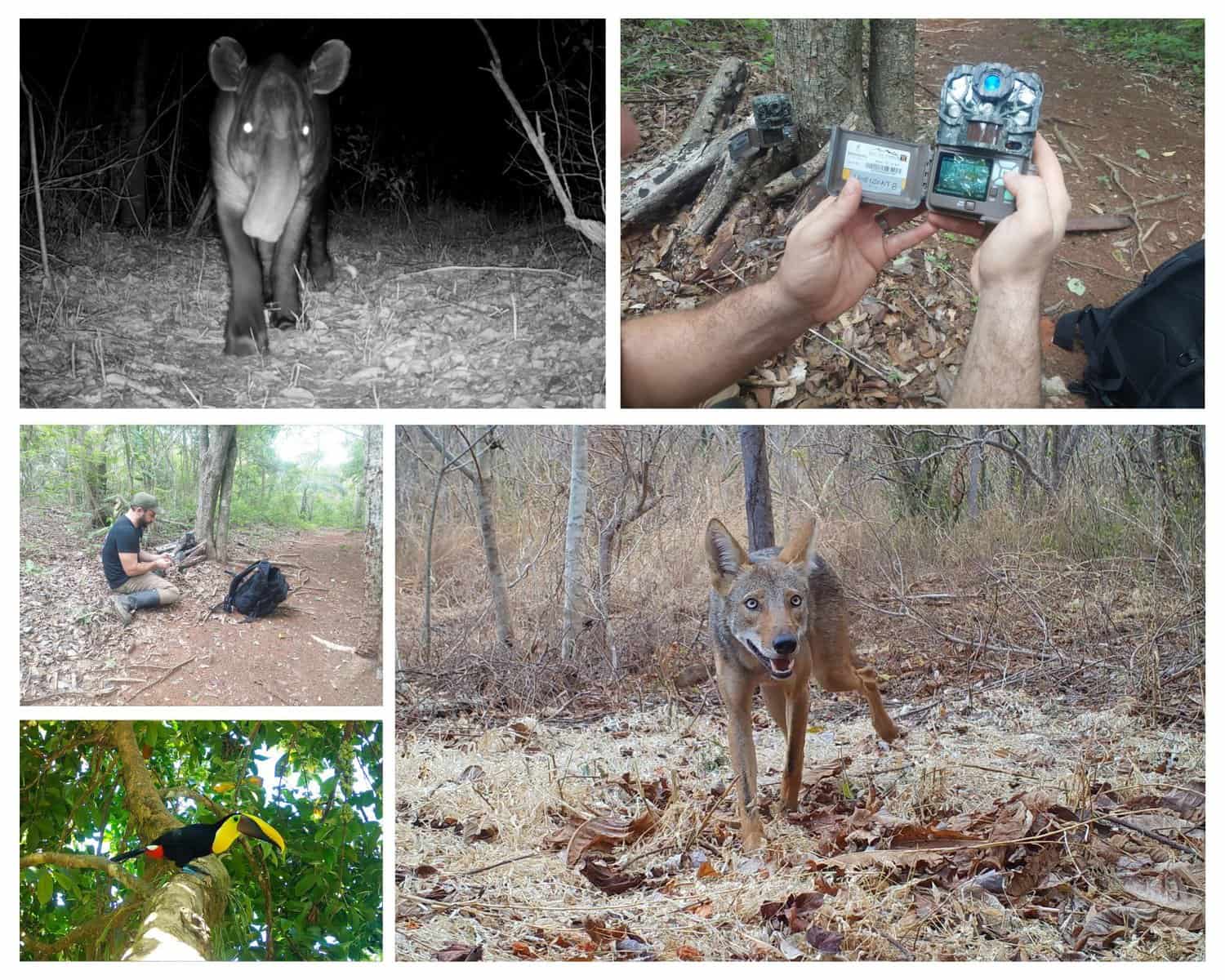
For five years now it has been my official job to confidently walk into the jungle, crash around looking for the best possible locations, strap a camera trap to a tree, and record the amazing biodiversity of Costa Rica. When people ask me what I do for a living and that is my reply they generally remark that it’s very interesting, take a moment to reflect, and then ask, “How did you get a job like that?” The short answer is, I made up. Here’s how it happened.
Upon completion of a graduate degree in environmental science and conservation in the States, my wife and I decided to upset our parents by moving to Costa Rica. With my shiny new credentials and a lifelong interest in wildlife, I set out to look for some sort of opportunity in the field of biology. I found what I was looking for in an opportunity to volunteer at a local wildlife rehabilitation and release center.
I contacted someone online and they assured me someone who spoke English would be there to greet meet me, and when I arrived two confused ladies said a lot of things that I didn’t understand in Spanish. I waved at them and got back in my car and drove away. I spent the next year studying Spanish and when I built up the courage to try again, I returned to the same place and met the same ladies, but this time, had the ability to actually communicate.
My foray into working with wildlife started in the form of a volunteer job at that center where I paid $10 a day to be allowed to rake leaves and cut up fruit. I stuck it out long enough and put forth enough effort that eventually the ten-dollar fee was waived. After a year or more I earned a part-time position caring for the center’s resident animals and working with the staff to rehabilitate and release the animals that had a chance of returning to the wild. With time and effort, that position was eventually expanded to full-time.
In some situations while working to rehabilitate certain species of wildlife, a camera trap was useful in providing me with information that I wasn’t able to sit around and record for myself. When I didn’t have a specific use for the cameras in the rehabilitation process, I started placing them in the forest of the grounds of the rehab center. I became hooked immediately.
Every chance I had, I’d grab a machete and hike into the forest and review the camera traps that I was slowly learning how to use properly. Even on the modest-sized chunk of forest I was monitoring, I was recording a wide variety of different species. At the same time I was seeing all sorts of interesting behaviors that you never get to see if you happen upon a wild animal while out for a hike.
Everyone who I showed the footage to absolutely loved it and when I started posting videos to social media the response was immediately large and positive. It was at this point that I started wondering if there was a way that I could make wildlife monitoring with camera traps into a real job.
After some research it became clear that the only people who were paid to work with camera traps were PhD candidates and professors. So in order for me to work with camera traps in Costa Rica, which I was already doing to some degree, I had to move to the US and get a degree that I didn’t really want in order to move back to Costa Rica with official permission to do what I wanted. Instead, with the go ahead from a very supportive wife, I created Guanacaste Wildlife Monitoring, an organization that provides wildlife monitoring with camera traps as a service.
Creating a camera trapping organization is all well and good, but it doesn’t mean much without someone interested in hiring you. My first opportunity came in the form of a biologist friend who had been working on an environmental education program with my wife’s non-profit. She had been contracted by a wildlife refuge to make a ten-year plan and she thought the best way to gauge the current biodiversity of the refuge was with camera traps.
After I had my first contract under my belt, my wife worked with me to find more opportunities. Slowly but surely different opportunities to work with private farms, national parks, schools, expat communities, hotels, and large-scale farms have arisen over the years. It has been extremely difficult, but what thing worth doing in life is easy?
So, there you have it. That’s how I started my wildlife monitoring organization. When people find my work interesting and ask how they could do something similar, I have no good answer. I suppose you could just get some sort of related education, move to another country, learn a new language, volunteer, work, and make up an organization that doesn’t exist otherwise. Easy peasy.
About the Author
Vincent Losasso, founder of Guanacaste Wildlife Monitoring, is a biologist who works with camera traps throughout Costa Rica. Learn more about his projects on facebook or instagram. You can also email him at: vincent@guanacastewildlifemonitoring.com