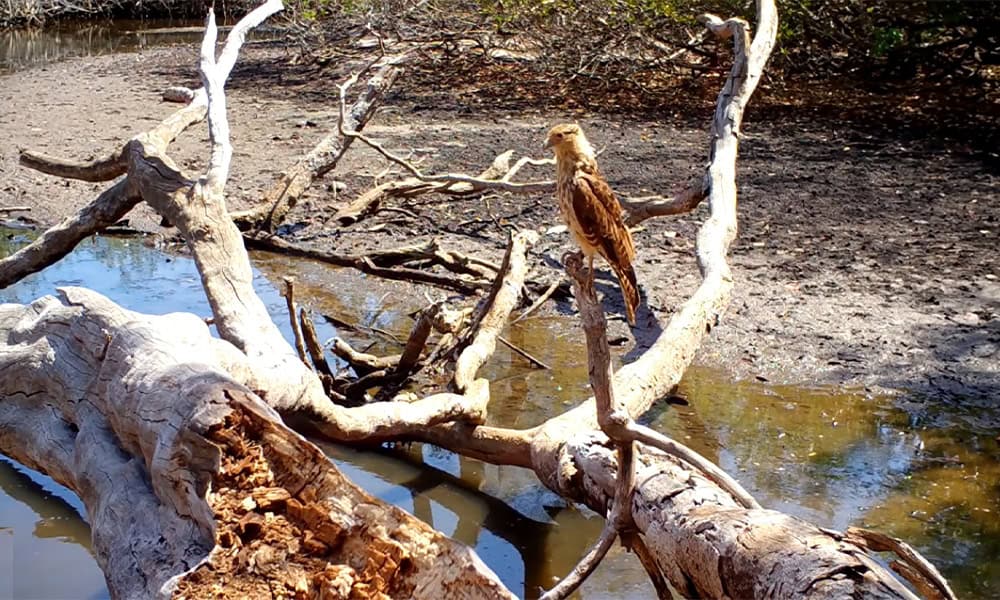
Today we meet the yellow-headed caracara, a fairly new resident of Costa Rica that has an intimate relationship with another, far larger species of wildlife.
The yellow-headed caracara (Milvago chimachima) is called the caracara cabecigualdo in Spanish. These are small, lightly built birds of prey. Their wings are dark brown and the rest of their body is a creamy white. They have light-colored legs and beaks, some orange around the eyes, and a dark streak emanating from the back of the eye.
Yellow-headed caracaras prefer open habitat. They’re found in savannas, agricultural land, pastures, forest edges, and around rivers. They are absent from heavily forested areas. This habitat preference is directly related to this species’ arrival and distribution throughout Costa Rica over time. Yellow-headed caracaras were first recorded in southern Costa Rica in 1973 as forests were being cleared around the Golfo Dulce. Over time they slowly moved northward along the Pacific coast taking up residence where forests had been cut.
They were recorded about halfway up the Pacific coast in Parrita by 1979 and by 1984 they were recorded on the Nicoya Peninsula. They seem to be continuing their territorial expansion to this day, with a report of an adult being spotted in Limon in 2018.
Yellow-headed caracaras are an omnivorous species feeding on a wide array of living and non-living items. They are perfectly capable and willing to hunt, taking fish, frogs, birds, small mammals, worms, and arthropods. They are also very happy to eat a meal that they don’t have to track down and kill themselves, like any sort of carrion that they can find or horse and cow feces. They also eat an item that is rare among birds of prey, ticks that are still attached to other animals.
Nine or ten years ago I was working at a wildlife rehabilitation and release center under the tutelage of a wild, older Finnish guy named Mika. Mika is a wildlife professional with years of experience working in zoos in the United States. It’s safe to say that he’s forgotten more about wildlife than I’ll ever learn.
That being said, he stopped me one day and showed me a picture of something that he’d never seen before from his recent trip down to Osa in southern Costa Rica. The photo was of a Baird’s tapir laying on the beach with a yellow-headed caracara standing on its back. He said he had watched the bird groom the tapir for quite some time.
I stocked that little piece of information in my head because it was the only fact I had learned about yellow-headed caracaras to that point. As the years passed, I started noticing pictures popping up on social media of yellow-headed caracaras perched on Baird’s tapirs. My very unscientific conclusion was, ‘Huh, that must be a thing.’
Well, after some looking into it, I’m pleased to announce that it is, indeed, a thing and somebody published a letter about it in a scientific journal. Over a five-year period the researchers personally documented three occasions of yellow-headed caracaras cleaning ticks off of Barid’s tapirs and discovered eight more instances that other people had documented by searching through wildlife photos on social media (We must have similar social media feeds.).
In scientific terms, this interaction is called cleaning symbiosis. In cleaning symbiosis, one animal, the cleaner, consumes parasites, necrotic tissue, or mucus from the other animal, the host. In this case, the yellow-headed caracara is the cleaner who is consuming ticks from the host, a Baird’s tapir. This interaction is a win for both species.
The caracara gets a blood-filled meal, and the tapir gets to shed some parasites. The tapir goes so far as to flop around in different positions to allow the caracara access to all of the ticks hidden in the creases of its substantial body.
I personally have not witnessed this amazing interaction, but I have come across some yellow-headed caracaras out in the world. Instead of participating in cleaning symbiosis, the ones I’ve seen were mostly sitting around. These birds are not a frequent character in my camera trap videos, but I have recorded them a few times. I’m happy to share a few of the best clips in the video below.
About the Author
Vincent Losasso, founder of Guanacaste Wildlife Monitoring, is a biologist who works with camera traps throughout Costa Rica. Learn more about his projects on facebook or instagram. You can also email him at: vincent@guanacastewildlifemonitoring.com