

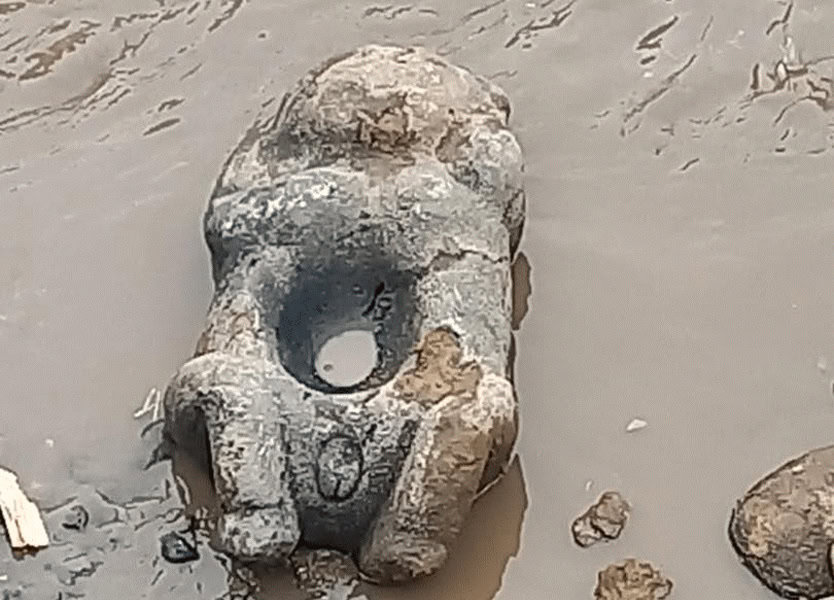
Over the weekend, a hidden archaeological treasure was found in Agua Caliente, in the province of Cartago. The discovery was made when personnel were carrying out work in Quebrada El Molino due to the risk of overflow and the potential impact on homes.
According to Ifigenia Quintanilla, Director of the National Museum, the machine operator and other municipal workers discovered a stone sculpture near a slope in El Molino Creek. Immediate communication was established thanks to a group of nearby neighbors—some closely linked to the care and protection of the Agua Caliente Archaeological Monument—who were present where the machinery was operating.
“From the photographs, it was determined that it was a pre-Columbian sculpture and, therefore, needed to be recovered and cared for,” said Quintanilla.
The recommendation was to collect the piece and keep it safe so that no one could take it for personal use. Thus, the piece was taken to the municipal campus. Subsequently, it was moved to the National Museum to be cleaned and catalogued.
“The finding of this sculpture is very relevant because it corresponds to a female figure, which has a slit in its belly. In different parts of the Caribbean region, and in the same archaeological site of Agua Caliente, similar sculptures have been found,” added Quintanilla.
The mayor of Cartago, Mario Redondo, was among the officials who announced the discovery of the piece. Redondo mentioned that they are working on the development of the Agua Caliente Archaeological Center in the same place. This would focus on the historical and touristic significance of the region.
Agua Caliente is a very important site. Infrastructure such as mounds and causeways has been found there, as well as ceramics, vessels that came from Guanacaste, stone sculptures, and gold jewelry. Its occupation has been recorded over 2,000 years through villages of both natural and agricultural exploitation. During the pre-Columbian era, daily life and ceremonial acts took place there. The tombs have been key to investigating details of the original inhabitants.





