
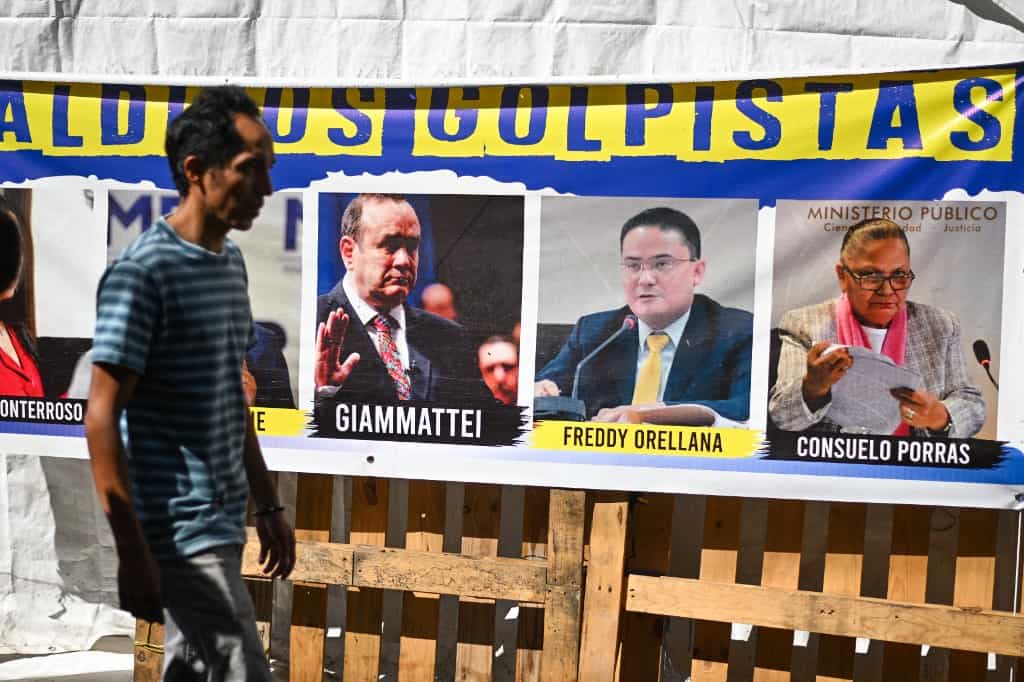
Bernardo Arévalo never had his inauguration as president of Guatemala secured this Sunday. For months, he faced a judicial onslaught attributed to the country’s powerful economic and political elite with one purpose: to perpetuate corruption.
Carried out by the Prosecutor’s Office, the offensive sought to remove his immunity, managed to suspend his Semilla party, and tried to annul the election results due to alleged electoral anomalies.
Arévalo asserts that it was a “coup attempt” motivated by his promise to pursue the corrupt, with which, against all odds, he won comfortably in the second round in August.
Analysts and humanitarian activists point out three keys to understand the magnitude of the problem:
A predatory elite
Inheriting from the oligarchy that emerged in the colonial era, the Guatemalan elite is considered one of the most “predatory” on the continent, according to former Human Rights Prosecutor, Jordán Rodas, exiled in Washington.
With 60% of its 17.8 million inhabitants in poverty, Guatemala has “one of the highest inequalities in Latin America, with a neglected population, mostly rural and indigenous, and employed in the informal sector,” noted a World Bank report in October.
According to a 2019 Oxfam International report, the richest 1% in Guatemala “has the same income as half of the population.” In Guatemala, with a high concentration of fertile land in few hands, the most powerful families, like the Castillos, the Bosches, the Novellas, or the Herreras, own sugar mills, coffee plantations, breweries, real estate, and banking businesses.
“It is a predatory elite, co-responsible for the rampant corruption of recent governments and for migration because starvation wages expel Guatemalans from the country,” commented Rodas.
For that elite, the State is not “to achieve the common good, but to enrich themselves, without satisfying their greed,” added the former prosecutor (2017-2022).
“They support each other because they want a State that does not collect taxes or apply labor or environmental regulations,” added Manfredo Marroquín, co-founder of Acción Ciudadana, the local version of Transparency International.
The corporate dictatorship
Created in 1957, the Coordinating Committee of Commercial, Industrial, and Financial Associations (CACIF) brings together the conservative business elite. “It is the real power that rules the country’s destiny,” Carmen Aída Ibarra of the ProJustice citizen movement told AFP.
With a State weakened by the civil war (1960-1996), the economic, political, and military elites, according to analysts, wove a web of corruption of such dimensions that it led the UN to get directly involved with the International Commission Against Impunity in Guatemala (CICIG), established in 2007.
In 2015, CICIG and the prosecutor’s office discovered a bribery network involving then-president Otto Pérez, who had to resign and went to prison, from which he was recently released on bail.
They also pointed to political parties for illicit financing in the 2015 elections with money from large businessmen and organized crime, affecting Pérez’s successor, Jimmy Morales.
In 2017, congressmen approved reforms that sought to shield political leaders from those accusations, sparking protests that forced them to retract. Protesters dubbed this the “pact of the corrupt.”
“It is the conspiracy of politicians, officials, and several elite businessmen with a perverse intention to perpetuate themselves in power as a corporate dictatorship, which has nothing to do with ideology,” explained Rodas.
The realm of impunity
Morales expelled CICIG in 2019 and appointed Consuelo Porras as the new attorney general, who was ratified in her position by the current outgoing president Alejandro Giammattei, pointed out by the previous prosecution in a case of bribes that did not prosper.
Porras, sanctioned by Washington for being considered corrupt, is accused of leading the criminal prosecution against Arévalo. With CICIG gone, Claudia Paz y Paz, the former prosecutor exiled in Costa Rica, said “they co-opted” Courts, Prosecution, Congress, Executive, Comptroller “placing officials who, in alliance with part of the economic elite,” act to “guarantee impunity.”
“They put judicial hitmen who build cases against journalists or officials who denounce corruption. They have deputies who pass laws under bribery, and prosecutors who are the tool of persecution,” Marroquín claimed.
According to Edie Cux, director of Acción Ciudadana, “several of these traditional power groups even have links to organized crime.” Out of 180 countries, Guatemala ranks 150th (from least to most) in Transparency International’s corruption index.
For Marroquín, the elite’s “agenda” is “clear”: “to continue in a state of total corruption and impunity, which is the oil that greases the entire political and economic system of the country.”
“It is a thousand-headed monster,” illustrated Rodas.