

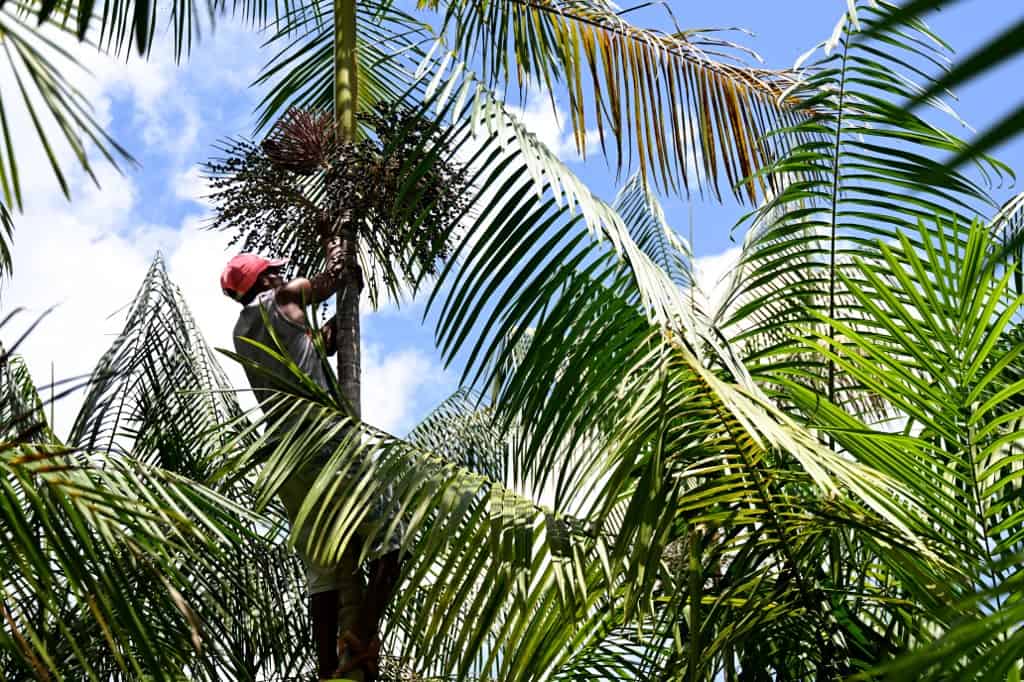
Under the oppressive heat of the Amazon summer, Brazilian Jose Diogo climbs a palm tree nimbly and cuts a cluster of black fruits: the açaí harvest is beginning, the livelihood of his community descended from Afro-Brazilians who were once enslaved.
The açaí boom has economically benefited traditional producers in the Amazon, but at the same time threatens the biodiversity of the tropical jungle due to increased monoculture.
The village of Igarapé São João, 120 km south of the city of Belém (Pará, north), is a rural hamlet on the banks of the Itacuruçá River, an area of floodplains where açaí grows naturally.
“When the harvest starts (from August to January), things get a lot better for us,” says 41-year-old Diogo, who thanks to his work managed to start building his house.
The community is located in Abaetetuba, the fifth municipality with the largest “quilombola” population in Brazil, as descendants of runaway slaves from the 17th and 18th centuries are called. Abaetetuba has become an important hub for açaí in the state of Pará, which concentrates more than 90% of Brazilian production.
Diogo scrapes the cluster and lets the fruits fall into a basket. On a good day, he explains, he manages to fill 25 14 kg baskets, which he sells for between 12 and 25 reais each (2.4 to 5 dollars).
Intermediaries buy the fruits from the community and take them by boat to the great Amazonian city of Belém, to sell them no later than the next day at the century-old Ver-o-peso market and prevent the fruit from perishing.
Every dawn, there is great bustle next to the pier: dozens of sweaty men unload the fruits from the boats to sell them to pulp, juice and other derivative manufacturers.
“On a night when all our customers come, I earn between 250 and 300 reais (between 50 and 60 dollars),” says 30-year-old Maycon de Souza, after stacking three baskets on his head and two more wedged on his right shoulder: 70 kg in total.
Açaization of the Amazon
Of indigenous origin, pure açaí has always been part of the diet of Pará natives, who enjoy it along with fried fish and other local dishes.
Due to its nutritional and antioxidant properties, in the last two decades it has become popular as a “superfood” in Brazil and countries such as the United States and Japan, which import it to make juices, shakes and desserts with granola and fruits.
This has driven up demand and benefited local producers, placing açaí as an example of “bioeconomy,” which allows generating income for Amazon inhabitants without deforestation.
But studies show that expansion is causing biodiversity loss in some regions due to replacement of other species.
“Naturally, some 50, 60 or up to 100 açaí plants grow per hectare (…) When it goes past 200, 60% of the diversity of other native species of floodplains is also lost,” as told by biologist Madson Freitas, a researcher at the Emílio Goeldi Museum of Pará, author of a study on this phenomenon, called “acaization.”
The loss of plant species even affects açaí, which becomes less productive due to the loss of pollinators, such as bees, ants and wasps, adds Freitas.
Prolonged drought periods, which may intensify due to climate change, also affect fruit development.
Environmental service
Freitas, himself originally from a quilombola community in Pará, believes that strengthening conservation rules and oversight can help combat monoculture. But it is necessary to give producers incentives to “keep the jungle standing,” he points out.
Salomao Santos, leader of the Malungu organization, which represents quilombola communities in Pará and community leader of the village of Igarapé São João, admits that monoculture “can become a problem.”
“Those of us who live in the Amazon do not live on a single species,” says this man, who fears that açaí will cease to sustain them, as already occurred with the economic cycles of sugar cane, rubber, and pottery.
Brazil’s quilombola communities – which according to the census number 3,500, with around 1.3 million people – often feel invisible in the eyes of society.
“We provide a great environmental service to the world, preserving” the jungle, indicates Santos. “Now we want the State and all those who benefited from the sweat and blood of those who were enslaved, to pay their debt to us.”





