
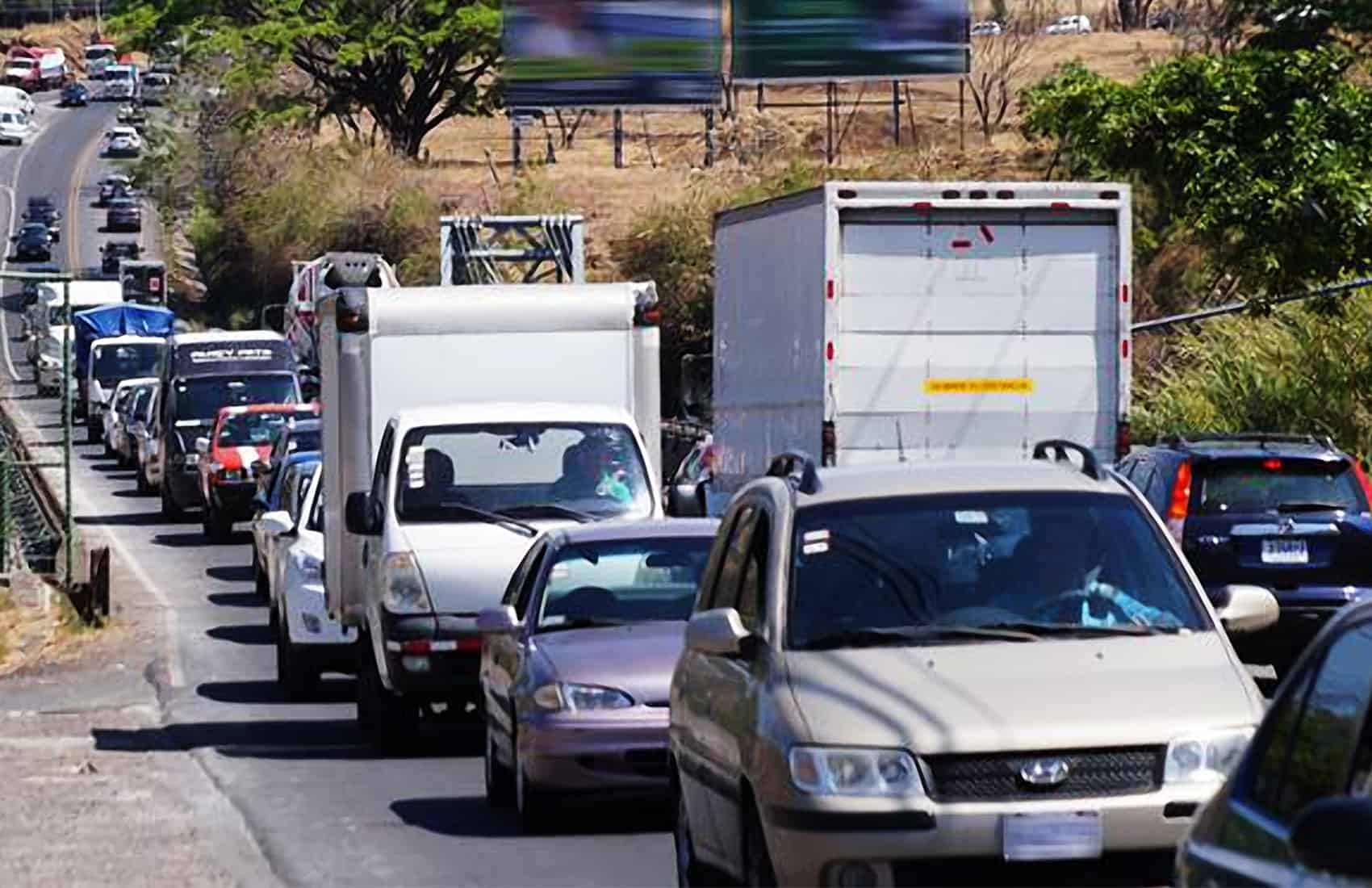
Costa Rica is ranked as the second-worst traffic in the world in Numbeo’s 2026 Mid-Year Traffic Index, placing behind only Nigeria and ahead of far larger countries known for severe urban congestion. It received a Traffic Index score of 301.0, compared with Nigeria’s 320.3. Sri Lanka ranked third with 254.5, followed by Bangladesh, Kenya, Egypt and Peru.
Costa Rica recorded an average one-way commute of approximately 60 minutes, the second-longest among the countries included in the ranking. Nigeria’s average was nearly 64 minutes, while Sri Lanka registered just under 54 minutes. The results place Costa Rica at the top of the traffic ranking for the Americas by a wide margin.
Peru finished second in the region with a Traffic Index score of 225.7, followed by Colombia with 196.0, Argentina with 177.8 and Mexico with 174.5. Numbeo calculates its Traffic Index using reported commute times, dissatisfaction with the amount of time spent traveling, estimated carbon emissions and the overall inefficiency of the transportation system. A higher score indicates more difficult traffic conditions.
The platform’s figures are based on information submitted by users rather than official traffic sensors or a comprehensive government study. The rankings should therefore be treated as a broad comparison of commuting experiences, rather than a precise measurement of every road and region in the country.
Even with that limitation, the results closely match the daily experience of drivers and public transportation users in Costa Rica’s Greater Metropolitan Area, known as the GAM. San José also placed second in Numbeo’s worldwide city ranking. The Costa Rican capital recorded a Traffic Index score of 327.6 and an average one-way commute of 63.3 minutes.
Only Lagos, Nigeria, ranked higher, while San José finished ahead of Los Angeles, Sharjah, Colombo, Delhi and Mexico City. The Costa Rica data indicates that private cars remain the main form of transportation to work or school, accounting for about 57% of reported trips. Buses represented approximately 18%, while only about 2% of respondents reported using trains as their primary transportation.
Those numbers underline one of the central mobility problems: a growing number of vehicles moving through a limited road network while public transportation remains fragmented and poorly integrated. A recent study presented by Costa Rica’s Road Safety Council, known as Cosevi, found that up to 90% of roads in San José, Tibás, Curridabat and Montes de Oca experience severe congestion during peak travel periods.
Average vehicle speeds in the metropolitan area were reported at approximately 12 kilometers per hour (7.5 mph) during the morning rush and 9 kilometers per hour (5.6 mph) in the afternoon. In some communities, afternoon traffic moved at only 6 or 7 kilometers per hour (3.7 to 4.3 mph).
Buses are also caught in the same congestion, frequently traveling at between 6 and 8 kilometers per hour (3.7 to 5 mph). That reduces the appeal of public transportation and encourages more commuters to use private vehicles, adding further pressure to the roads.
Costa Rica’s National Laboratory of Materials and Structural Models (Lanamme), has described the transportation situation in the GAM as a structural crisis. Earlier this year, the laboratory recommended treating road congestion as a national emergency to speed up improvements to public transportation and mobility planning.
Proposals discussed by transportation specialists include reorganizing bus routes, creating integrated fares, expanding urban train service, improving real-time passenger information and coordinating the government agencies responsible for roads and public transportation. Telework, flexible schedules and staggered starting times have also been proposed as ways to reduce the concentration of vehicles during the morning and afternoon rush hours.
For anyone who drives here, the Numbeo ranking provides international context for a problem that already shapes daily life. Long commutes affect productivity, increase fuel and transportation costs, worsen air pollution and leave workers with less time at home. Without major improvements to public transportation and long-term planning, the second-place ranking is unlikely to feel surprising to anyone regularly traveling through the metropolitan area.