

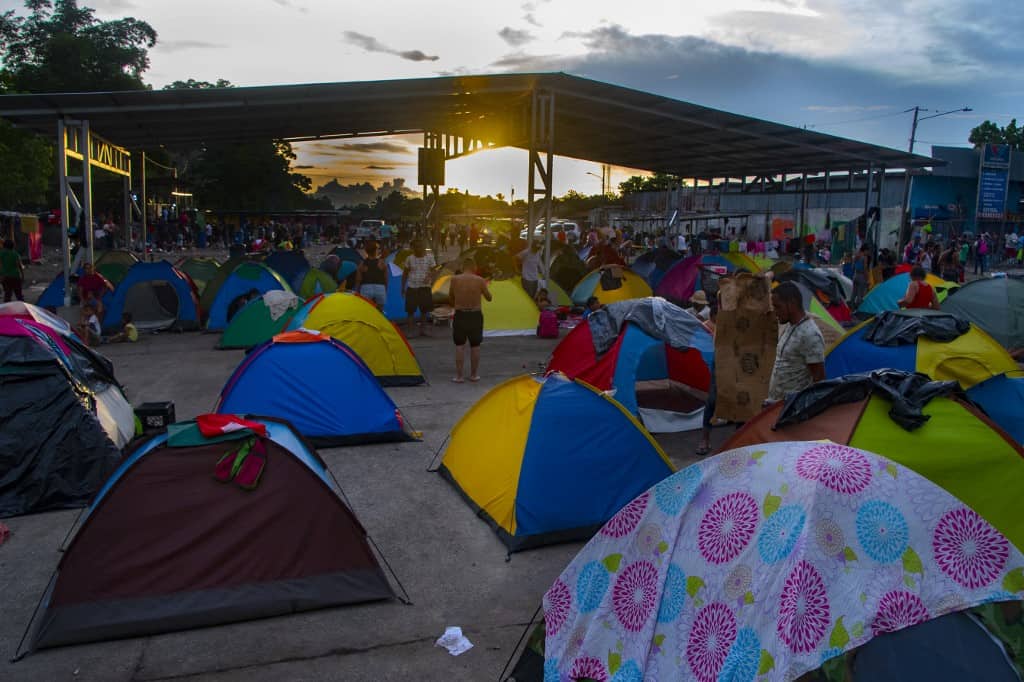
An abandoned airfield now houses a miserable camp with thousands of migrants who crossed from Panama to Costa Rica and were stranded lacking $30 to continue towards the United States.
Paso Canoas, the main border crossing between Panama and Costa Rica, has become a crossroads for migrants: those who have money only stay a few hours in the place and those who do not have money see their “American dream” become a “nightmare.”
“The 22 days I’ve been here have been hell for me because my children have been sick, we’ve been hungry because we haven’t had money, we can’t even go out to beg, even though we can’t go out to work,” said Venezuelan José Toro in dismay.
The 25-year-old migrant sees 50 yellow and green buses leave the mud-filled camp every day heading to the border with Nicaragua. It is a 350-kilometer route through the Inter-American Highway, which takes nine hours.
The bus ticket costs $30 per person, whether adult, child or baby, a non-negotiable fare that many migrants cannot afford. “If we had the opportunity and the money to move forward we wouldn’t be stuck here,” comments Toro.
Some spent what little they had when crossing the dangerous Darién jungle between Colombia and Panama. Others were robbed or extorted by criminal gangs operating in the area and lost every last dollar.
A record of more than 248,000 migrants have crossed the inhospitable Panamanian jungle so far this year, more than in all of 2022, according to the Panamanian government.
Of these, just over 204,000 have entered Costa Rica through Paso Canoas after traveling almost 1,000 kilometers through Panamanian territory, according to official figures.
The Camp
Upon entering Costa Rica, migrants are sent to the dreary camp.
It was the site of a former community fair and has served as an improvised solution since May. The Costa Rican government enabled it in response to complaints from neighbors and merchants in the town of Paso Canoas about the hundreds of destitute migrants wandering the streets.
This is a binational town. One portion belongs to Panama and the other to Costa Rica. The people of the Costa Rican area complain about the dirtiness and insecurity generated by the presence of migrants, mostly Venezuelans, Ecuadorians and Haitians.
But the migrants also complain about the ordeal they experience in Paso Canoas. “We are suffering,” said Venezuelan Daniel Serrano, stranded since August 2.
“We came looking for a better dream, but unfortunately we have found a nightmare because no government agency is helping us,” adds this 42-year-old social worker.
The camp has just half a dozen filthy bathrooms surrounded by garbage. About 10 square meters of corrugated metal roofing save the lucky ones who planted their small tents underneath. The rest suffer from the more than 30 degree Celsius heat and daily downpours that flood the ground.
Help us
Four police officers, inside two air-conditioned patrol cars, guard the improvised ticket booth where the coveted bus tickets to continue to Nicaragua are sold.
A few hours a day the Costa Rican Red Cross provides first aid care on site. “They have many injuries on their feet, wounds, we find many swollen, ulcerated feet. There are many stomach problems due to the water they consume along the route,” said Daniel Picado, coordinator of the Red Cross team.
The volunteers clean the muddy face of a girl about 10 years old with water, who smiles as she is tended to. Dozens of other children scamper and play as best they can in the camp, while adults cry out for help.
“Help us, find us a solution!” said Venezuelan Yadira González.
“The idea is that there has to be security, people to care for us, medicine for children and for them to pay attention to us as human beings,” adds the 40-year-old mother of three.
Keep moving forward
Central American governments are managing the growing migratory flow as best they can, while the United States warns that travelers who arrive “irregularly will be processed and returned quickly to their country of origin.”
The migrants have their own plan: “keep moving forward, never backwards,” said Venezuelan Katiuska Pérez, a single mother who arrived with her four children on July 19.
“The worst part I already went through, which was the jungle (…), I have to keep going forward with my children, I have to give them a future,” says the 28-year-old woman.
“The idea is that there has to be security, people to take care of us, medicine for children and for them to pay attention to us as human beings,” she adds.





