
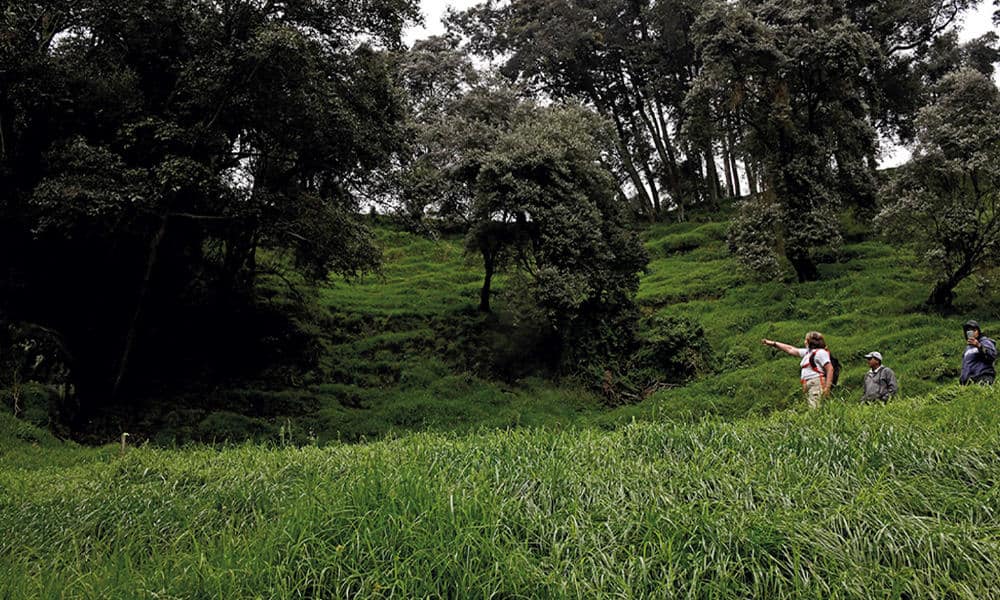
According to the University of Costa Rica, in February 1952, on the slopes of the Irazú volcano, the Retes Archaeological Site was accidentally discovered in the Retes Hacienda.
Numerous stone and organic objects were discovered, such as drums, wooden sticks, and a fragment of cotton fabric, due to a landslide near the Pavas stream.
This year marks the 70th anniversary of this exceptional discovery, and a new interinstitutional and interdisciplinary study came to light, providing new scientific evidence of this site.
Farm workers doing their daily duties at Alfredo Volio’s family estate found the Retes Archaeological Site.
Later, an official investigation was conducted. The first scientific investigation was carried out by Carlos Aguilar Piedra, the first archaeologist in the country, who led an excavation at the site. He recovered 175 new pieces and more than a dozen that the locals had looted before his arrival. These artifacts are safeguarded in the National Museum.
Currently, pastures, some patches of forest, and areas of tourist interest predominate in the zone.
According to the researchers, ancient lava flows from the Irazú volcano and into the site. In fact, the land is covered with a thick layer of volcanic ash.
The volcanic soil preserved the site and even protected wooden objects, which remained untouched.
These acidic soils helped protect the wood from agents such as bacteria, fungi, and insects, as well as from the environment and other chemical actions. In addition, some woods were hard and resistant to weathering processes or insects.
Carolina Cavallini, archaeologist and curator of the Carlos Aguilar Piedra Archaeology Laboratory and another of the participants in the research, explained that it is not common to find wooden objects in an archaeological excavation because it is challenging to preserve them.
For Cavallini, there was likely a connection between Retes and Alto del Cardal, another archaeological site discovered one kilometer away and in the Cartago valley.
The Retes Archaeological Site was built during the late pre-Columbian period (800 A.D. to 1500 A.D.) and is contemporary to Guayabo de Turrialba and other sites in the Caribbean.