

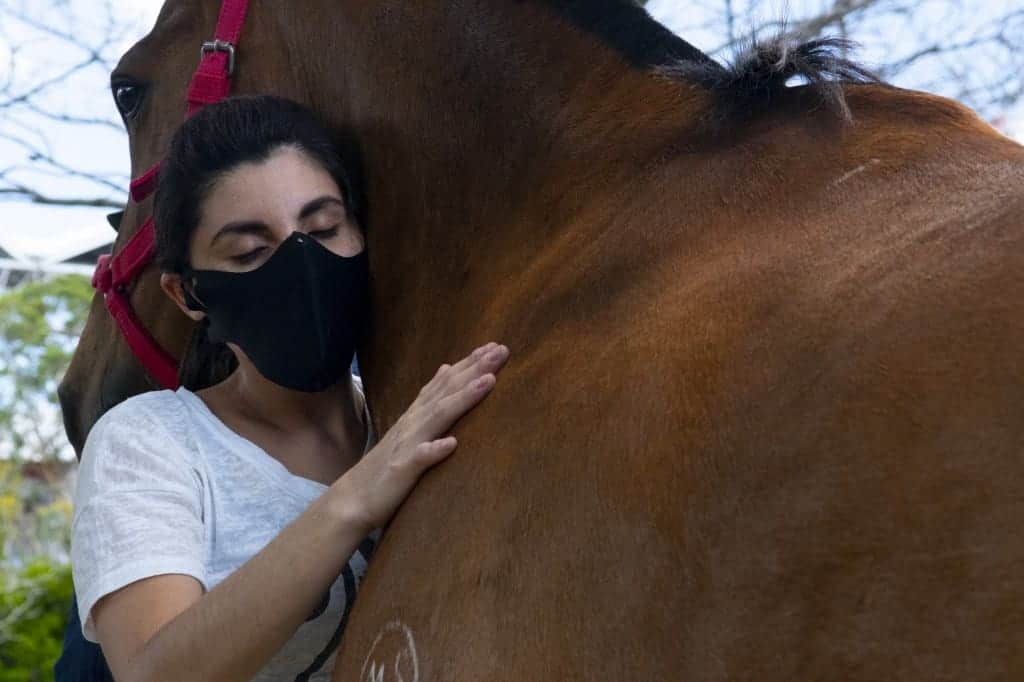
When María Lourdes caresses the shiny brown coat of “Presidente” in a park in Costa Rica, an energy travels through her body and explodes in her face in the form of a smile. The horse has managed to jump the fence to help treat her cerebral palsy.
“Presidente,” along with “Jorge,” “Porky” and “Palomo” await their patients in the Parque Metropolitano La Sabana de San José. The so-called equine therapy, each 45 minutes, is held once a week.
There are four American Quarter Horses that are members of the Costa Rican Mounted Police.
“They have training in meekness and are trained so that they are not disturbed by the noise, they are very sensitive, docile,” says the head of the Mounted Police, Mayor Víctor Porras.
“With our horses, we contribute to the most needy, bringing them a smile, a hope. (…) We work with children, with the elderly, people with disabilities, totally free,” he says about this project that began in 2020.
Equine therapy is an increasingly widespread therapeutic technique that takes advantage of the horse’s movements and energy to support the treatment of various ailments.
“We give people strength, raising that emotional potential they have, because they are frustrated, psychologically damaged, in a society that often turns its back on them. We work to lift their spirits,” Porras explains.
Her smile is worth it
Helped by two officers, María Lourdes walks to meet the horses. She is 18 years old and was born prematurely. A respiratory arrest a few days after arriving in the world caused cerebral palsy.
During her life, learning and socializing have been difficult, says her mother, Isabel. Through relatives, she learned about equine therapy and decided to try it.
“She did not have much affinity with animals. When she felt contact with an animal of any kind, it made her nauseous (…) What a surprise that (upon arriving at therapy) María Lourdes did not have nausea, she happily played with the horses, and with the policemen,” says her mother.
She has been attending therapy for two months. She rides the horse, hugs it, and interacts with the policemen. She is a more sociable person, and the seizures resulting from her brain damage have decreased.
“We look forward to each week, the day to come back to therapy, to see her with her achievements, little by little (…) For us, seeing that smile is worth everything in life,” says Isabel.
‘She knows she was suffering’
Stephany Arce is 34 years old, suffers from anxiety, depression and has panic attacks that complicate her work life. She believes that traditional medical treatment was not enough.
“I was ready to do something crazy, I was tired, I didn’t want to live … thank God I have been with this therapy,” she explains.
Stephany hugs the horse, walks with it and caresses it.
“The horse lets you transmit to it; you receive warmth and you receive tranquility (…) I imagine you know that inside maybe I was suffering, and I had pain, but not physical, it was pain mental, emotional, of the soul,” she adds.
What do horses have to do with it?
Gilbert Serrano is 63 years old, and a blockage in an artery left him with paralyzed limbs. His family helps him with his daily needs.
While he was waiting for a medical appointment, he learned about equine therapy. “They told me it was with horses and I said to myself: ‘What do horses have to do with this?’ I was wrong to say that,” he confesses now.
“When I started doing this therapy, I began to feel a certain energy, something chemical that ran through my left arm, which was the most affected. I felt a tingling, which the horse was transmitting to me,” he says.
He says that he arrived almost unable to walk, and in five sessions he has already recovered much of the movement of his body. And he proves it by taking a light jog in the park.
But the horses treat not only civilians, but also their own “fellow” police officers.
The RCMP agent, William Jiménez, 53, says that bullying in 2017 led him to consider suicide. In addition to professional and family support, he turned to horses.
“They radiate that peace, that tranquility (…) For me — and it may sound ridiculous to some — they are four-legged psychologists with a huge heart,” he says.





