

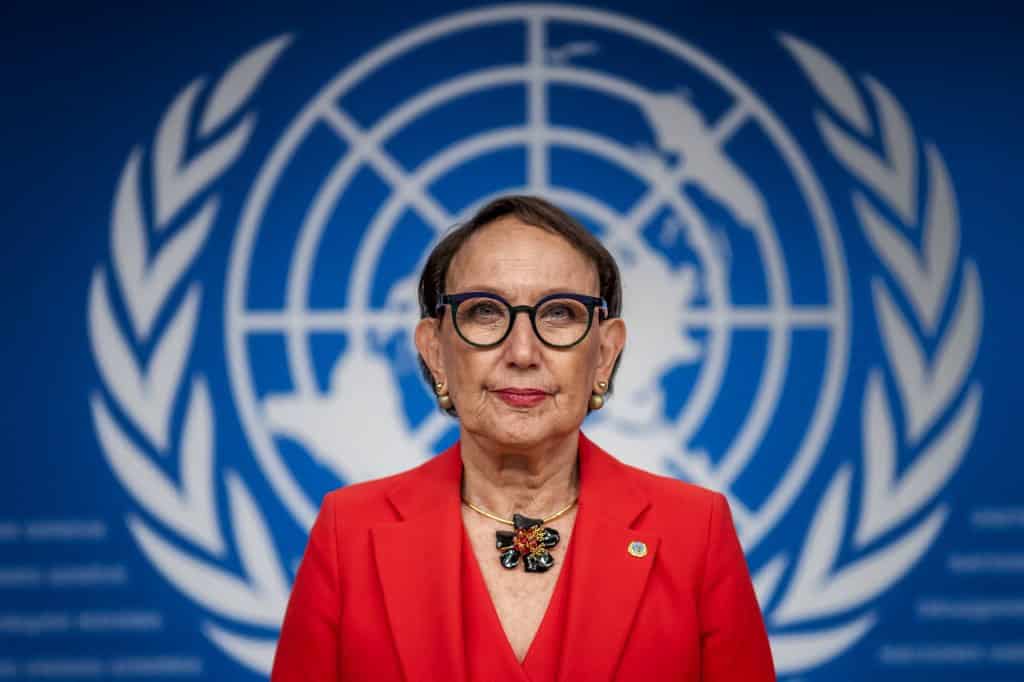
Costa Rica’s push to place Rebeca Grynspan at the head of the United Nations moved into a more public phase this week, as the former vice president used her interactive dialogue before member states to argue that the next secretary-general must put peace back at the center of the organization and take a more active role in preventing conflicts. Her candidacy gives Costa Rica an unusual opening to project its long-standing diplomatic identity onto one of the most important jobs in multilateral politics.
Grynspan is one of four declared candidates currently in the race to succeed António Guterres when his second term ends on December 31, 2026, with the next secretary-general set to begin on January 1, 2027. The other contenders are Michelle Bachelet of Chile, Rafael Grossi of Argentina, and Macky Sall of Senegal. Costa Rica formally registered Grynspan’s candidacy on March 3, presenting her as a figure with government experience, deep U.N. knowledge, and a track record in crisis negotiation.
For Costa Rica, the campaign carries weight beyond personal ambition. The Foreign Ministry has framed Grynspan’s bid as an extension of the country’s image abroad: a small democracy that leans on diplomacy, dialogue, and multilateral rules rather than military power. Officials in San José have argued that her campaign reflects Costa Rican priorities of peace, democracy, and international cooperation, and have tied her candidacy to a broader call for a U.N. that is more agile, more accountable, and more useful to member states.
Grynspan’s message this week matched that line closely. She said peacemaking would be her first priority and warned that trust in the U.N. is fading at a moment when the institution faces pressure to prove its relevance and manage with tighter resources. She also made reform a central part of her argument, saying the organization must change if it is going to respond better to current crises. Costa Rica’s government has said her platform rests on three broad points: giving greater priority to durable peace and security, deepening institutional reform, and preparing the U.N. for emerging challenges.
Her résumé gives Costa Rica a serious case to present. Grynspan has led UNCTAD since 2021 and became the first woman to head that agency. Before that, she served as secretary-general of the Ibero-American Conference, held senior leadership roles at the U.N. Development Programme, and was Costa Rica’s vice president from 1994 to 1998. Costa Rican officials have also highlighted her role in negotiations linked to the Black Sea grain initiative, pointing to that work as proof that she can operate in politically tense settings and help move talks forward.
Still, Costa Rica’s candidate faces a hard political road. The public hearings matter, but the process is still shaped heavily by the five permanent members of the Security Council, whose veto power can end a candidacy behind closed doors. The current field is smaller than the one that produced Guterres in 2016, yet diplomats and analysts still expect backroom calculations among Washington, Beijing, Moscow, London, and Paris to weigh heavily on the outcome. Tradition also suggests that this is Latin America’s turn, and there is pressure in some diplomatic circles to choose the first woman to lead the U.N., but neither factor guarantees anything.
That leaves Costa Rica in a familiar position: making a values-based case in a contest that will also turn on raw power. Grynspan’s appearance this week did not settle the race, and more candidates could still emerge. But it did give Costa Rica a visible platform at the center of a debate over what the United Nations should look like after years of war, division, and declining confidence. For a country that has long tried to punch above its weight through diplomacy, that alone is significant.





