

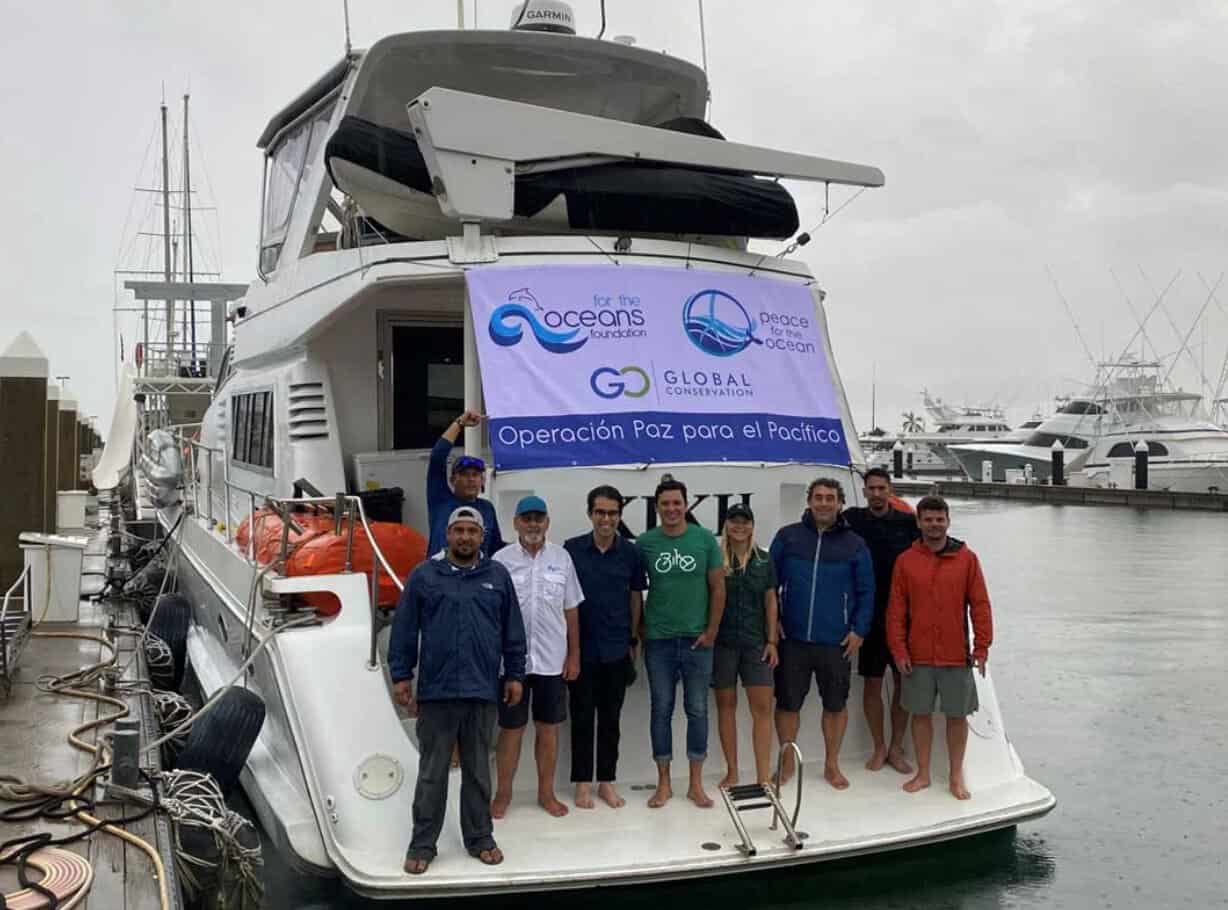
The For the Oceans Foundation, working under the framework of the One Ocean Worldwide Coalition, announced the launch of Operation Peace for the Pacific, a scientific expedition focused on Costa Rica’s South Pacific. The mission will monitor, document and conduct scientific assessments in the marine corridor between Isla del Caño and Puerto Jiménez, one of the country’s most important ocean areas for marine life and coastal communities.
The operation aims to gather updated information on highly migratory species and marine ecosystems in the Eastern Tropical Pacific. Researchers will focus on sharks, oceanic manta rays, sea turtles, cetaceans and pelagic species that play an important ecological role and are also linked to fisheries in the region.
The expedition will be led by Jorge Serendero, director of the operation and director of the For the Oceans Foundation. He will be joined by biologist Oscar Brenes, the mission’s scientific director, and Swedish scientist Linnéa Swenson, who will collect biological data and prepare technical and scientific conclusions from the expedition.
During the operation, the team will carry out systematic observations, produce audiovisual documentation and collect scientific evidence aimed at supporting future marine conservation strategies. The work will also contribute to sustainable management efforts and a better understanding of the ecosystem services provided by the marine corridor between Corcovado and Isla del Caño.
The expedition will include an additional research component focused on collecting phytoplankton samples and monitoring oceanographic changes. That work is being developed in collaboration with Maribel Vargas Montero of the University of Costa Rica, a scientist who specializes in this field.
Organizers said the mission will also highlight the importance of the region for marine biodiversity, coastal communities, responsible fishing, sustainable tourism and the economy of Costa Rica’s South Pacific.
The area is considered part of a broader marine system that connects Osa, Isla del Caño and Cocos Island, one of the most important marine ecosystems in the Eastern Tropical Pacific. The expedition will document current conditions, ecosystem dynamics and the pressures facing the region.
The operation is being carried out in coordination with maritime authorities and other strategic stakeholders involved in national and international marine protection. The expedition was made possible with the support of Global Conservation, one of the key strategic partners behind the mission. Global Conservation is an international organization focused on protecting national parks and indigenous territories in developing countries.
The mission also has the support of members and partner organizations of the One Ocean Worldwide Coalition, which works on marine protection, scientific research and ocean conservation. Organizers said the operation remains open to new strategic partnerships that could expand future phases of monitoring, research and marine protection in Costa Rica’s Pacific waters.





