
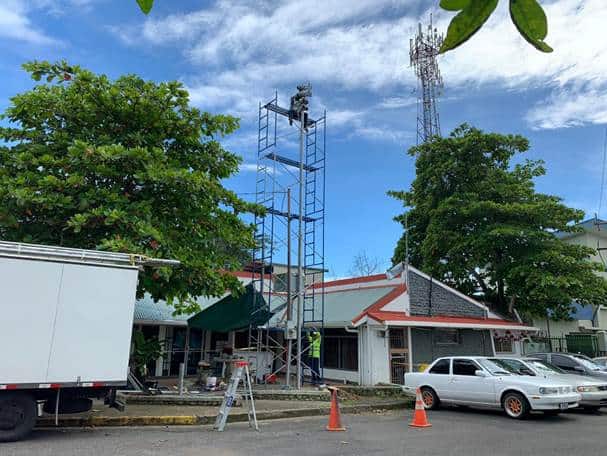
The National Emergency Commission (CNE) is installing tsunami-alert sirens in five Puntarenas towns, the institution announced this week. The communities of Tivives, Jacó, Esterillos Oeste and Quepos are receiving the systems, which would provide a preventative alert in the event of a possible Pacific coast tsunami.
The sirens were donated by the U.S. Embassy and cost $70,000, the CNE says. They fortify the growing network of sirens in Costa Rica’s Puntarenas and Guanacaste provinces. In 2021, the CNE hopes to further expand that network with sirens on the Caribbean coast.
“The placement of the sirens is part of a process where people were educated and trained in tsunami evacuation by preparing maps and indicating to people the meeting points, the routes to be taken,” said Silvia Chacón, a representative of the National Tsunami Monitoring System (SINAMOT).
In addition to the sirens, many oceanside towns have signage indicating proper tsunami evacuation routes. According to the University of Costa Rica, Puntarenas, Caldera, Quepos and Golfito are among the population centers that could be affected by a tsunami.
Perhaps the most significant of these occurred in 1854, when a magnitude 7.2 earthquake near the Osa Peninsula provoked a tsunami that destroyed several towns. At least 15 other tsunamis have affected Costa Rica, the majority on the Pacific coast.
Watch the tsunami alert siren in action below:
How to react to a tsunami
The U.S. Department of Homeland Security recommends the following steps for responding to a potential tsunami:
- First, protect yourself from an earthquake. Drop, cover, then hold on.
- Get to high ground as far inland as possible.
- Be alert to signs of a tsunami, such as a sudden rise or draining of ocean waters.
- Listen to emergency information and alerts.
- Evacuate: DO NOT wait! Leave as soon as you see any natural signs of a tsunami or receive an official tsunami warning.
- If you are in a boat, go out to sea.
In Costa Rica, the CNE has helped prepare tsunami risk and evacuation maps for several communities. Their tsunami webpage has more resources.