

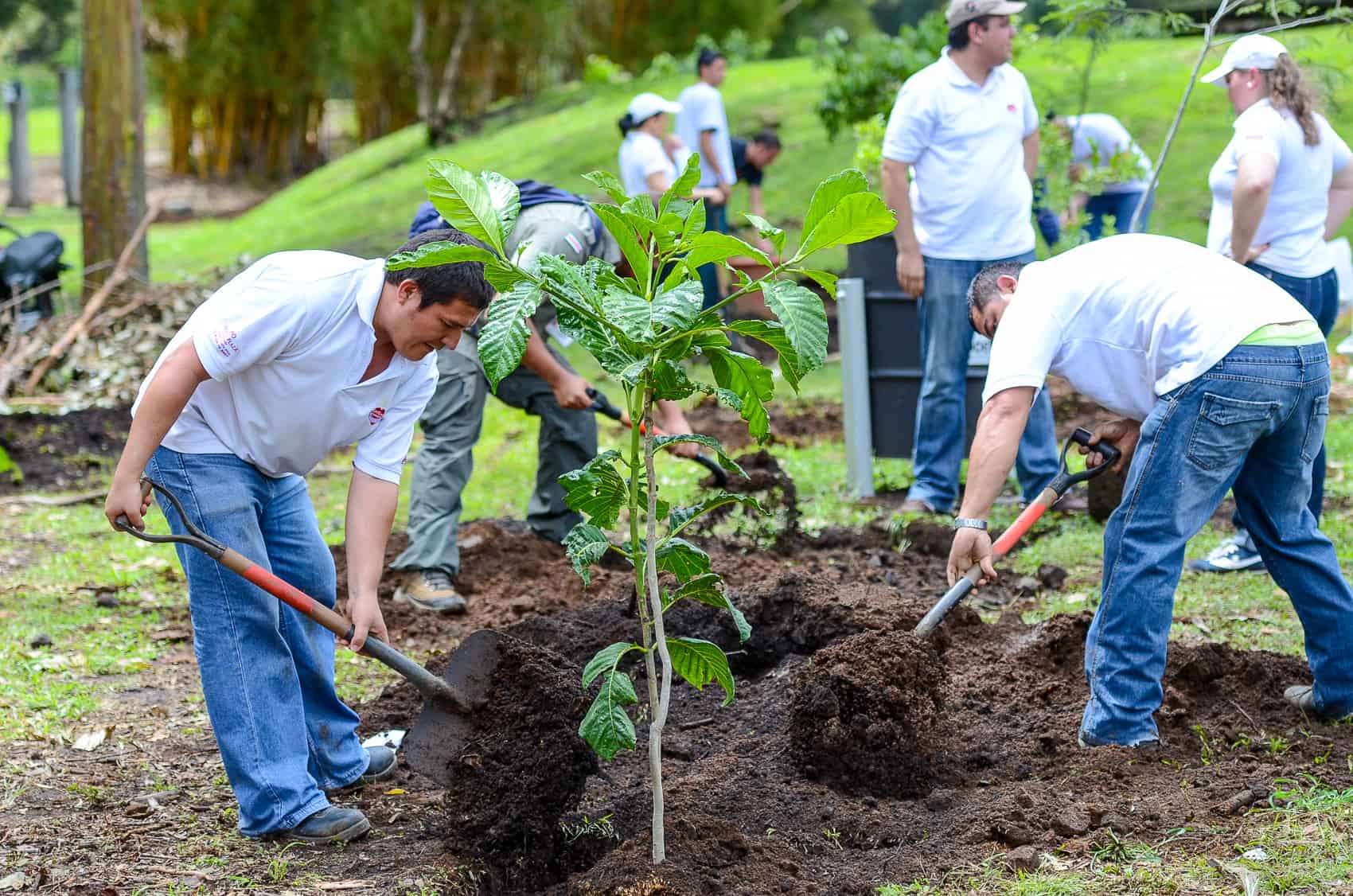
Costa Rica decided to take the challenge of decarbonizing its economy, for which the transportation sector represents a fundamental challenge, followed by the solid waste sector.
Inventories of greenhouse gases (GHG) made by the municipalities of San José, Desamparados, Belén, La Unión, Monteverde and Golfito show that both activities are the main sources of GHG across the six municipalities.
Currently, there are 12 municipalities that have taken measures and important steps to implement mitigation and adaptation to climate change, in order to become sustainable and walkable cities. They have the ambitious goal of lowering their carbon emissions, as is the case of Golfito, which aims to reduce 118,000 tons of CO2.
Juliana Madrigal, forest engineer from the Municipality of Golfito, stated the following: “We look to build complete trails with sidewalks and cycle paths, restructuring both private and public transport, promote carpooling and bicycles and walking through the streets to migrate from the use of vehicles toward a better environmental awareness”
With this reality, the Directorate of Climate Change (DCC) of the Ministry of Environment and Energy (MINAE, in its Spanish acronym), through the “Cantonal” category of the Neutral Carbon Country Program 2.0 (NCCP 2.0), works in the formalization of the processes related with the GHG inventories report and the implementation of the National Standard of Carbon Neutrality.
Andre Meza, director of the DCC said: “Based on this motto and the interest and enthusiasm of the municipalities, we are working together with academia, NGOs and the international cooperation in the design of tools that facilitate the participation of municipalities to contribute with country commitments (NDC, in its English acronym) adopted under the Paris Agreement. The NCCP 2.0 is one of these tools.”
Priority sectors for mitigation
A pilot project between the DCC, the German Cooperation GIZ and the Center for Urban Sustainability (CFUS) encouraged the municipalities to achieve carbon neutrality within the framework of the PPNCN 2.0. This project offered technical and methodological support during 2018 to the cantons of San José, Belén, Desamparados, La Unión, Monteverde and Golfito in the process of determining their emission sources, measuring their GHG inventories and developing an action plan for the implementation of possible mitigation steps.
In San José, Desamparados and La Unión, more than half of GHG emissions are generated by the transportation sector. In Belén, the largest source of emissions is stationary energy; that is, the energy produced by the burning of fossil fuels (LPG gas, gasoline, diesel, bunker or others) in the use of stoves, ovens, boilers or other types of facilities. In Desamparados and Golfito, it is the waste sector. In Monteverde, the transportation, livestock and fertilizer use sectors in the agricultural area have the same weight in the district’s contribution of emissions.
“We are working in the treatment of organic waste and in programs with the refrigerant industries to reduce emissions from these sectors. We are also carrying out studies to make a bike path, because the community is asking for it, and they feel it as a need, ” said Thais Zumbado Ramírez, vice mayor of Belén.
Exchange of experiences at the international level
As part of the strengthening of local governments, in October 2018, a tour was held to exchange experiences with German and Spanish municipalities. The six pilot municipalities, plus Alajuela, Liberia, Talamanca, Montes de Oca, Curridabat and Cartago, which cooperate with the DCC in projects of the Adaptation Fund, knew of a wide range of climate projects in Europe and acquired new knowledge, mainly in active and electrical mobility and waste management. The tour was organized by GIZ and the Spanish Cooperation AECID.
Among the sustainable transport projects, they learned about the “Low Emission Zones” in Madrid, Spain, which restrict access to the city center and the most polluting vehicles. Access permits, and parking and detention permits incentivize less-polluting vehicles. In a coastal area in Barcelona, sustainable management of maritime areas was shown with mobility as an integrating element.
Non-motorized mobility is encouraged, among others, with bicycle rental stations. In Seville, the service is continually optimized by monitoring the frequency of passing bicycles, parking points and parking. The “Bicycle Academy” of the Innovation Center for Mobility and Social Change in Berlin, Germany, analyzes ideas on how to integrate bicycle lanes in urban mobility planning, particularly at intersections and connections with greater traffic.
For Marcel Soler, mayor of Montes de Oca, it is necessary to motivate changes to modern mobility systems: “We recognize the importance of offering incentives to people to impulse change. We have started with a series of incipient efforts to improve the infrastructure, develop public bike systems, integrate different means of transportation and generate intermodality, as well as install recharging points for electric vehicles.”
Another priority sector is waste. In Mannheim, Germany, the delegation learned about a project to optimize the planning of garbage collection routes: sensors in the dumpsters indicate if they are full to avoid unnecessary collection trips. During visits to the sanitary landfill and to a solid waste transfer plant that could be re-evaluated in Barcelona, Spain, they also learned about solutions to improve separation, recycling and waste treatment.
For its part, Katherine Quirós, environmental management professional of the Municipality of La Union, stressed the importance of communication work to achieve a positive environmental impact in the cantons and stated that “they should ask citizens what they want before building, do not forget to plan for the people and ask ourselves the question of what kind of city we want to live in.”
Next steps toward decarbonization
The 12 municipalities currently identify priority actions to be implemented, which may be supported by the Municipal Development and Advisory Institute, the National Union of Local Governments and international cooperation. Feasibility studies are being prepared for some of the projects, derived from the action plans of the pilot municipalities with the GIZ and the DCC.
“At GIZ, we are committed to supporting the government of Costa Rica in decarbonization and promoting municipalities as generators of sustainable development. That is why we have been supporting this initiative, providing technical assistance and support to the training process, inventory surveys and development of climate change actions and projects,” said Sandra Spies, project director at GIZ.
With the support of GIZ, virtual teaching modules are being developed to teach how to apply the PPNCN 2.0 tool, in order to prepare GHG inventories and establish mitigation actions at the municipal level, so that all local governments can carry out their own inventories. Through additional guides in the sectors of refrigerants and air conditioners, agriculture, forestry and land uses, it is expected to disseminate good practices and portfolios of mitigation actions. A financing guide will help to recognize ways of mobilizing financial resources toward climate change; for example, through the management of the municipal budget.
This story first appeared in Latin Clima. It was translated and republished as part of a partnership with Latin Clima. Read the original story in Spanish here.
This story was translated by Ariana Arguedas Bermúdez.





