
Some important decisions arrive with headlines, prohibitions, and grand speeches. Others seem much more modest. Last week in Lisbon, we saw one of the latter.
I participated as an observer representing FECOP at the 104th Meeting of the Inter-American Tropical Tuna Commission (IATTC). Amid discussions about tuna, sharks, bycatch, and other species that cross borders without asking permission, Central America managed to open a specific path forward on something many of us have been saying for years about billfish in the Eastern Tropical Pacific, we need to understand them better. It sounds like a simple conclusion. It is not.
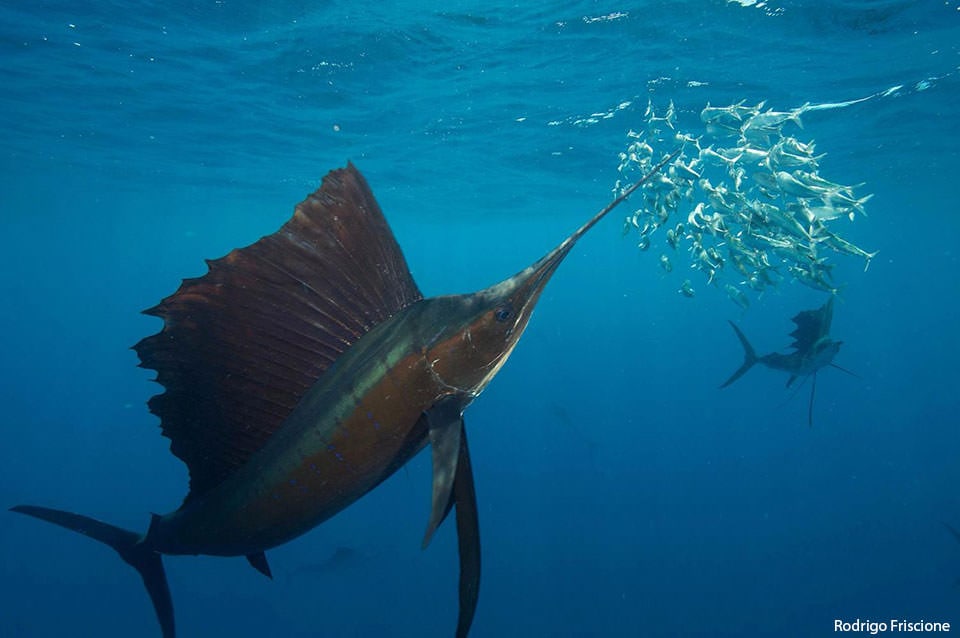
Sailfish, marlins, and swordfish are highly migratory species. In a matter of weeks, they can move through the waters of several countries. They interact with industrial, artisanal, coastal, recreational, and sport fisheries. Some of these species also support an important tourism economy that sustains captains, crews, marinas, hotels, restaurants, transportation services, and coastal communities. Trying to manage them using information from only one country or one fishery is like trying to understand a movie by watching only a few scenes. That has been precisely one of our problems.
Information on billfish in the Eastern Tropical Pacific exists, but much of it remains fragmented. There are still gaps in catch and effort data, biological information, monitoring and data verification, post-release mortality, and our understanding of how different fisheries interact with these species. The proposal presented in Lisbon itself recognized many of these limitations.
For years, pieces that were once scattered have gradually been coming together. At FECOP, working alongside scientific partners and the sportfishing sector itself, we have sought to turn fishing records into useful information to better understand billfish.
Collaborations with researchers from Stanford University, for example, demonstrated the value of recreational fishing records from Costa Rica, Guatemala, and Panama for studying the occurrence of sailfish and blue marlin and their relationship with changing ocean conditions. We have also used historical data generated by sportfishing operations to examine changes in the local abundance of sailfish along Costa Rica’s Pacific coast.
Regional initiatives have added another layer to these efforts. The Pacífico Sostenible project, working with OSPESCA, governments, and private-sector actors, developed a regional pilot focused on recreational fisheries for sailfish and marlin. That process reached a conclusion that is particularly relevant to what later happened in Lisbon, our region needs to strengthen the collection, analysis, and standardization of data generated by recreational fisheries, and we need to do it in a coordinated way across countries and sectors.
An important change has also been taking place within the private sector. Sportfishing organizations in Central America have increasingly understood that asking governments to recognize the economic contribution of our activity is not enough. If we want to participate seriously in conversations about fisherie management, we also have a responsibility to help generate the information needed to make better decisions.
That principle has been part of the work of CASA, the Central America Sportfishing Alliance. Its 2026 agenda placed science and conservation among its strategic priorities and called for progress on regional information about sailfish and the creation of scientific spaces dedicated to billfish. This matters because fisheries discussions have too often fallen into a comfortable trap, each sector arrives at the table with its own numbers, its own experiences and, of course, its own certainties.
Science should help us get out of that trap.
In June 2026, the IATTC Scientific Advisory Committee recommended developing a work plan for billfish data collection and stock assessments, including the costs, staffing needs, and potential sources of external funding required to carry it out. Two months later, Panama, supported by Belize, Costa Rica, El Salvador, Guatemala, Honduras, and Nicaragua, arrived in Lisbon with a proposal to establish a specialized scientific working group on billfish.
What was ultimately agreed was more gradual, in 2027, a specialized workshop will be held to identify the main information and research gaps, establish priorities, and develop a draft work plan that will later be considered by the IATTC Scientific Advisory Committee. Is that enough? No. Is it important? Absolutely.
For the first time, a clear institutional pathway is opening to turn a concern that different actors have raised for years into scientific questions, research priorities and, eventually, better management decisions. And this is where we also need to accept our share of the responsibility.
Sportfishing holds something extremely valuable for science, thousands of days at sea, encounters with fish, locations, dates, sizes, ocean conditions, fishing effort, and releases. Much of that information is still lost or remains scattered across logbooks, phones, applications, databases, and the memories of captains. Turning that accumulated experience into useful scientific data must be part of the next stage.
But the same must happen with every fishery that interacts with billfish. This is not about proving in advance who is right. It is about building the information that will allow us to find out. That is why I left Lisbon thinking that perhaps the most important progress made at this meeting was the recognition of something quite basic, before we argue over the answers, we first need to agree on the questions.
Sailfish and marlins have been crossing the Pacific for millions of years without recognizing our borders, institutions, or sectoral differences. Perhaps it is time we learned to do the same.
Damián Martínez Fernández
Director de conservación y política pública Federación Costarricense de Pesca FECOP