
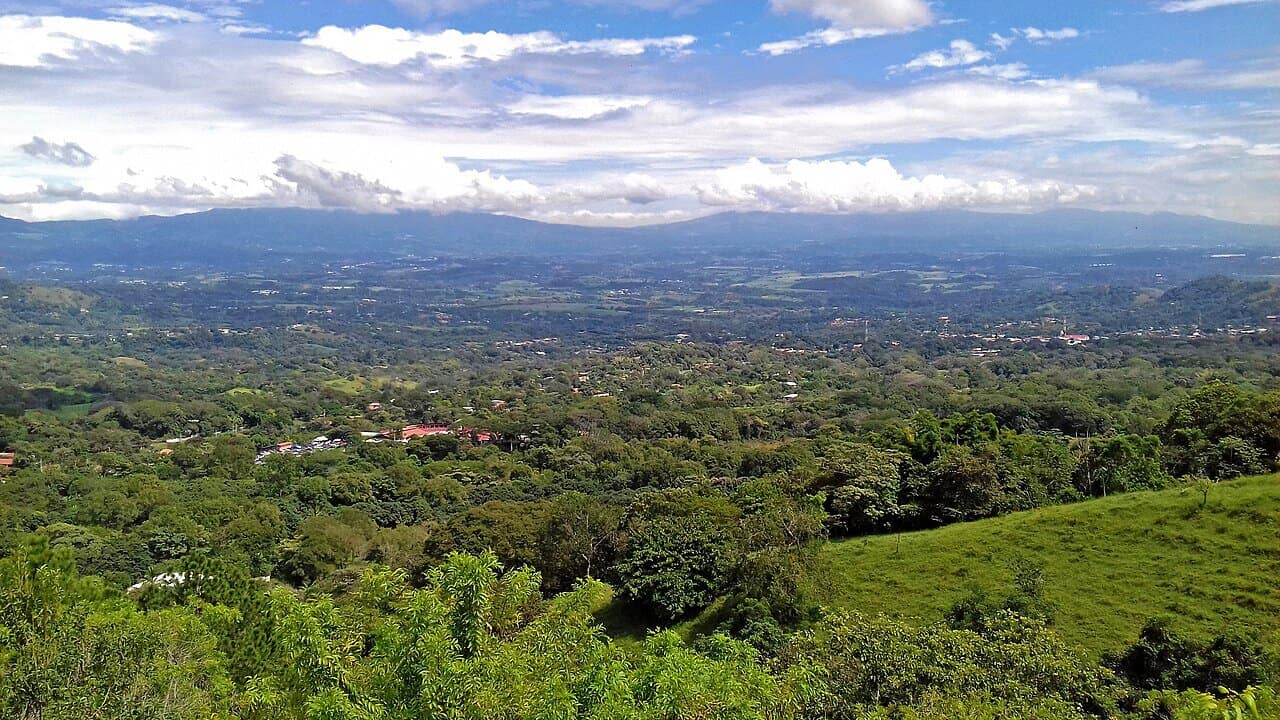
For buyers looking to build a home in Costa Rica’s western Central Valley, Atenas and Puriscal often land on the same shortlist. Both offer mountain living west of San José, a cooler climate than the coast, walkable town centers, local markets and enough access to the capital to make daily life practical.
But the two towns are not interchangeable. Atenas is the more established and more expensive choice, with a long-standing foreign resident community and a deeper support network for international buyers. Puriscal remains more rural, more Costa Rican in feel and often more affordable for buyers who want land, views and space without paying Atenas prices.
The comparison starts with geography. Atenas sits in Alajuela province, on the western edge of the Central Valley, with relatively quick access to Route 27, Juan Santamaría International Airport in San Jose and the Pacific corridor. Puriscal, in San José province, sits farther southwest in the mountains, with Santiago de Puriscal serving as the main town center. It is still close enough to the capital for regular trips, but it feels more removed from the region’s main expat and commuter belt.
Climate is one of the biggest reasons both towns attract homebuilders. Atenas has built much of its reputation around mild weather, stable temperatures and lower humidity than the coast. The town center sits at about 700 meters above sea level, while the broader Atenas area ranges from lower, warmer sections to higher hillside communities with stronger breezes and cooler nights.
That variation matters for buyers. A home near central Atenas will not feel exactly the same as a property in a higher area such as San Isidro or Barrio San José. Elevation, exposure, wind, shade and slope can change the feel of a property even within the same canton.
Puriscal sits higher. Santiago de Puriscal is around 1,100 meters above sea level, giving the area a cooler, breezier mountain climate than much of Atenas. Buyers who want the classic warm Central Valley feel often prefer Atenas. Buyers who want cooler evenings, more breeze and a more rural mountain setting may find Puriscal more appealing.
Price is where the two markets separate most clearly. Atenas has already been discovered. Decades of demand from U.S., Canadian and European buyers have turned it into one of Costa Rica’s best-known inland expat destinations, and that maturity is reflected in land and home prices.
Premium Atenas communities can command high per-square-meter prices, especially where lots have paved access, confirmed water, security, strong views and proximity to town. More rural or larger parcels can still price far lower, but the overall market is more developed and more competitive than Puriscal.
Puriscal remains earlier in its real estate cycle. Buyers can still find larger lots, farms and mountain properties at prices that would be difficult to match in comparable Atenas locations. That does not mean every Puriscal property is a bargain. Road access, water availability, slope, title status and buildability can change the real cost quickly. But for buyers comparing land size, privacy and views, Puriscal often offers more space for the money.
Infrastructure favors Atenas. The town has a more mature network of real estate offices, contractors, property managers, restaurants, shops, medical services and English-speaking support built around foreign buyers and retirees. For someone moving from abroad who wants a softer landing, Atenas is the easier place to plug in quickly.
Puriscal has practical town infrastructure of its own. Santiago has supermarkets, banks, pharmacies, hardware stores, clinics, local restaurants and a strong farmers market culture. Daily life is not isolated. But the town is less tailored to foreigners, and buyers should expect fewer expat-specific services, fewer English-language conveniences and a more local rhythm.
Community character may be the deciding factor. Atenas has a large and well-established foreign resident population. That can be a major advantage for newcomers who want social connections, referrals, clubs and a ready-made network. It also gives parts of the area a more international feel.
Puriscal remains more distinctly Costa Rican. Its appeal is less about joining an existing expat hub and more about living in a working mountain town with local markets, agricultural roots and a slower country pace. Buyers who want immersion in small-town Costa Rica may prefer that. Buyers who want convenience, familiarity and an existing foreign community may prefer Atenas.
Terrain is another practical difference. Both areas offer mountain views, rolling hills, forest patches, coffee country and river valleys. Puriscal’s higher, more rugged setting can produce dramatic views, but also steeper building sites. That can add costs for access roads, drainage, retaining walls, foundations and utilities.
Atenas, because of its longer development history, has more established residential areas where buildable lots, roads, water and electricity have already been sorted out. That can reduce uncertainty, especially for buyers building their first home in Costa Rica.
For homebuilders, the choice comes down to priorities. Atenas is the stronger fit for buyers who want a proven expat market, warm mountain weather, better-established services and easier resale confidence. It is the more turnkey option, but usually at a higher price.
Puriscal is better suited to buyers who want more land, cooler temperatures, stronger local character and a market that still feels less saturated. It rewards buyers who are comfortable doing careful due diligence and who value space and authenticity more than convenience.
Neither town is simply better. Atenas offers maturity, services and name recognition. Puriscal offers value, elevation and a more Costa Rican mountain-town feel. The right choice depends less on which place looks better on paper and more on what kind of life the buyer wants to build.