
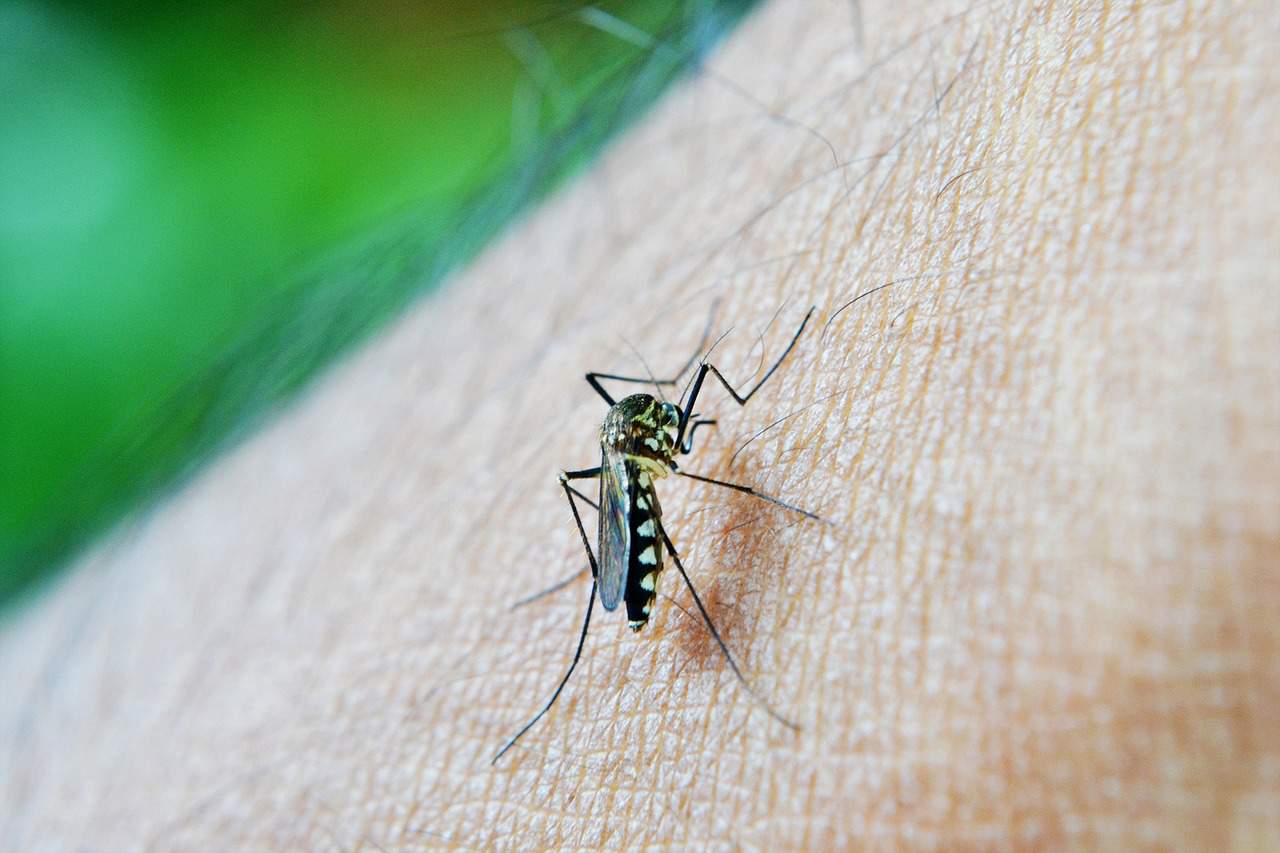
Why are some people like “magnets” for mosquitoes while others seem to escape them? According to scientists, who are still working to decipher the mechanisms involved, at the heart of this attraction, sometimes fatal, lies a complex and changing chemical mix.
“Of the just over 3,500 known mosquito species, about 100 bite humans and half a dozen are vectors of diseases” such as malaria, dengue, yellow fever, chikungunya, Zika or West Nile virus, Frédéric Simard, director of studies at the Research Institute for Development, or IRD, in southeastern France, told AFP.
And “it is not a myth: we are not all equal when it comes to mosquitoes’ appetite. But we are not magnets all the time either,” added the medical entomologist. Humans attract these tiny vampires, including the now well-known tiger mosquito, through multiple sensory signals, mainly body odors, carbon dioxide from breath and heat, experts agree.
Female mosquitoes, the only ones that bite, detect these signals through specialized receptors, and that is how they choose their target. “We have known for more than 100 years that mosquitoes are attracted to the carbon dioxide we exhale: it is the first signal that triggers their behavior, from several dozen meters away,” Rickard Ignell, author of a recent study on the chemical basis of mosquitoes’ differing attraction to human breath, said.
At about 10 meters, “mosquitoes begin to detect our odor, which, combined with CO2, attracts them even more,” the Swedish scientist added.
Popular beliefs
Several popular beliefs about what attracts these insects have been disproved, however. “The difference between blood types has no solid scientific basis: some studies have been carried out, but with very few people. Nor is it related to skin, eye or hair color,” said Simard, of the IRD.
One key factor of attraction is undoubtedly smell, “a mixture of molecules produced by our microbiota that is more or less attractive to mosquitoes,” the entomologist said. Humans emit between 300 and 1,000 different odor compounds, according to various studies, but scientists are only beginning to better identify which ones attract these small blood-sucking animals.
For the research in which Ignell took part, scientists evaluated in a laboratory how attractive 42 women were to Aedes aegypti mosquitoes, vectors of yellow fever and dengue, among other diseases, across large areas of Latin America. “We have shown that a mixture of odor compounds, 27 of which we identified as detectable by these mosquitoes, influences the degree of attraction,” the scientist said.
“The women most attractive to mosquitoes, especially those in the second trimester of pregnancy, produced slightly more of a compound derived from the breakdown of sebum,” he said.
One of the surprises, Ignell said, was precisely that such a small increase in the amount released of 1-octen-3-ol, also known as mushroom alcohol, could change the behavior of these insects. “Mosquitoes are fascinating creatures,” he added.
Watch the alcohol
Drinking beer, which raises body temperature, increases the amount of CO2 exhaled and changes skin odors, can also contribute to making people more attractive to mosquitoes, according to some studies. One standardized study carried out in Burkina Faso with volunteers who drank a local beer and, a few days later, the same amount of water, showed that Anopheles mosquitoes, the main vector of malaria, were more drawn to the odors of those who had consumed the alcoholic drink.
These mechanisms are fueling growing research as the health threat linked to some of these insects expands. The tiger mosquito, in particular, is spreading into areas where it was not endemic, driven by global warming, urbanization and globalization. “The risk affects more and more people, and also more countries where there is money to protect themselves, so this generates funding and research results,” Simard said.
When mosquitoes are around, experts recommend protecting against bites with long, loose-fitting clothing, mosquito nets or repellent. “And try to eat lightly and consume alcohol in moderation,” the scientist added.