

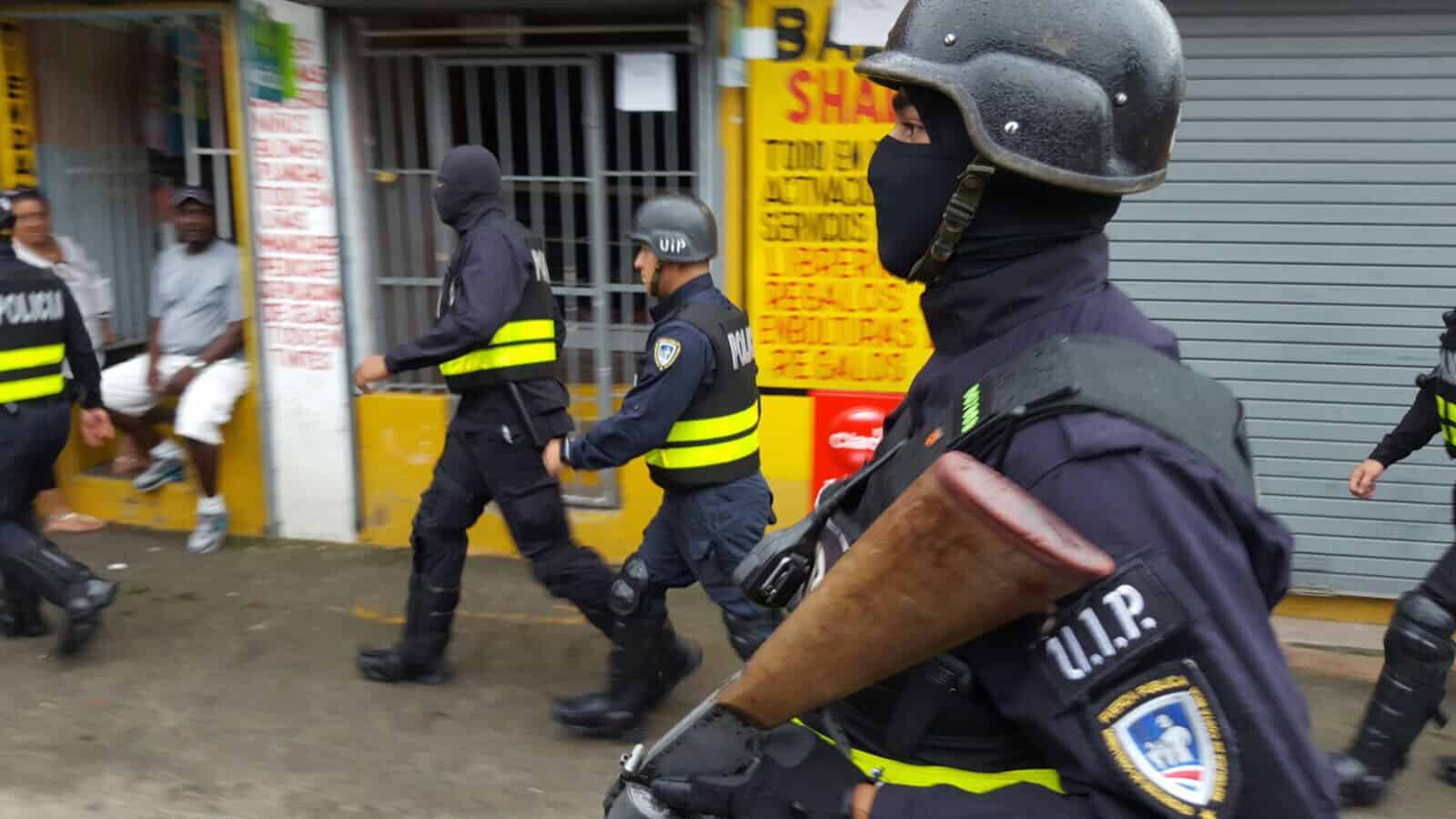
Wiretap recordings incorporated into the criminal case against the organization led by Alejandro Arias Monge, known by the alias “Diablo,” describe a network of police officers who prosecutors allege warned the group ahead of raids, passed along confidential information from inside the security forces, and in at least one instance allowed a cocaine shipment to move past a highway checkpoint. The allegations have sharpened long-running concerns about how deeply organized crime has penetrated Costa Rica’s police institutions.
The recordings, analyzed by the Organismo de Investigación Judicial, form part of case file 21-000115-0622-PE, known within the judiciary as Caso Colorado. Investigators established that members of the Arias Monge organization maintained regular telephone contact with officers stationed in Guápiles and Cariari de Pococí, the Caribbean lowland corridor where the group built and defended its territory for more than a decade. Some officers, investigators concluded, were recruited specifically to alert the organization before raids, highway checkpoints and OIJ movements, giving its members time to conceal drugs, relocate shipments or warn associates before agents arrived.
Five officers now face formal charges brought by the Fiscalía Adjunta contra el Narcotráfico y Delitos Conexos before the criminal court of the specialized organized crime jurisdiction. Three of them served with the Traffic Police and the remainder with the Fuerza Pública. None has been convicted, and every conclusion drawn from the wiretap analysis remains a prosecution hypothesis that the courts will weigh during the judicial process.
Among the most striking intercepts described in the accusation is an October 2021 call in which an officer assigned to the Operational Support Group in Guápiles allegedly warned a member of the organization, identified by the surname Aragón, that the Fuerza Pública, the Ministry of Health and the Fábrica Nacional de Licores were preparing a joint inspection of a supermarket and liquor store linked to the family in Astúa Pirie de Cariari.
According to prosecutors, Aragón immediately began alerting the operators of other businesses that faced the same risk. Investigators allege those establishments were used to launder proceeds through the sale of contraband goods, and that Aragón described his source as a man who worked inside the Fuerza Pública. The accusation states that the officer was known within the organization by two nicknames and acted as a facilitator from his position as a public servant.
A separate intercept from April 2022 captured a member of the organization referring to a police collaborator as the man who worked with them “from the blues,” a phrase investigators interpreted as code for a cooperating officer.
The three Traffic Police officers face a different but related set of accusations. On May 11, 2022, three members of the organization were moving roughly half a kilogram (about 1.1 pounds) of cocaine from Pococí toward Moravia, in San José, when they attempted to evade a Traffic Police checkpoint on Route 32.
Prosecutors allege the men threw a firearm and a bag containing the drugs into brush beside the road, and that the officers at the checkpoint allowed the shipment to continue. One of the three men has since died and another is listed as absent from the proceedings.
The same accusation file describes a further allegation against a Fuerza Pública officer accused of using his position, and a marked patrol vehicle assigned to his sector, to scout farms in Sarapiquí and Guácimo before cattle raids carried out on the organization’s behalf in November 2022. Prosecutors say five people at one farm were threatened at gunpoint, bound and held while the theft was carried out.
Taken together, the charges represent a significant expansion of the case against the Arias Monge organization, which prosecutors say operated for years with the benefit of inside information that allowed it to survive repeated attempts to dismantle it. The OIJ has concluded that the alleged collaboration was not a series of isolated favors but a structured arrangement involving multiple officers across different units.
Arias Monge was detained on July 24 in Operación Némesis, a pre-dawn raid on a farm in Río Frío de Sarapiquí that ended nearly a decade as Costa Rica’s most wanted fugitive. Agents from the OIJ’s Organized Crime Section and its surveillance and tracking unit, supported by the Special Tactical Response Service and prosecutors, were met with gunfire on entering the property.
The exchange lasted close to an hour, left OIJ officers wounded and one alleged member of the organization dead, and ended with the detention of Arias Monge alongside Jonathan Pérez Méndez, considered his second in command. The United States had offered a reward of up to $500,000 for information leading to his arrest or conviction, the largest ever posted for a Costa Rican national.
The criminal record prosecutors are working through is extensive. Investigators say Arias Monge began committing residential burglaries in Guápiles at nineteen and eventually consolidated control over roughly 65 percent of the criminal territory in the canton of Pococí, extending his reach into Guácimo, Sarapiquí, Pocora and San Carlos.
The organization is linked to drug trafficking, aggravated robbery, homicide and money laundering, including a cattle operation that accumulated at least 569 head of livestock across properties in Pococí and Sarapiquí between 2020 and late 2023. The corridor where the group operated has already paid a heavy price. In January 2025, the deputy chief of the OIJ office in Guápiles, Geiner Zamora Hidalgo, was shot inside a restaurant and died four days later.
Investigators later concluded the killing was retaliation by a criminal structure disturbed by the drug trafficking and cattle theft cases Zamora was directing, several of which involved the Arias Monge organization. Recordings attributed to Arias Monge, in which cash was offered for the killing of Fuerza Pública and OIJ officers in the region, circulated publicly and drew national attention to him.
After his detention, Arias Monge told OIJ agents that he had received help from officers of the Ministry of Public Security during his years as a fugitive. Attorney General Carlo Díaz confirmed the remark publicly but cautioned that a spontaneous statement carries no weight in a criminal proceeding without supporting evidence, and said the claim was being investigated.
The charges against the officers will now move through the specialized organized crime courts, where prosecutors must convert wiretap analysis into evidence a judge accepts. The outcome will test whether a case built largely on intercepted phone calls can hold, and how far the accountability reaches beyond the men already in custody.





