

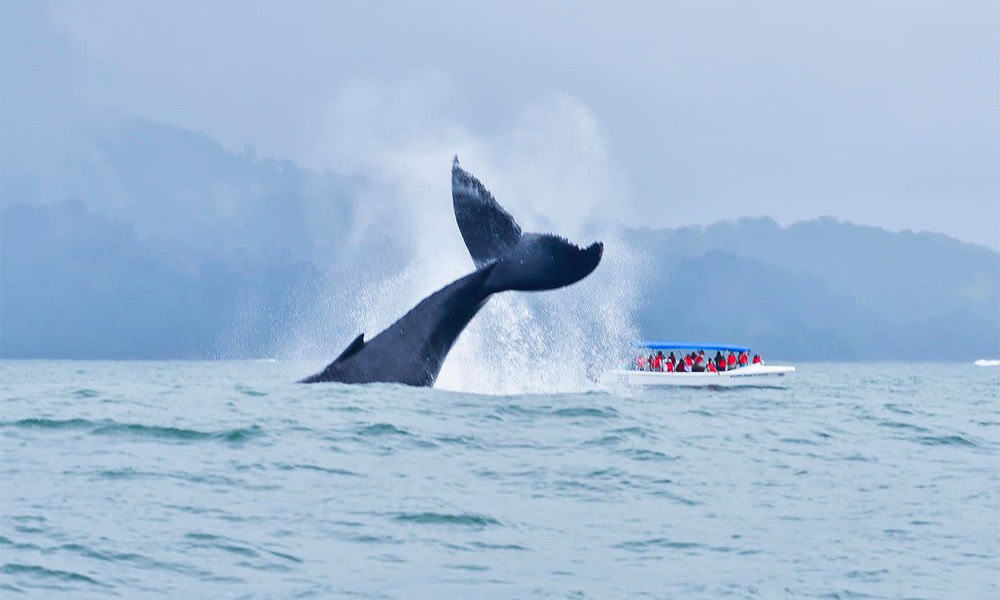
Few wildlife encounters rival the sight of a humpback whale breaching from warm tropical waters, and Costa Rica has quietly become one of the best places on the planet to witness exactly that. Thanks to a rare geographical advantage, the country hosts not one but two distinct humpback migrations each year, giving it one of the longest humpback-watching seasons in the world.
The secret lies in Costa Rica’s position along the Pacific coast, which acts as a magnet for whale populations from opposite ends of the earth. Humpbacks from the Southern Hemisphere, feeding in the cold waters off Antarctica and southern Chile, begin making their way north in July and linger through mid-November.
Their counterparts from the Northern Hemisphere, after feeding off the northwest coast of the United States, arrive mainly from December through March, with sightings possible into April. The quietest period usually falls between May and late June, when both populations are back in their respective feeding grounds.
Of the two seasons, the southern migration is the showstopper. August and September are widely considered peak months, when the concentration of whales is at its highest and sightings become more frequent rather than lucky. These animals travel to Costa Rica’s warm coastal waters to do some of the most important things in their lives: mate, give birth and nurse their calves. Watching a mother guide a newborn calf through calm, sun-dappled water is the kind of experience that stays with a person for decades.
The southern Pacific coast is where most of the action happens. Marino Ballena National Park, near the town of Uvita, is perhaps the most famous whale-watching destination in the country and draws visitors from around the world during peak season. But the Osa Peninsula, farther south, has developed a strong reputation among serious wildlife enthusiasts.
The Golfo Dulce, a rare fjord-like tropical gulf that borders the peninsula, creates unusually calm and sheltered conditions. Whales are drawn to it as a nursery habitat, and the geography can make it a strong place for sightings. Operators based out of Puerto Jiménez put visitors close to the heart of the action.
Beyond the flagship spots, whale sightings are possible along much of the Pacific coast during peak months. Manuel Antonio, a perennial favorite for its combination of beach and rainforest, offers solid sightings in August and September. Even the Gulf of Papagayo in the northwest, better known for luxury resorts and sport fishing, can see southern humpbacks pass through during this time.
The northern migration, which runs mainly from December through March, brings fewer whales overall, since many Northern Hemisphere humpbacks winter in Hawaii, Mexico or other northern breeding areas rather than continuing south to Central America. Still, sightings happen, and the experience of being out on the water during the dry season, under clearer skies and calmer seas, has its own appeal.
What makes Costa Rica stand out beyond the sheer length of its season is the quality of the experience itself. Tours are typically led by naturalist guides who can explain whale behavior, point out the difference between a breach and a spy hop, and provide context about conservation efforts in the region. Dolphins, sea turtles and seabirds often make appearances on the same outings, turning a whale-watching tour into a broader encounter with the Pacific ecosystem.
For anyone visiting Costa Rica between July and November, the timing could not be better. The southern humpbacks are on their way.





