

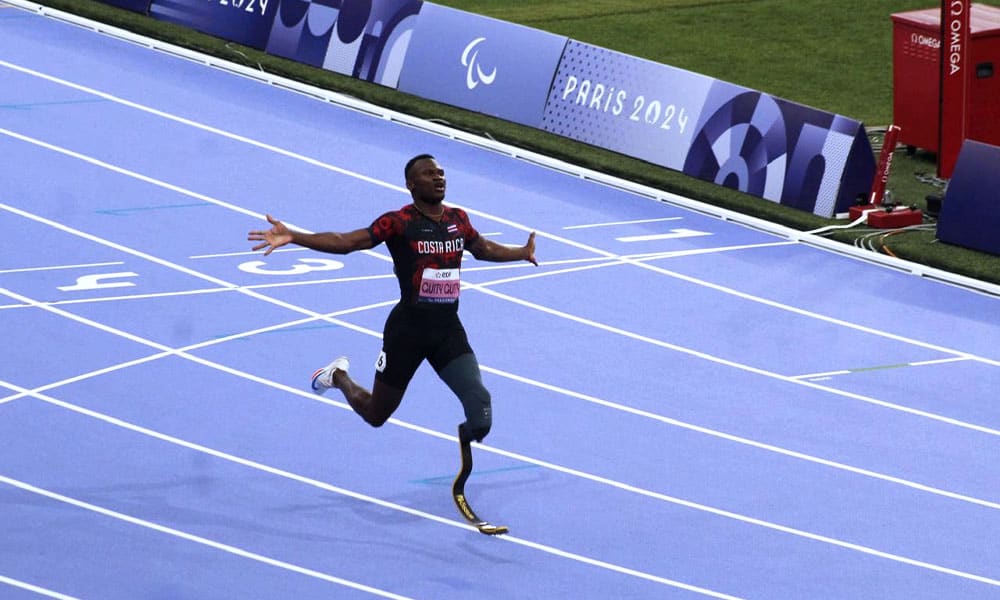
The trial of Costa Rican Paralympic sprinter Sherman Guity, one of our country’s most decorated athletes, failed to begin as scheduled this week after judges granted a defense motion requiring a psychiatric evaluation of the accused before proceedings can move forward.
Guity, a four-time Paralympic medalist and current world record holder in the T64 100m and 200m sprints, appeared Wednesday morning at the Heredia Criminal Tribunal to face six charges stemming from a 2022 complaint filed by a former partner. The accusations include three counts of mistreatment, two counts of offenses against the dignity of a woman, and one count of rape.
The proceedings were expected to open with the public prosecutor’s reading of the formal accusation, but a last-minute petition from the defense halted the start of the debate. Defense attorney David Fernández, himself a former athlete, told the court that the existing medical assessment of his client was recent but insufficient, and needed to be expanded with a specialized evaluation analyzing Guity’s conduct, comprehension, and sexual development to avoid procedural defects later in the case.
Fernández argued before the panel that the requested examination should clarify “the conduct, the behavior, the sexual development, the comprehension of sexuality, to determine whether he is a person who could have deviations and could not control his sexual impulses.”
Heredia prosecutor Mario Andrés Castro did not formally oppose the defense request but suggested the trial could move forward in parallel while the assessment was obtained. Castro also expressed doubts about whether forensic medical examiners could actually determine the specific aspects raised by the defense, noting uncertainty about the scope of such a forensic determination.
The tribunal sided with the defense, ruling it was not viable to begin the trial without first having the expert evidence in hand. Judges said proceeding without it could create gaps in the case and potentially force a repeat of the entire debate down the line. They also pointed to legal timelines that complicate running the trial in parallel with the evaluation, since once issued, the report must be made available to all parties for an eight-business-day window for possible challenges, in line with current procedural rules.
The psychiatric evaluation itself could take up to eight business days to complete, but no new trial date has been set. Fernández acknowledged that the postponement is likely to be lengthy, saying the trial may be delayed by at least a year given the backlog at the Forensic Medicine department and the need to find a new opening on the court’s calendar.
Fernández maintained that his client’s athletic career will continue as planned, noting that the original complaint was filed four years ago and that Guity has continued training and competing throughout. The athlete most recently took part in the Torneo Abierto 2026 at the Hatillo 2 track, where he competed against able-bodied sprinters in the 100m and 200m for the first time on Costa Rican soil since his 2017 accident. The Costa Rican Athletics Federation granted him clearance earlier this year to compete in conventional national track meets.
Fernández said Guity will be required to be in the country once a new trial date is set, adding that he expects the case will ultimately be revealed as “a misunderstanding.”
Guity, a native of Limón, became Costa Rica’s first-ever Paralympic medalist at the Tokyo 2020 Games, winning silver in the 100m T64 and gold in the 200m T64. At the Paris 2024 Paralympics, he added a second 200m gold and captured his first 100m T64 title with a Paralympic record time of 10.65 seconds, cementing his status as one of the fastest blade runners in the world





