

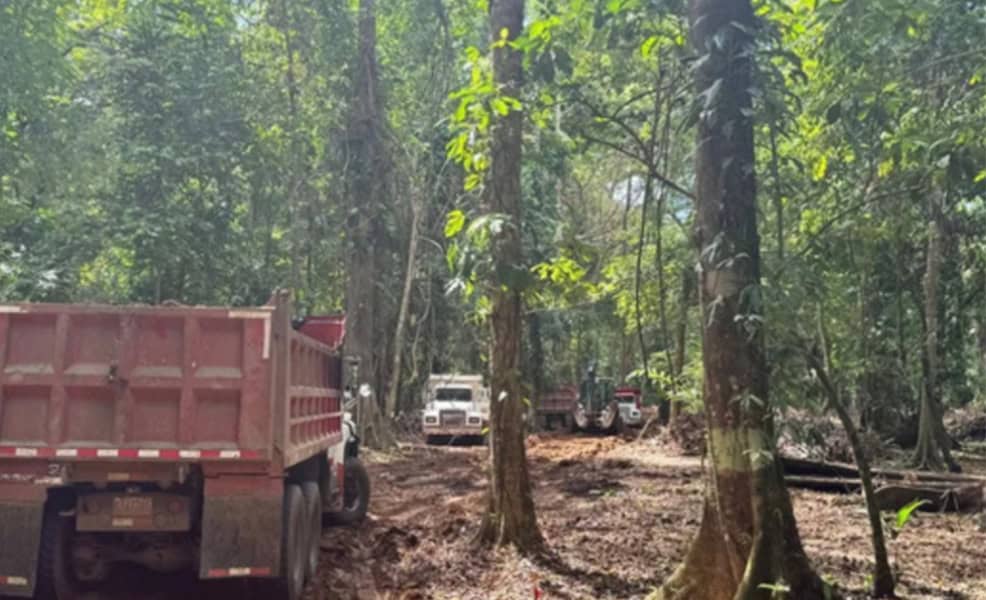
In the community of La Guaria de Sarapiquí, in the lowland rainforest corridor of northern Heredia province, primary forest is disappearing at an alarming rate. Residents and environmental advocates have denounced the systematic destruction of old-growth trees in the area, a zone that forms part of one of Costa Rica’s most ecologically sensitive biological corridors connecting Braulio Carrillo National Park to the Caribbean lowlands. Despite repeated complaints filed through official channels, the chainsaws keep running, often at night, and the forest keeps shrinking.
The story of what is happening in La Guaria is not an isolated incident. It is a window into a nationwide crisis of illegal logging that a broken, understaffed, and allegedly compromised regulatory system has been unable, or unwilling, to stop.
The scale of the problem across Costa Rica is staggering. Between 2023 and 2024, SINAC’s own complaint processing system received more than 7,200 environmental crime reports in a single year, with illegal logging accounting for the largest category at 2,600 complaints. Yet complaints rarely translate into action, and even more rarely into convictions.
Environmental Prosecutor Luis Diego Hernández has described the situation as critical, noting that forestry law violations are the top complaint both on SINAC’s platform and at the Public Prosecutor’s Office. The driving force behind the surge, he has explained, is the relentless expansion of monoculture agriculture, pineapple, banana, and palm plantations, which pushes illegal loggers deeper into primary forest zones like Sarapiquí to clear land and extract valuable timber ahead of crop conversion.
The networks operating in these areas are not casual woodcutters. When a joint operation by MINAE, the OIJ, and the DIS raided a logging operation in Tambor de Cureña in Sarapiquí last September, they did not find a small farmer with a chainsaw. They found a man carrying an illegal 9mm pistol, two illegal Remington rifles, an illegal 12-gauge shotgun, a drone, communication radios, and more than a million colones in cash.
Environment Minister Franz Tattenbach acknowledged that what began as a logging complaint had exposed the hallmarks of organized crime. The use of drones for surveillance, armed escorts for timber transport, and nighttime operations are characteristics that investigators and environmental prosecutors have now documented across multiple zones, including Sarapiquí, Osa, and Guanacaste.
What makes the destruction in La Guaria and the broader Sarapiquí region so enraging to local communities is not just that it is happening, but that it continues in broad defiance of a system that is supposed to prevent it. Last August, the Comptroller General’s Office published a damning audit of SINAC, report DFOE-SOS-IAD-00004-2025, which found that 81% of the forestry permits analyzed in 2024 failed to comply with at least one mandatory legal requirement, and 83% presented deficiencies in technical controls or document management.
The traceability of extracted timber, meaning the ability to verify that wood came from a legal source, was functionally impossible to confirm in most of the cases reviewed. The Comptroller found that SINAC’s information system, SIREFOR, is obsolete and dependent on third parties, that only 10% of forestry files are digitized, and that $325,000 budgeted in 2024 to modernize the system was quietly redirected to other institutional expenses.
Most alarmingly, the audit concluded that SINAC lacks any functioning integrity governance model and that more than 50% of the institution had made only minimal progress in identifying corruption risks.
Legislators did not mince words. Congresswoman Cambronero stated publicly that more than 80% of tree-cutting permits issued by SINAC were granted irregularly, and warned that MINAE, under Minister Tattenbach, had slashed SINAC’s budget by 40% since 2020, leaving rangers without vehicles, offices without staff, and protected zones without any real surveillance presence. The result is a regulatory vacuum that organized logging networks have learned to exploit with precision.
A separate and high-profile corruption case involving the Gandoca-Manzanillo Wildlife Refuge on the Caribbean coast exposed what happens when that vacuum is filled by collusion. SINAC officials, local municipal authorities, and private businessmen, one of them a neighbor of President Rodrigo Chaves, were arrested in 2024 on charges of granting illegal logging permits inside a protected refuge, forging land classifications, and conspiring to carve private real estate profits from state natural patrimony.
The Environmental Prosecutor described it as a partnership between a powerful economic group and public officials to reduce the limits of the refuge and extract its natural assets. Three separate opinions from the Attorney General’s Office had warned SINAC to restore the original refuge boundaries. SINAC did not act on any of them.
That pattern is exactly what residents of La Guaria have experienced: complaints are received, nothing is done, and the forest is gone forever. The incoming Costa Rican government, taking power in 2026, faces a choice that is fundamentally not about conservation aesthetics, but about institutional integrity.
Digitizing the forestry permit system and making it publicly searchable, cutting the financial relationship between forest engineers who work as paid regentes and the permit applicants they are supposed to supervise independently, restoring SINAC’s operational budget, and prosecuting permit fraud as the organized crime it demonstrably is are not optional reforms. They are the minimum required to stop what is, by every measure, a systematic pillaging of the country’s most irreplaceable natural inheritance.





