
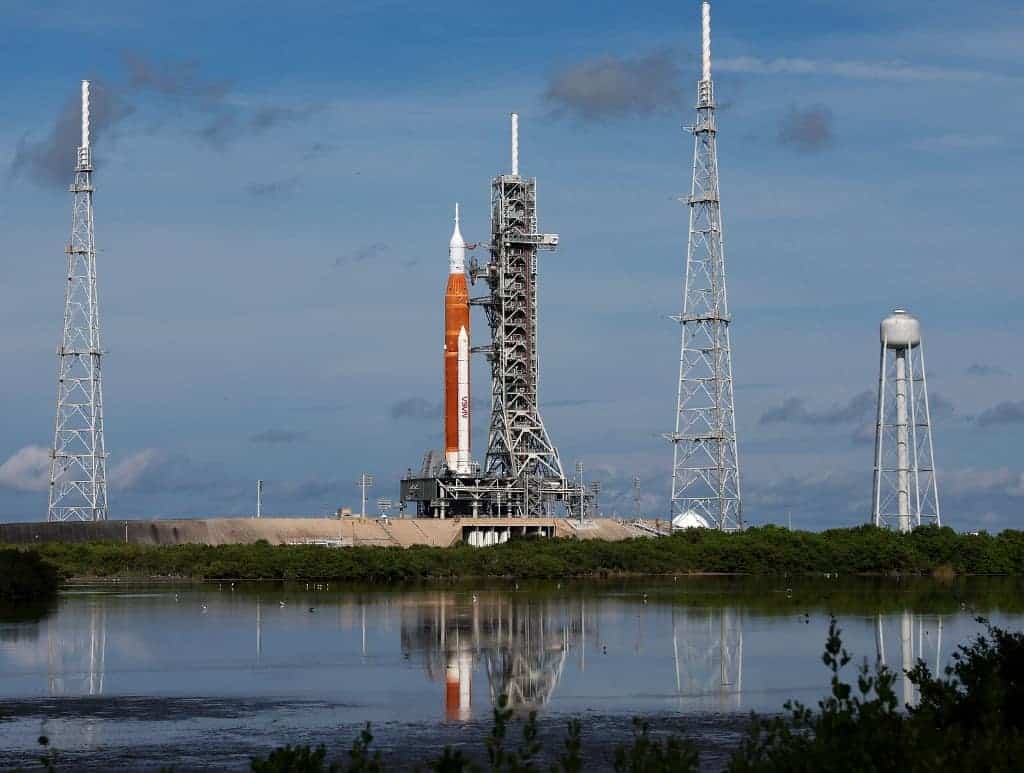
Three men and one woman are set to leave this Wednesday on the first crewed journey to the Moon since 1972, a historic odyssey intended to push the United States into a new era of space exploration. NASA’s Artemis II mission has been years in the making, with repeated setbacks along the way. But it is finally scheduled to lift off from Florida this Wednesday, April 1, at 6:24 p.m. local time (10:24 p.m. GMT).
The astronaut crew, made up of Americans Reid Wiseman, Victor Glover and Christina Koch, along with Canadian Jeremy Hansen, is expected to remain on the mission for about 10 days. The spacecraft will speed around Earth’s natural satellite without landing, in a mission similar to Apollo 8 in 1968.
The journey will mark a series of milestones. It will be the first time a woman, a Black man and a non-American citizen take part in a mission to the Moon. It will also be the first crewed flight of NASA’s new lunar rocket, known as the SLS. The enormous orange-and-white rocket is designed to allow the United States to return to the Moon on a regular basis in the coming years. The long-term goal is to establish a permanent base that can serve as a platform for deeper exploration.
“It is a step toward Mars, where we could have the greatest chance of finding evidence of past life, but it is also a Rosetta Stone for understanding how other solar systems form,” Koch said at a press conference over the weekend.
Ready
The mission had initially been scheduled to launch in February. But repeated setbacks delayed it and even forced the rocket to be returned to its hangar for analysis and repairs. “The vehicle is ready, the system is ready, the crew is ready,” said Amit Kshatriya, NASA’s associate administrator, during a press conference.
As of Tuesday afternoon, NASA officials said they were confident that engineering operations and final preparations were moving forward smoothly and that the weather forecast was promising. If Wednesday’s launch is canceled or delayed, there will be additional launch opportunities through April 6, although weather later in the week appeared slightly less favorable.
“We’ll have to keep an eye on those troublesome cumulus clouds and possibly some showers and wind gusts,” launch weather officer Mark Burger said Tuesday. But he added that even if some showers develop, “none appear particularly intense.” “We should be able to find a patch of clear sky to launch Artemis.”
“We’re really looking forward to it. We’ve never seen anything like it,” said Melinda Schuerfranz, a 76-year-old woman who traveled from Ohio to Florida to witness the launch.
Astronauts for Halloween
The Artemis program has been plagued by delays and huge cost overruns. It is also under pressure from President Donald Trump, who has sped up the pace of the ambitious project, whose goal is to see footprints on the lunar surface before 2029, when his second term ends.
The objectives of Artemis II include verifying that both the rocket and the spacecraft are in perfect working order, in hopes of paving the way for a return mission and a lunar landing in 2028. That timeline has sparked skepticism among experts, in part because it depends on technological advances from the private sector.
The astronauts will need a second vehicle to descend to the lunar surface, a landing module still under development by rival space companies owned by billionaires Elon Musk and Jeff Bezos. For NASA’s newly appointed chief, Jared Isaacman, this is a multi-front effort tied to scientific discovery, national security and economic opportunity, as well as less tangible goals.
“I guarantee that after this flight around the Moon, more children will dress up as astronauts for Halloween,” Isaacman said during a television interview. “And that will inspire the next generation to take us even farther.”