
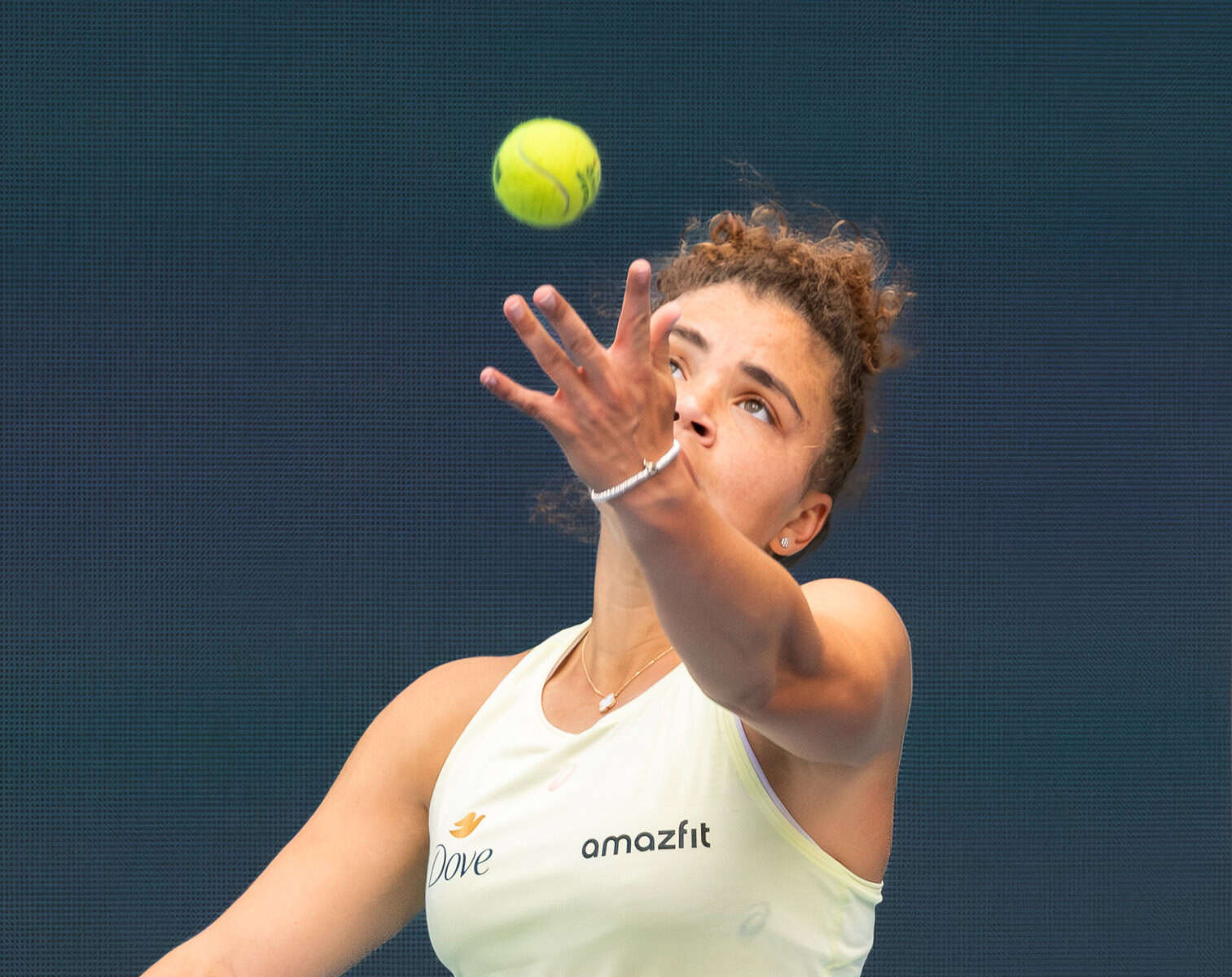
Australian qualifier Talia Gibson pulled off one of the biggest upsets of the BNP Paribas Open on Tuesday, defeating seventh-seeded Jasmine Paolini 7-5, 2-6, 6-1 to advance to her first WTA quarterfinal and shake up the women’s draw.
The 21-year-old from Western Australia, playing in her debut WTA 1000 main draw, claimed her first career win over a top-10 opponent. Ranked around No. 112, Gibson entered the tournament through qualifying and has now compiled four main-draw victories here. She becomes the first qualifier to reach the quarterfinals at Indian Wells since Lesia Tsurenko in 2015. She is also the youngest player to achieve the feat in her first WTA 1000 event since Elena Rybakina at the 2019 Wuhan Open.
Gibson started the match with purpose. She broke late in the first set to take it 7-5, outpacing Paolini 18 winners to nine in that frame. The Italian responded in the second set, building a 3-0 lead and using sharp drop shots to claim it 6-2. Gibson refused to fade. She broke early in the third set and rolled to a 6-1 finish, finishing with 42 winners overall by repeatedly stretching Paolini side to side and forcing weak replies.
After the match, Gibson stood on court clearly overwhelmed. “Yeah, gosh, still haven’t processed it all,” she said. “I think I’m just super proud of what I have been able to achieve over these last two weeks. Yeah, honestly, still pretty speechless that I made it this far.”
She added that her aggressive style has paid dividends. “I think I know that with my aggressive game, often I am able to create a lot of opportunities for myself in points,” she noted. Gibson had entered 2026 with just two WTA main-draw wins to her name. She spent time winning a W75 title and reaching the Brisbane semifinals before arriving in California.
The result removes a top seed from the draw and creates a more open path in that section. Gibson will face Linda Noskova in the quarterfinals after the Czech player defeated Alexandra Eala 6-2, 6-0.
Later on the same day, world No. 1 Aryna Sabalenka showed why she sits atop the rankings, overpowering Naomi Osaka 6-2, 6-4 in the round of 16. The match pitted two four-time Grand Slam champions against each other for the first time since the 2018 US Open, where Osaka had prevailed on her way to her maiden major title.
Sabalenka arrived with serious firepower. She won 39 of 56 service points, fired eight aces with zero double faults, and never faced a break point. Osaka managed one hold in the second set after saving a break point at 3-2 but could not match the Belarusian’s pace or variety. Sabalenka broke at key moments, including with two heavy forehand winners to seize a 4-3 lead in the second set, and closed out the contest in one hour and 20 minutes.
Sabalenka spoke afterward about the tactical adjustments that made the difference. “I’m super happy with the performance today, the way I brought variety on court, that I made her guess most of the time,” she said. “I was trying to change the rhythm and make sure that the ball comes back on her side at different heights and speeds. So I think that was the key of the match.”
She also addressed the long gap since their previous meeting. “Yeah, that’s crazy, for so many years we only played once. I’m pretty sure we are playing many more matches — she’s coming back playing great tennis. I’m pretty happy for the result today, much better than last time.”
Sabalenka improves to 18-6 lifetime at Indian Wells and reaches the quarterfinals here for the third time. She has now made 14 consecutive WTA quarterfinals, excluding the WTA Finals — the longest such streak since Justine Henin in 2006-08. The win sets up a quarterfinal meeting with Victoria Mboko, who advanced earlier by defeating Amanda Anisimova 6-4, 6-1.
Tuesday’s results delivered both surprise and dominance on the women’s side. Gibson’s breakthrough adds fresh energy to the later rounds, while Sabalenka’s controlled power keeps the top seed on track. The BNP Paribas Open now moves into an intriguing quarterfinal stage with several paths wide open after the seeding shake-up.