
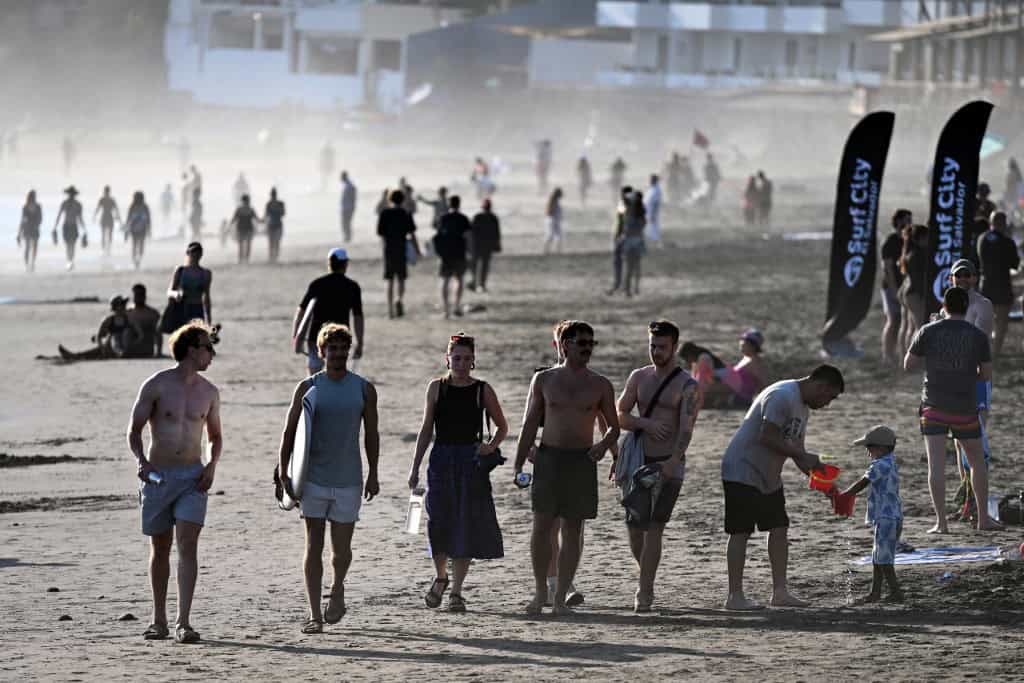
Between waves and postcard sunsets, foreign tourists enjoy El Tunco beach in El Salvador, once overrun by gang members. They do not hold back their praise for President Nayib Bukele, even as they acknowledge that innocent people may have been caught up in his crackdown.
El Salvador is experiencing a tourism boom after bringing criminal violence down to historic lows, under a state of emergency that has allowed the imprisonment, without a judicial warrant, of tens of thousands of alleged gang members. Although his own country boasts some of the world’s most attractive beaches, Costa Rican Juan Gabriel López vacationed with his wife in El Tunco, a surfers’ paradise where people stroll with their boards, slathered in sunscreen.
Like many others, he came not only for the beautiful sunsets and Shakira’s recent concerts, but also for the sense of safety heavily promoted by Bukele and his influencer supporters. “If you want to verify El Salvador’s safety, go to the ugliest, darkest place, sit on a rock, and wait for dawn,” the president recommends to foreigners.
On his social media accounts, followed by millions, Bukele posts videos of surfers riding giant waves, and he held up Shakira as proof that the country “is changing.” “A radical change,” says López, a 44-year-old engineer who came from Limón, a Caribbean port in Costa Rica battered by drug traffickers.
Just people paying for others’ sins
But NGOs such as Amnesty International and Human Rights Watch denounce the cost of the war on gangs: under the state of emergency, around 90,000 people have been detained, including about 8,000 innocent individuals who have since been released, the government acknowledges.
In an open letter, Movir, a collective of relatives of detainees, expressed to Shakira their concern that her “Las mujeres ya no lloran” tour was being used by Bukele to “cover up injustice and his condemnable acts.” “In El Salvador, women also cry mothers and relatives of innocent victims who suffer prison, torture and death, forced evictions, persecution and rigged trials,” the letter said.
The accusations, however, have not dented the popularity of the 44-year-old president, backed by nine out of ten Salvadorans, according to polls. Nor have they deterred tourists. “As with any process of change, there’s always going to be that idea that the righteous pay for the sinners,” López says on a lively street of bars and restaurants, where T-shirts are sold stamped with Bukele’s face wearing his trademark sunglasses.
Visiting El Tunco with his parents, Dutchman Camille Schyns, who lives in Guatemala, says he knows there are “quite a lot of human-rights violations” and that “they’re arresting people” without due process. “But at the same time… what people I know, Salvadorans, tell me is that they like that security has increased a lot,” he said.
On the tourism map
Bukele, who ironically calls himself a “cool dictator,” rarely misses a chance to promote the security model that led Donald Trump’s government to lower travel alerts for Americans visiting the country to the minimum level. With Pacific beaches, volcanoes and archaeological ruins, El Salvador received 4.1 million visitors last year, 60% more than in 2019, when Bukele came to power.
That is significant in a country of six million people, where in 2025 tourism generated $3.6 billion in revenue, nearly 10% of nominal GDP. “We are leaders in international visitors. El Salvador is now on the map as a host of events,” Tourism Minister Morena Valdez recently told the international press, noting that the country hosted Miss Universe in 2023.
Shakira gave five concerts that drew more than 144,000 attendees, nearly half of them foreigners, who generated $110 million in revenue, according to the government. In that crowd were tens of thousands of Guatemalans and Hondurans, whose countries still suffer gang terror.
“We wish we had in Guatemala the peace you feel here,” said Glendy Pineda, 45, during one of the concerts. Even the Costa Rican tourist, from a country known for defending human rights, praised the Bukele model: “We’d like to take this step,” he said.