

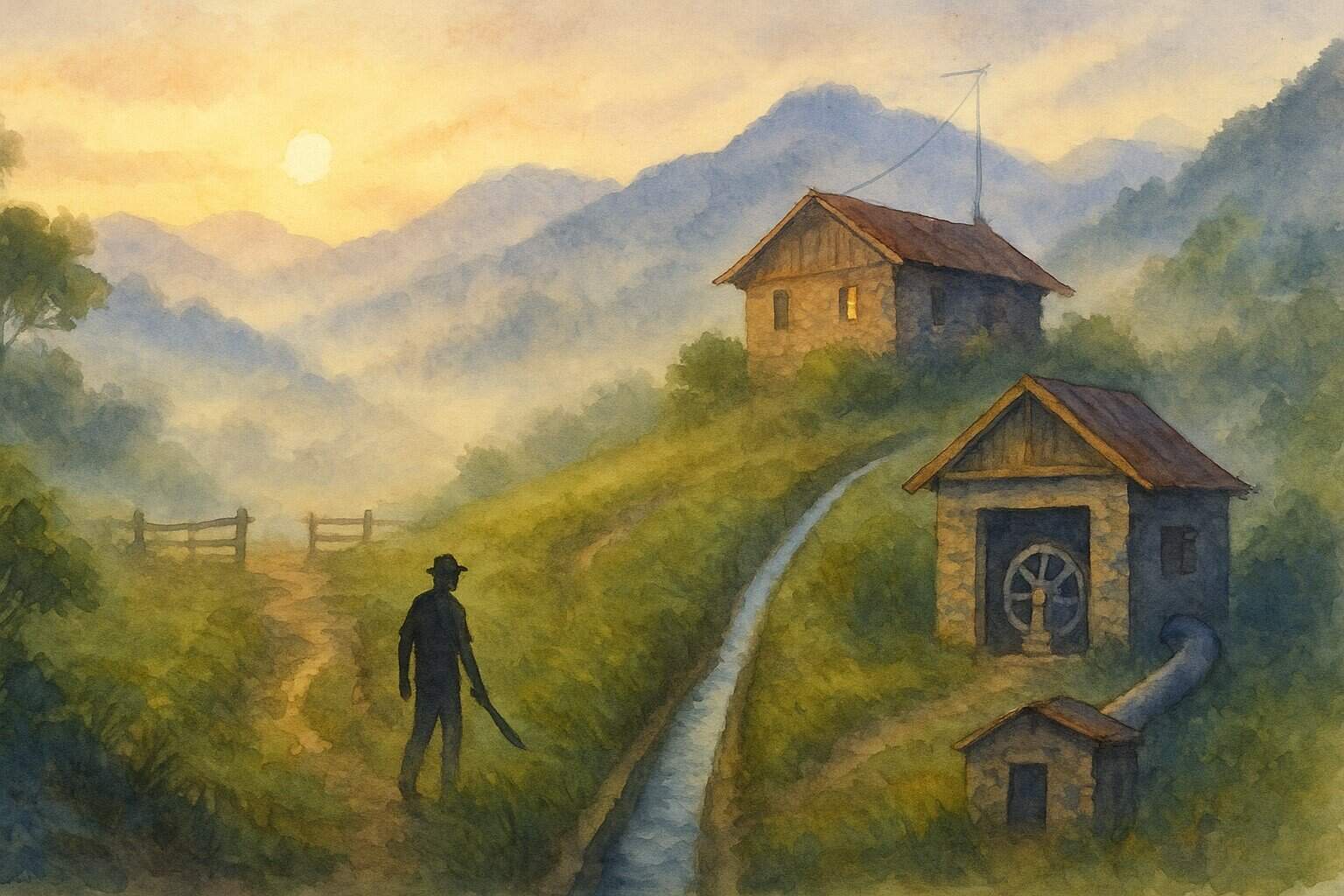
I once spent nine months on an off-the-grid farm about an hour south of San Isidro del General. Located near a river and along a high, lonely ridge in the foothills of the Talamanca/Chirripó range, it was a rough six-kilometer uphill drive from the old Pan-Am Highway.
The final kilometer featured two rustic gates to open and a shallow stream to cross before arriving. There was a spartan house of stone and wood, with a hand-hewn support beam carved from an oak tree that ran the width of the house and anchored the second floor.
The owner was a hyper-industrious organic farmer from the midwestern US. He built the house himself, laying every stone, milling every log into usable posts and planks, putting on the roof, and wiring the entire property through an old-style Pelton hydro generator. The power house sat at the base of a hill that supported a holding pond.
The owner paid an annual fee to the Costa Rican government for permission to divert water from a river about a kilometer away through a series of cement culverts into the pond. From here gravity took over: water flowed down the steep hill through a wide pipe and fed the generator. There was a spring for drinking water, a freezer full of meat (raised and butchered on the farm), a solar oven for drying fruit, and a number of fruit trees.
The guy had done incredible work. It was several years of his life, but he wanted to return to the States for an extended visit, and I was in charge of maintaining the property. My main responsibility was keeping the canal clean. It ran along the edge of the jungle and, in rainy season, branches and leaves would clog it.
Every morning I walked the length of it, to the river and back. On one memorable occasion, we noticed our lights dimming after a storm. A tree had fallen across the canal and slowed the water flow to a trickle. It took most of the day, with only a hatchet and a machete, to chop the trunk into movable pieces.
The year was 1992. Given the technological changes then and now, we may as well have been living in 1962. We had a shortwave radio. The nearest phone was a thirty-minute drive. The internet was in its infancy, with only about seven million users worldwide. The idea that someday someone on this same farm could get a signal that allowed instant communication with the world would have been like science fiction to me then. I hadn’t even heard of the internet.
In the years since, the idea of living so remotely has taken a dark turn. Especially in the past decade, there have been several killings on remote Costa Rican farms. Some were out of greed where the killer knew the victims; others were coldly calculated for financial gain; and another—where I knew some of the victims—was an attempted robbery of farm equipment that ended in a slaughter.
Every time I read of these crimes, I remember being on this dark, remote farm, armed only with machetes and a hatchet. Late in my stay there, I encountered two hunters—carrying firearms—on the property. I called to them, and when they saw me, they hurried in the other direction. Lucky for me.
It was an educational experience living so remotely, one I would never repeat. Since then, when choosing where to live, I have adopted the philosophy of the wildebeest on the Serengeti: don’t stray too far from the herd.





