
Costa Rica is home to around 220 species of non-marine mammals. Roughly half of those species, 117 is the current number, are the type of mammal that many folks are worried will fly into their hair – bats. 117 is a lot of different kinds of bats and probably more than you would have guessed, but to put it in greater context, there are only around 40 species of bats in the United States. Pretty impressive considering you need around 192 Costa Ricas to equal the size of the US. Taking the whole planet into consideration, around 8% of the world’s bats can be found in Ticolandia.
Costa Rica’s bats come in many shapes and sizes. To get feel for the physical diversity of bats, do yourself a favor and give ‘bat face close up’ an image search. You’ll find a range of faces that starts at ‘undeniably adorable’ and ends at ‘so horrible it would be too scary for a horror film.’ This wide variety of bats has a huge impact on Costa Rica’s environment.
The insectivorous bats keep insect populations in check, bats that eat fruit do the important job of pooping seeds all over the forest, and bats that subsist on pollen and nectar are responsible for pollinating hundreds of species of plants.
Since I am the farthest thing from a chiropterologist, a biologist who studies bats (and a word 99% of us has never heard before now), I cannot go into any great detail about the biology of any of the over one hundred species of bats in Costa Rica. As a guy who spends a fair amount of type crashing through the underbrush and videotaping wildlife, I have gotten to know a few bats on a personal level.
Tent-making Bats
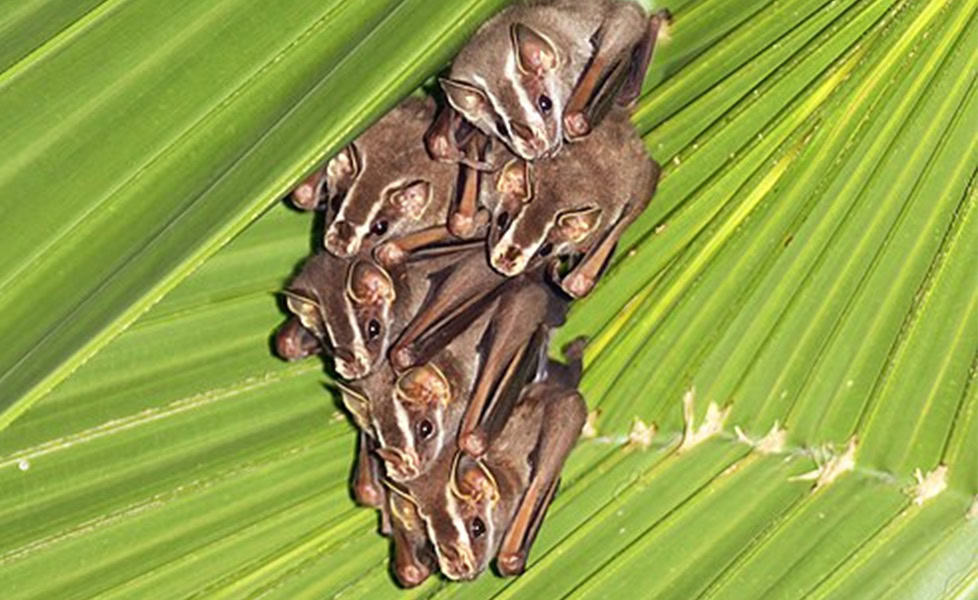
There are at least 17 species of bats in Costa Rica that create their own homes. These bats systematically bite specific parts of broad leaves causing them to droop, forming tents for them to hang out in. There are many styles of tents that can be created from many different species of plants.
The tents protect them from the predators and the weather and provide a nice place to eat a meal. At some point I noticed the kinds of palms and other broad-leafed plants that these species make tents in and ever since then I find it nearly irresistible not to stop and peer underneath to see if anybody is home. My success rate is extremely low.
They abandon old tents and make new ones all the time. Every once in a while, I’ll get lucky and there are a handful of adorable bats looking back at me. I’ve also learned to be careful with my tent inspections because wasps also find them to be a good place to set up shop.
Fishing Bats
There are two species of fishing bats in Costa Rica, the greater fishing bat and the lesser fishing bat, with the former being somewhat larger than the latter. They’re also known as bulldog bats because they appear as if somebody stuck a bulldog’s face on a bat’s body. These bats have enlarged feet with powerful claws that they drag over the surface of the water to catch fish.
Once they snatch the fish from the water, they dispatch them with their large canines, store them in their cheek pouches, and continue hunting. I’ve had the opportunity to record fishing bats with camera traps placed on patches of still or slow-moving water. Once, I recorded fishing bats that were hunting the fish that were foraging off of the gunk kicked up by swimming Baird’s tapirs. I’ll include a clip in the video below.
A Large Carnivorous Bat
I’m going to be perfectly honest and admit that I can’t identify the majority of the bat species that appear in my camera trap videos. Most can accurately be described as tiny and fluttery. What made the video I recorded of a spectral or great false vampire bat immediately stand out was the size of the bat. These are the largest bats in the western hemisphere with a wingspan of a meter.
The second thing that stood out was that this bat wasn’t flaying around attempting to eat insects, it was hot on the trail of some sort of desperately trying to escape rodent. They also feed on other bats and a wide variety of birds. I’ve only ever recorded one video of this species, and I’ve never seen it in person. Though I am generally bat curious, I’m not sure if I’d like to see this giant in person or not.
About the Author
Vincent Losasso, founder of Guanacaste Wildlife Monitoring, is a biologist who works with camera traps throughout Costa Rica