
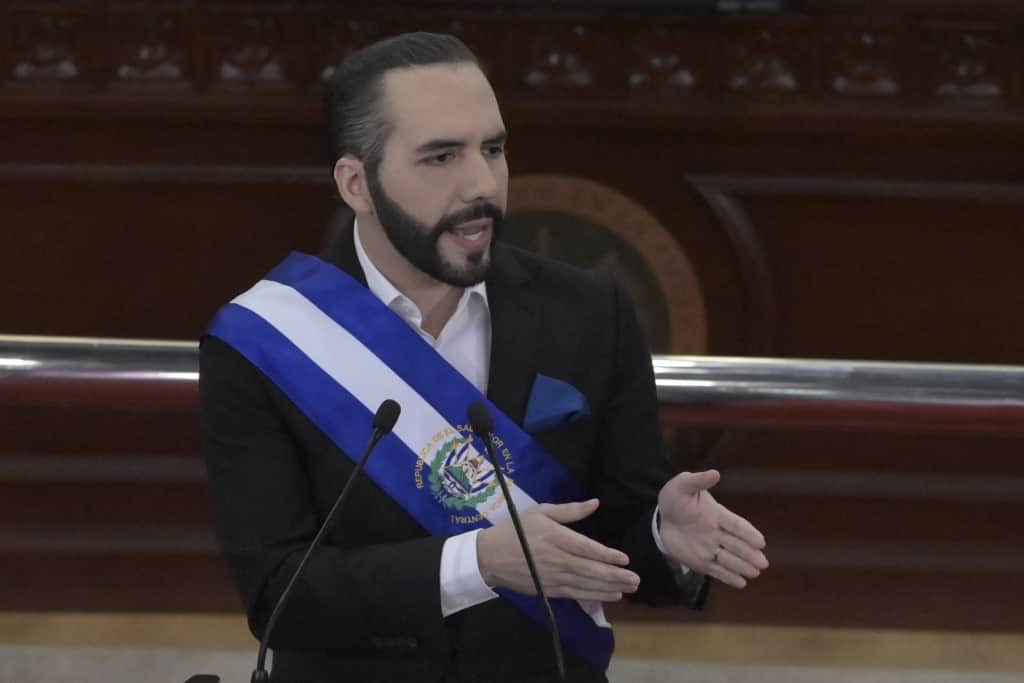
The president of El Salvador, Nayib Bukele, plans to issue debt papers in bitcoin to improve public finances, but his offer of the so-called “volcano bonds” may be unattractive to investors, economists warn.
With the approval of the Digital Assets Law on January 11, the president has opened the way for the issuance of bitcoin bonds for about US$1 billion, although a former president of the Salvadoran central bank doubts that they will be well received in the market.
“I don’t think there is much appetite,” said economist Carlos Acevedo told.
In November 2021, at an international forum on bitcoin, Bukele announced he would issue cryptocurrency debt to build “Bitcoin City,” a city in the east of the country that would run on geothermal energy from the Conchagua volcano.
But last week, in its annual review of El Salvador’s situation, the International Monetary Fund (IMF) suggested caution.
“Given the legal risks, fiscal fragility, and largely speculative nature of crypto markets, the authorities should reconsider their plans to expand the [Salvadoran] government’s exposure to bitcoin, including the issuance of tokenized bonds,” the IMF said in a statement.
In September 2021 Bukele made El Salvador the first country in the world to adopt bitcoin as legal tender, alongside the dollar, which has been in circulation since 2001.
He did so with the aim of banking 70% of the population excluded from the financial system and making it cheaper to send remittances from abroad to Salvadoran families, but the cryptocurrency has had little acceptance in the country.
In 2022, El Salvador received $7.742 billion in remittances, but only 1.6% of the total arrived in bitcoin, according to the Central Reserve Bank (BCR).
In addition, the bitcoin price plummeted: after trading at $68,000 in November 2021, it is now bordering $24,000.
Failed bet
In Salvadoran commerce there are few transactions in bitcoin.
“At the beginning, out of every 20 people, 10 wanted to pay with bitcoin; now in a week it’s two or three people,” Carlos Torres, who runs a coffee shop in downtown San Salvador, explains to AFP.
In addition, a survey by the Central American University (UCA) showed that 74% of Salvadorans did not use bitcoin in 2022. The bitcoin “has been a failed bet from the point of view of the population,” said to AFP the vice rector of the UCA, Omar Serrano.
It is the “only” Bukele measure that does not convince Salvadorans, despite the high support obtained by the president for his crusade against gangs, he added.
For economist Rafael Lemus, bitcoin is a “failed” policy, because “it does not respond to a concrete need of the population”. Paradoxically, according to Acevedo, the low acceptance of the cryptocurrency spared Salvadorans from suffering losses when its price plummeted. “[People’s] salvation has been in the failure” of bitcoin in the country, he noted.
Sleeping millionaires
The sale of bitcoin bonds “is going to depend on the interest rate” offered by the government, because the higher it is “the more attractive it will be for those who buy,” economist Ricardo Castaneda of the Central American Institute for Fiscal Studies (Icefi) told AFP.
That the bonds help raise the first bitcoin city “could have a positive impact on the crypto world in general” and be taken into account “when lending money,” he also noted.
But Acevedo cautioned that the bonds would come to market amid a “volatile” environment. “At least this year, I don’t see that we will be able to stimulate a favorable environment for issuing debt,” he said.
Meanwhile, Lemus said that El Salvador’s fiscal situation “is unsustainable”, with a public debt equivalent to 80% of GDP, so “buying volcano bonds is a speculative bet (and) practically has to find sleeping millionaires”.
Bukele allocated $107 million to the purchase of bitcoin from September 2021 to October 2022. Last November 17 he announced that he would buy one bitcoin per day, without specifying for how long.
In line with the president, the Salvadoran ambassador in Washington, Milena Mayorga, was optimistic that “big companies” will buy the bonds.
“We were in Europe talking to potential buyers and I think that will be important for President Bukele’s plans”, said the diplomat to the Salvadoran state-owned Canal 10.