
Rio de Janeiro’s mayor declared the world’s biggest carnival officially open Friday for the first full-scale edition in three years, calling it a celebration of life and democracy after the turmoil of Covid-19 and Brazil’s bitterly divisive elections.
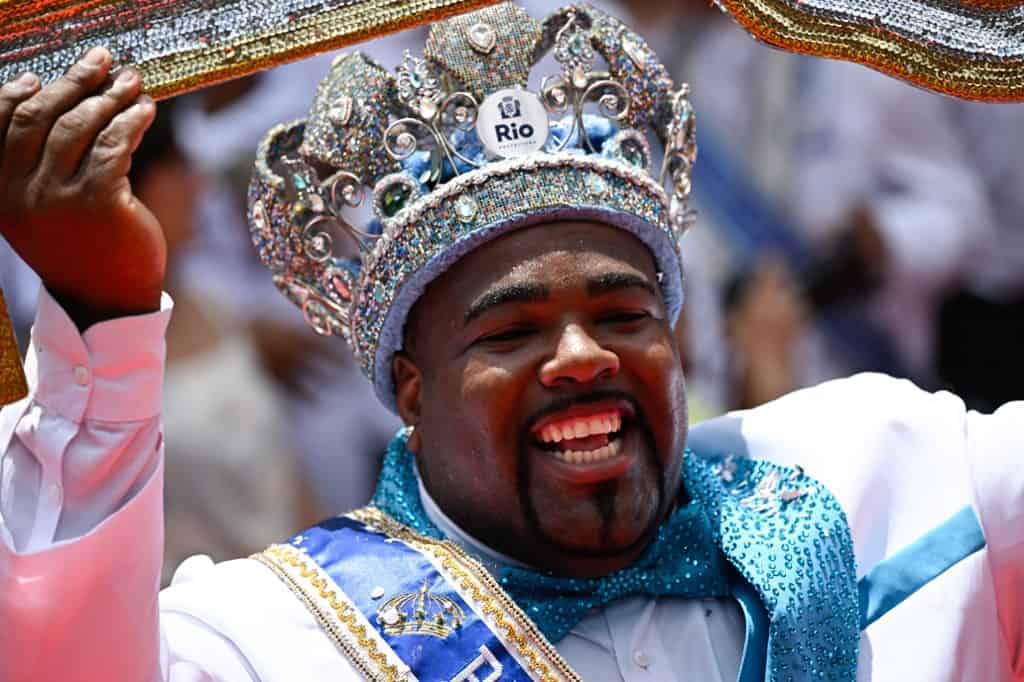
Embracing the party spirit in a Panama hat, a grinning Mayor Eduardo Paes symbolically handed the key to the city to “King Momo,” the jovial “monarch” who will “rule” Rio for the four-day free-for-all.
“It is with great happiness, celebrating life, celebrating democracy, that I have the honor of handing the keys to the city to King Momo,” said the mayor, an avowed carnival lover, as he handed the giant key to the “king” — a carnival fanatic chosen in a sort of pageant for his charisma, party spirit and samba skills.
Rio is ready to party, after two carnivals disrupted by the pandemic and a polarizing presidential election in October, in which veteran leftist Luiz Inacio Lula da Silva ousted incumbent Jair Bolsonaro — an ultra-conservative carnival critic accused of authoritarian tendencies, who had regularly come in for protests and mockery during the festivities.
In reality, carnival has been under way for weeks in the iconic beach city, with massive street parties known as “blocos.”
The official festivities will peak Sunday and Monday nights with the glittering floats, pulsating drums and skimpy, jewel-encrusted costumes of the annual samba school parade competition.
Rio held a reduced version of carnival last year, postponed by two months because of the pandemic — which has claimed nearly 700,000 lives in Brazil — and minus the street parties.
This year, the full-on festival is back. The samba schools are racing to put the finishing touches on the all-night spectacle.
“We always give it everything we’ve got. We work until dawn, we sleep right here, we have no social lives. Whatever it takes to bring people that happiness on carnival day,” said Rogerio Sampaio, 54, a prop master at the Viradouro samba school.
Officials are expecting a sold-out crowd of more than 70,000 people each night at the “Sambadrome,” the avenue-turned-stadium where the 12 topflight samba schools will compete for the coveted title of parade champions.
Millions more people will be watching on live TV. And more than five million are expected for the hundreds of street parties.
Emerging from ‘darkness’
The samba schools, which were born in Rio’s impoverished favelas, assemble thousands of dancers, singers, and drummers and corteges of over-the-top floats to tell a story on a chosen theme, vying to wow the jury.
During Bolsonaro’s presidency, the shows often included politically charged messages on topics such as racism, intolerance, environmental destruction and Brazil’s disastrous management of Covid-19.
This year’s parades are less political.
Many of the schools are returning to the roots, choosing themes linked to founding figures of the samba genre, the Afro-Brazilian culture from which it emerged, and Brazil’s northeast — the poor, majority-black and -mixed-race region that is the spiritual home of the percussion-heavy musical style.
“This is a moment when Brazil needs to reaffirm what’s best about itself, after a dark period for both politics and popular culture. This is a time of light after the darkness,” said Leandro Vieira, creative director at the samba school Imperatriz Leopoldinense.
“Carnival is a mirror of Brazil,” he told newsmagazine Veja.
His own school’s parade will tell the story of Lampiao, a northeastern outlaw-hero from the 1920s and 30s who has been called Brazil’s version of Robin Hood or Jesse James.
Great expression of joy
This year’s carnival will be “a great expression of joy,” said Adair Rocha, head of cultural programming at Rio de Janeiro State University.
“It’s all about life, about overcoming difficulties,” he said. The city estimates carnival will move 4.5 billion reais ($880 million) for the local economy.Hotel occupancy rates are expected to top 95 percent.
The city has set up 34,000 portable toilets in public areas, and deployed a small army of sanitation workers, who typically clean up around 1,000 tons of carnival trash.