

CORCOVADO NATIONAL PARK, Puntarenas — Our guide tiptoed up to a tree with a couple of vultures in it and then signaled for me to come forward quietly. I couldn’t figure out why Vincent Campos, our excellent 47-year-old guide, wanted to sneak up on vultures until I looked to my right and saw the Baird’s tapir resting in the shade just a few feet away from me. It had its eyes open, and knew we were there, but it didn’t really care, because it knew we were just tourists.
“I let it smell me first,” Vincent said, “then I let it see me.” And with that, the rarely spotted tapir, known here as a danta, knew it could go back to napping, because it knew that human tourists are the most harmless creatures it ever encounters here.
This is the Corcovado model: Very remote place, animals highly assimilated to human contact, no chance of violence. Tourists snap pictures as close as they want; rare animal slumbers unconcerned.
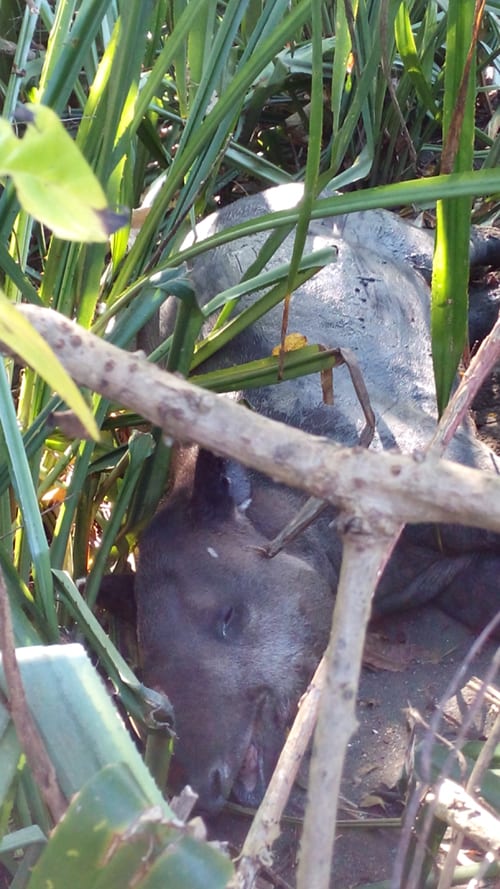
The tapir was big, maybe 300 kilos, and lying in a shaded spot surrounded by a plant with spiny leaves that Vincent had shown us earlier. The spines don’t bother the thick-skinned tapir, a cousin of the rhinoceros, but they do bother predators like puma and jaguar.
In fact, Vincent said (in a normal speaking voice, without worrying about disturbing the tapir’s nap), if a puma pounces on a tapir, the thick skin is its first defense against the cat’s deadly teeth, and its second defense is to charge into brush so thick and spiny that it tears the predator off its back.
The tapir is tough enough to blast a hole for itself through seemingly impenetrable vegetation (like the X-Men character Juggernaut), but the predators are not necessarily tough enough to hang on.
“They are very, very good swimmers,” Vincent said. “You see them going into the water, going down and coming out on the other side. Before, we just imagined how they can walk on the bottom, like a hippo, but now, on the Internet, somebody took a video under the water in a clear river, and a small tapir was running on the bottom, running very fast. And not jumping, it’s like they’re so heavy they can run.”
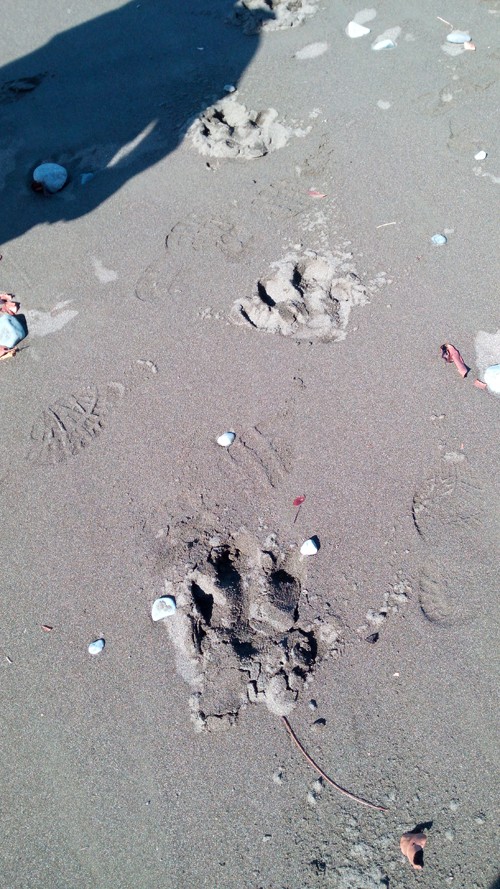
Spotting the elusive tapir, Costa Rica’s largest land mammal, was the highlight of an 8-hour boat trip to La Sirena in Corcovado National Park, arranged by La Paloma Lodge in Drake Bay. But it was by no means the only nature-spotting coup.
There was one point where we didn’t have time to look at a spider monkey with a baby because we were too busy watching an adorable and rarely spotted tamandua anteater in another tree. Later, over lunch, another tamandua joined us up close, trolling for termites, and it lingered so long we got tired of taking its picture.
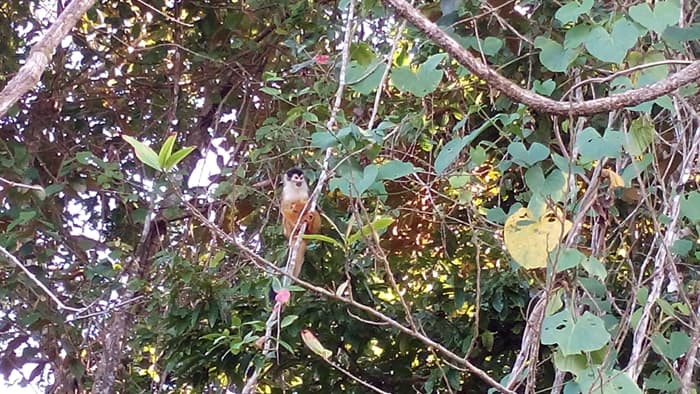
We saw three of Costa Rica’s four species of monkeys, all but the white-faced capuchin, which is abundant elsewhere but is less common here. But we saw two troops of the country’s most threatened species, the squirrel monkey or titi, with the tiny, surprisingly human-like face.
We saw plenty of spider monkeys, and the howlers put on an audiovisual show for us when the males started squabbling over turf. Their deep, throaty howls went on for five minutes as an alpha chased away pretenders to his throne (and his girlfriends).
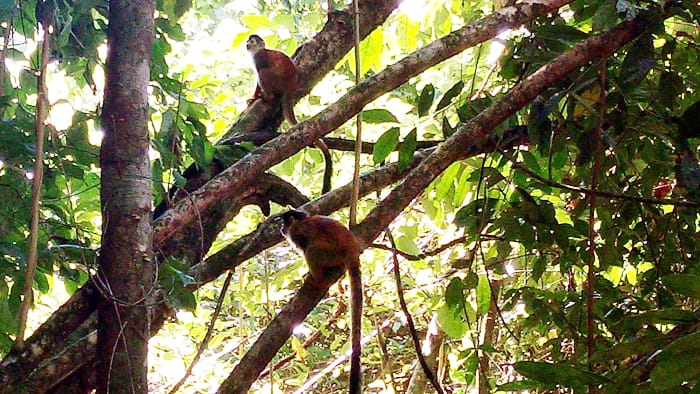
Howlers are slow-moving, sleepy leaf-eaters, like sloths, but we actually saw them moving at surprising speeds, both in the treetops and on the ground, as they challenged each other for dominance.
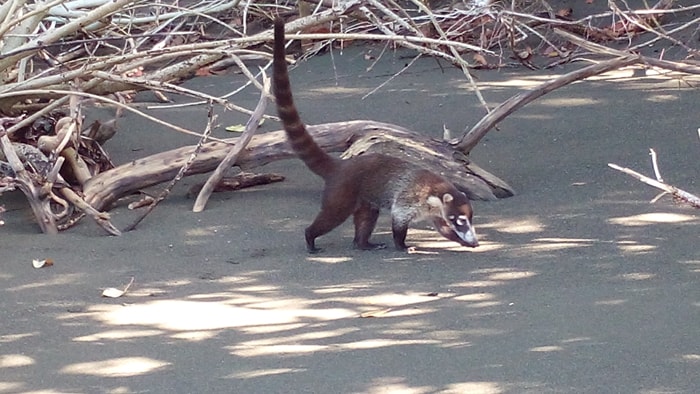
No fewer than three solitary male coatimundis crossed our path, and like all the other animals here they resolutely ignored us. In many places coatis, known in Costa Ricas as pizotes, will approach humans to beg for food, but here, Vincent said, “We never feed them,” so they go on their way. We saw one coati digging up and eating a crab, and we saw another place where one had dug up and feasted on turtle eggs.
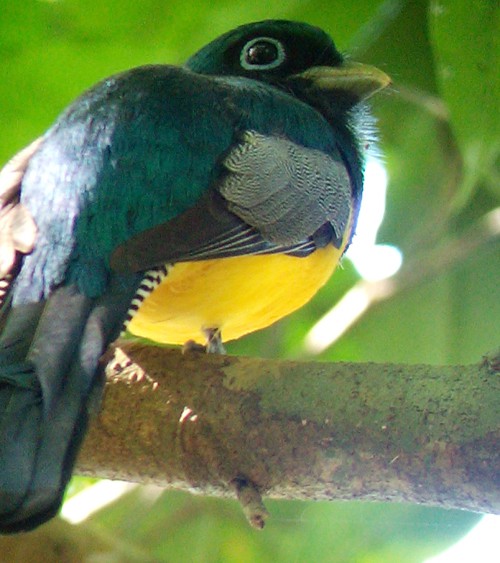
Among the numerous birds we saw were a black-mandibled toucan, some kind of antshrike, a double-toothed kite, a mangrove black hawk, snowy egrets, male and female black-throated trogons, a crested guan, a blue-crowned manakin, a great curassow, some kind of woodcreeper, a white-throated shrike-tanager and a tiger heron.
We saw crocodiles swimming in the Río Claro, we saw plenty of lizards, and we spotted a strange-looking blue shrimp in a little creek.
“Ceviche?” said one of the tourists.
During a break from stalking wildlife, Vincent showed us a “naked Indian” tree, which has bark that peels off when a strangler fig tries to climb it — a defense against suffocation by a parasite known as a matapalo, tree killer. Then he showed us one of the latter.
“Strangler ficus — this is the one that kills a tree to steal its place,” he said. “This is the one the naked Indian defends itself against so it doesn’t kill it. Because it starts growing on a tree like a vine, and when it reaches the sun, it becomes strong and it covers the whole thing and kills it and takes its place.”
He explained how the strangler grows up toward the sunshine and gets the energy it needs to get bigger and stronger, until it completely envelops and suffocates the host tree, which dies and rots, leaving a hole in the middle of the strangler.
“This hole in the middle is a good home for animals like bats, raccoons, snakes, spiders, scorpions, chupacabras….”
If there is one tour guide in Costa Rica who lacks a sense of humor, I have yet to meet him.
IF YOU GO
Getting there: All hotels in Drake Bay can arrange guided tours by boat to Corcovado, to either the Sirena station or the San Pedrillo station. There tend to be more animals in Sirena, while San Pedrillo involves less walking but includes a dip in a waterfall pool and may be better for families with children. The boat ride from Drake Bay to Sirena takes an hour and 10 minutes.
What to bring: Flip-flops or sandals for rocky beach landing, then hiking shoes to change into. You can wear shorts or long pants and T-shirt, and you might want to bring rain gear. Water, hat, sunglasses, sunscreen and insect repellent are all good ideas. For San Pedrillo, bring a swimsuit for the waterfall.





