

English is a universal language in our transnational world; proficiency in English can be the key to a better future, a better job or a scholarship to study abroad.
Although English is a required subject in Costa Rican schools, few students graduate with the proficiency and confidence needed to speak it well. Tommy Quinn and Xinia Quirós, Costa Ricans living in Texas, know this well, so they started the Spanglish Foundation to help children in grade school get a jump start on mastering English.
Both Quinn and Quirós know what it’s like to learn a new language. Quinn is from Texas but moved to Costa Rica with his Tica mother when he was nine. While he spoke Spanish before the move, he struggled with the switch to full-time Spanish. Quirós made the reverse journey: she was born in Costa Rica, but a family business took her to Texas, where she had to deal with English every day.
“She is still learning,” says husband Quinn. Although they speak Spanish at home, because it’s more comfortable, they need English in their business, and try to spend time each day speaking only English.
The Spanglish Foundation is their way of paving the road to a better future for kids from their home area.Because of their own backgrounds in Cartago, they’ve started with four schools in that area, with 150 fifth and sixth graders divided into groups of 15.
“We chose that age level so that they can finish up the year-and-a-half program before graduating” from primary school, explained Didier Zúñiga who coordinates the program here. Spanglish is taught in Cervantes, Layola, Quircot and Coris, rural areas near Cartago where students often lack opportunities or help with studies. Students are chosen based on their good grades and attendance records and their desire to learn.
The program uses the “Side by Side” series from the United States, a course designed for learning English as a second language. Teachers are English graduates from the University of Costa Rica or the National University, and have experience in English through visits or studies in the United States.
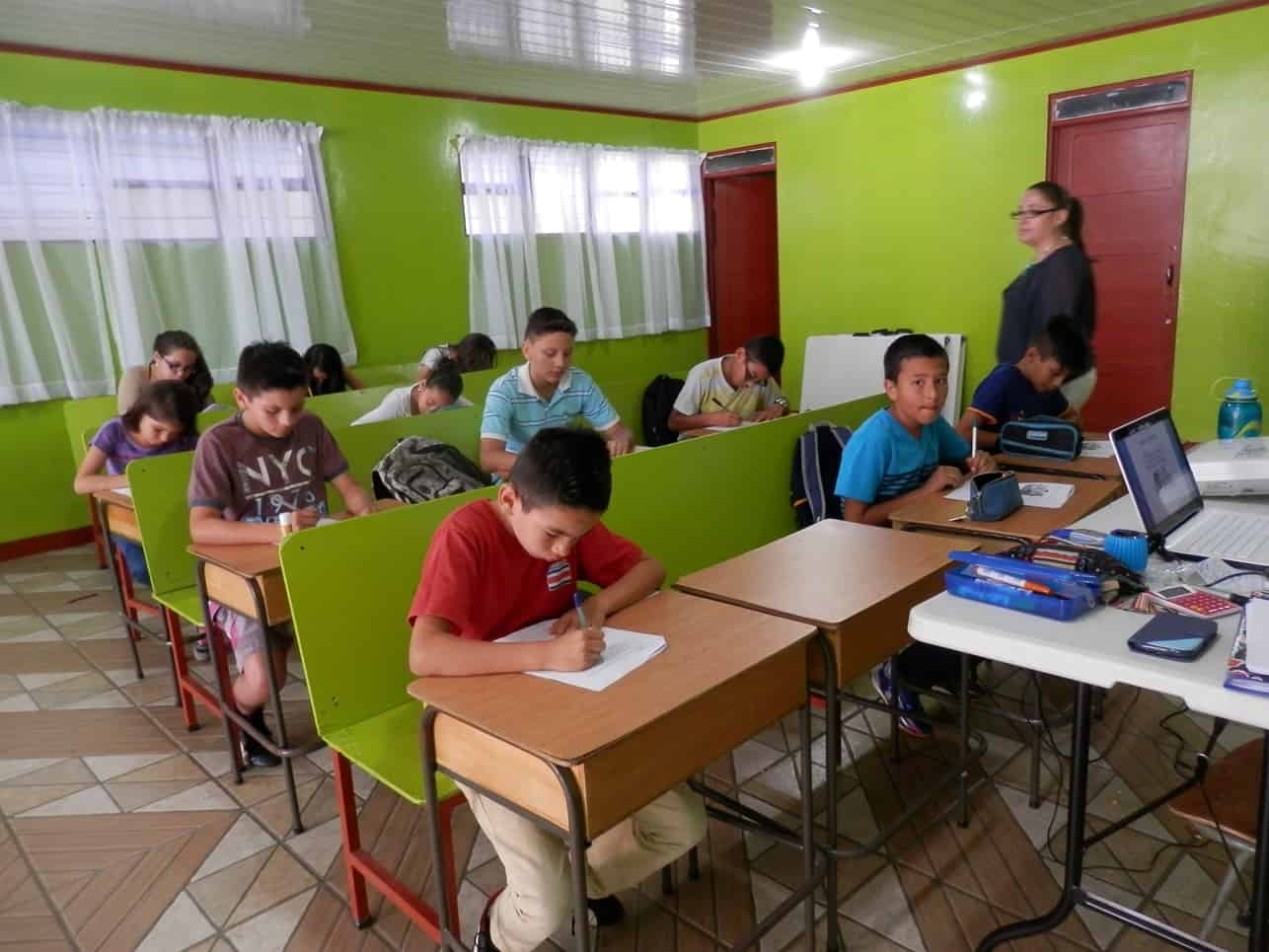
Lessons are conducted in English from the minute the class begins. In Cervantes, Karin Pereira uses audiovisuals, computer games and Show and Tell to get students’ English flowing, and all conversation is English. The children, who had been studying with her for ten months during our visit, understood her instructions and answered questions in English. If a student needs help, she gives it – in English.
“I want them to enjoy class. The parents want them to learn English. This is an opportunity for them,” she explained, adding that because Cartago attracts its share of tourists, students have access to foreign-language signs, materials and visitors. At the end of the course, in December, she will test them on reading, writing, listening and speaking.
In Layola the class is preparing for an English holiday party. After six months of classes they are able to give presentations with simple sentences and follow their teacher’s instructions.
The final measure of their English skills will be the Test of English as a Foreign Language (TOEFL), a universally acknowledged assessment for those who plan to use their English to work, study or live in English-speaking countries.
“We want to expand the program,” says Didier. “We have requests from other schools, but we need resources to cover the costs. Teachers donate much of their time and equipment, and the program is free for the children. We need company and individual donations to provide more materials and pay teachers better, and include more students.”
A donation of $25 will sponsor a child for one month, paying for books, notebooks and pencils and teachers. A donation of $1,000 will help a group of fifteen students for six months.
Information on donating in Costa Rica or in the United States is available at www.spanglishfoundation.org.
Read previous “Giving Back” stories here.
“Giving Back” is an occasional series that seeks to draw attention to the work of nonprofits, community organizations and other donation-based initiatives around the country. Nominations for the series can be sent to us at kstanley@ticotimes.net.





